Crypto exchange Binance officially activated phase one of its withdrawal resumption plan on November 1, 2026, marking the first tangible progress following the worst security disaster in the history of the digital asset industry. On-chain capital flow monitoring data shows that as soon as the liquidity gateway reopened, withdrawal pressure from users surged to a record high within 24 hours.
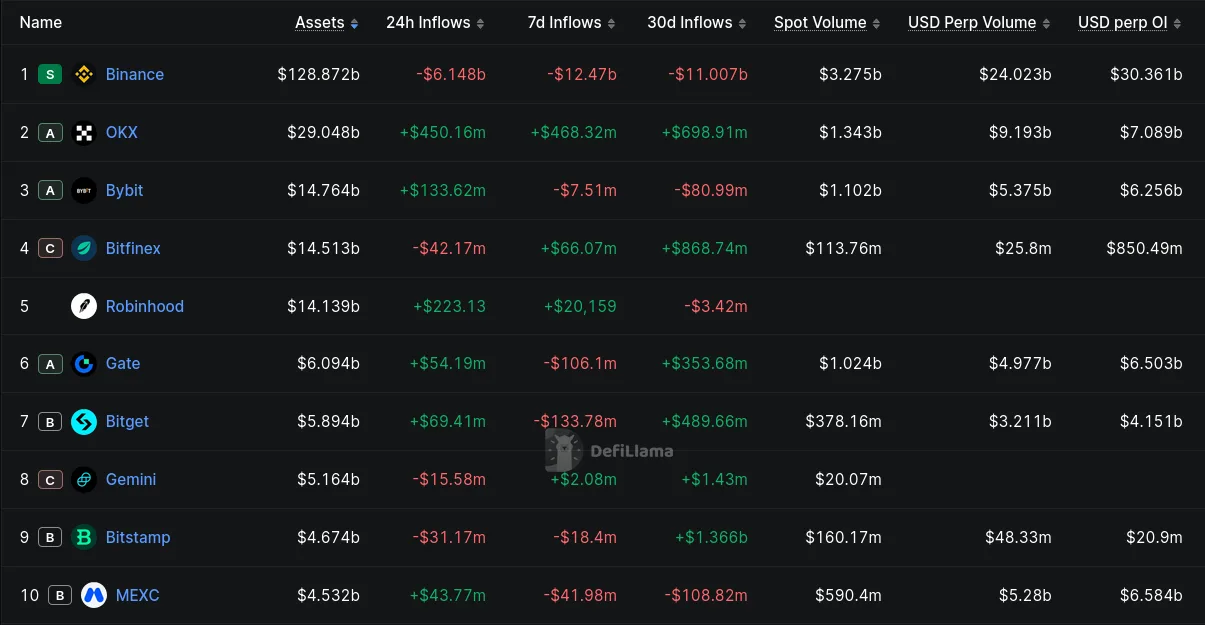
A net outflow wave of nearly $6 billion recorded on-chain
According to aggregated data from DefiLlama’s centralized exchange reserve tracker, total assets held across Binance’s wallets currently stand at $128.637 billion, with net outflows over the past 24 hours reaching $5.949 billion. This figure aligns closely with independent statistics from Cointelegraph as the exchange began processing a backlog of transactions between 06:00 and 09:00 UTC on November 1.
A Binance representative shared that during the initial reopening phase, the exchange processed $4.6 billion in withdrawals against approximately $1.0 billion in deposits, creating an immediate net outflow of $3.6 billion before reaching nearly $6 billion by the end of the day. The bulk of the withdrawal volume was concentrated in the three most liquid assets: USDT, USDC, and Bitcoin. The exchange’s executive team assessed that the initial flight of capital surged due to natural pent-up sentiment but has begun to cool down and stabilize, representing only a small portion of the total scale of customer assets under custody.
Progress in compensating 95% of assets and commitment to absorb losses
The reopening of withdrawals follows a tense period since Binance was hacked for over $6 billion on October 29, 2026, via a hot wallet vulnerability. To stabilize market confidence, the exchange stated it has raised the compensation rate for stolen assets from 90% to approximately 95% of total losses, drawing resources from the SAFU emergency fund, the futures insurance fund, and corporate treasury reserves.
The remaining roughly 5% of assets consists of tokens outside the top ten assets, which have thinner market liquidity and require time to accumulate via over-the-counter (OTC) channels to avoid slippage. Binance affirmed that all balances of core currencies such as BTC, ETH, USDT, BNB, SOL, and USDC are 100% fully secured. Notably, authorities and stablecoin issuers have assisted in freezing approximately $3.0 billion of the stolen assets, significantly hindering the hackers’ ability to launder the funds.
The exchange reiterated its unalterable principle: retail users will not bear any financial losses, and the platform will absorb the entirety of the damages onto its balance sheet. Even so, the market continues to await an independently audited proof-of-reserves report rather than relying solely on self-reported statements from the exchange.
The challenge of retaining liquidity in the post-crisis cycle
Liquidity outflow pressure reflects the standard defensive reaction of investors following a seismic incident, especially after the FBI accused North Korean hackers of attacking Binance and warned DeFi networks to block money laundering addresses. That Binance managed to maintain the liquidity to pay out nearly $6 billion without disrupting its order execution systems is an important technical milestone.
However, the true test for Binance lies not only in the first day of reopening withdrawals, but in its ability to restore net deposit inflows over the coming weeks. As the investigation into infrastructure vulnerabilities continues, the degree of patience exhibited by major financial institutions will reshape the market share of the world’s leading cryptocurrency exchange.