On October 2, 2026, the Blast project announced that it will shut down the Ethereum Layer-2 network it has been building since 2023. In an official post on X, the project stated the reason clearly: the costs of maintaining Blast exceed the revenue generated by the Layer-2, and the team sees no “credible path” to making the chain financially viable.
From $2.2 Billion Down to $32 Million
Since its debut, Blast was among the most high-profile Layer-2 projects in the space. Driven by anticipation for its token airdrop, the volume of assets deposited into the system surpassed $1.1 billion even before the network officially went live in February 2024.
Although it once recorded a total value locked (TVL) in DeFi applications exceeding $2 billion in June 2024 (according to CoinDesk citing DeFiLlama), Blast’s asset base has now plummeted dramatically, standing at just around $22 million at the time of writing.
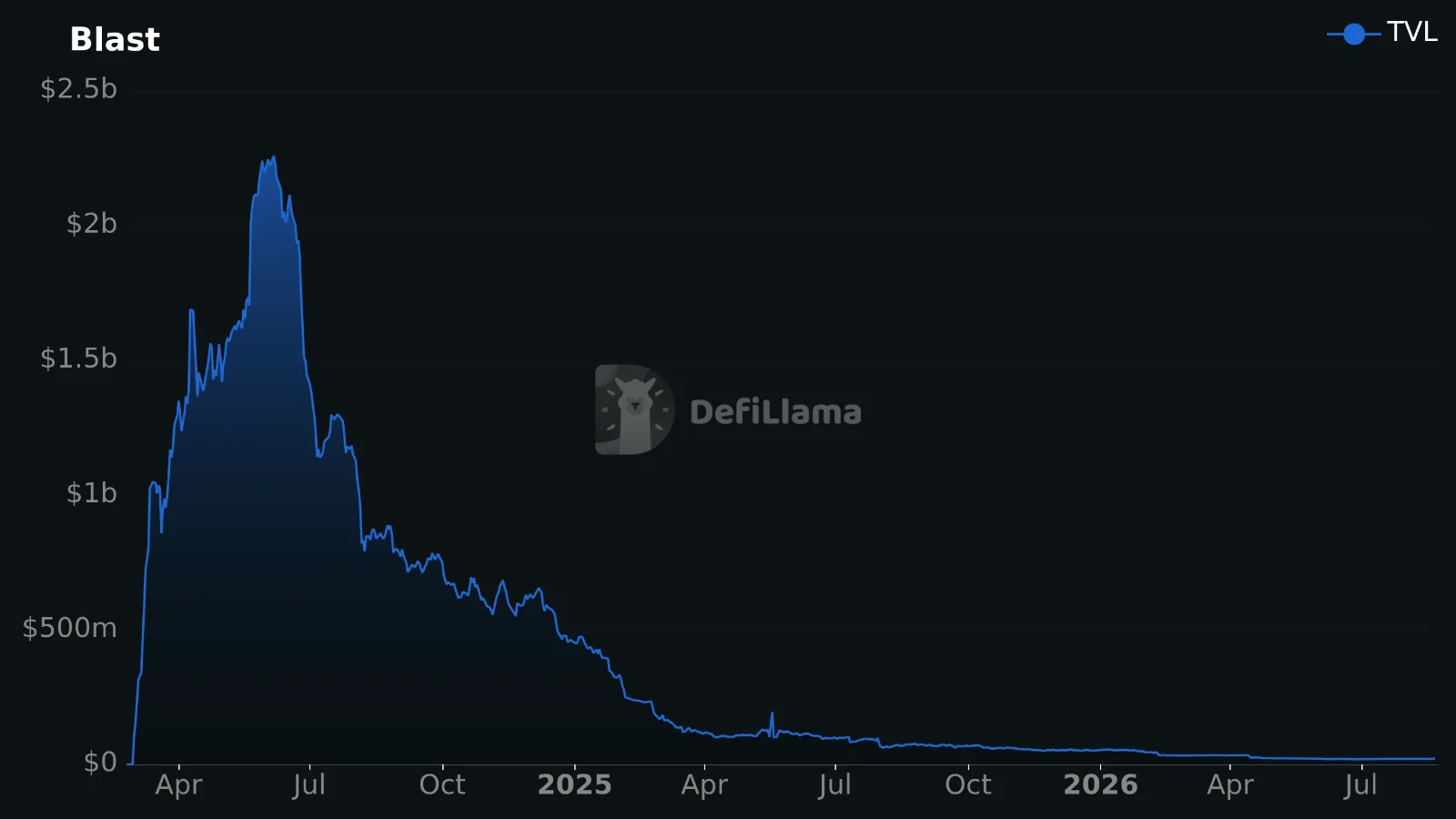
The downturn is most visible in its revenue metrics: while it once reached a peak of around $3.5 million in June 2024, revenue from network usage in Blast’s most recent month shrank to just $1,793. Concurrently, the BLAST token shed 19% of its value immediately following the news and is down 98% from its launch price.
These contrasting pictures highlight the core nature of the collapse: the fixed costs required to maintain a blockchain remain constant, while revenue fluctuates entirely with market conditions. As liquidity dried up, the platform became financially unsustainable. Unlike many chains that choose to downsize to stay afloat, Blast was forced to shut down completely as operational conditions were no longer viable.
$63.5 Million Remains in the Bridge
According to data from DefiLlama, Blast’s canonical bridge on Ethereum still holds approximately $63.5 million. This figure represents assets locked in the bridge, distinct from funds deposited within DeFi protocols across the Blast ecosystem.
These assets are largely tied to the project’s native yield model. According to Blast’s documentation, its automatic balance-rebasing mechanism for ETH on L2 was powered by passing through Ethereum staking yields generated via Lido. Per L2BEAT’s assessment as of the morning of October 2, stETH accounted for roughly $46.8 million of canonically bridged assets on Blast.
The shutdown process begins with unwinding assets from Lido, which is estimated to take around a week. During this processing window, withdrawals will be temporarily paused, even though developers have reduced the standard waiting period to 24 hours. Once this phase concludes, withdrawals will reopen normally with a 24-hour turnaround time.
The October 26, 2026 deadline applies only to withdrawals made through the official user interface; it does not mean funds will be lost. Beyond that date, users can still recover their assets by interacting directly with the bridge smart contracts on Ethereum. The project noted that this process also applies to accounts on its PWA app and pledged to publish detailed guidance ahead of October 26. In addition, L2BEAT notes that the challenge period applied to withdrawals from Blast is 7 days.
A Shifting Competitive Landscape
CoinDesk viewed Blast’s situation against the backdrop of an aggressive wave of market consolidation. Currently, industry heavyweights hold a dominant advantage: Coinbase is driving Base to become a focal point for stablecoins and asset tokenization by leveraging its existing user and developer base, while Robinhood has also introduced its own Layer-2 with impressive initial on-chain transaction volumes. This dominance has thrust smaller networks into an uphill battle for market share, users, and fee revenue.
The financial strain on smaller chains is further compounded by cybersecurity demands. CoinDesk pointed out that a spate of recent crypto exploits, combined with the use of AI tools to discover software vulnerabilities, has driven security expenses higher. Consequently, the fixed cost of running a Layer-2 is no longer just technical infrastructure, but also expensive security overhead that smaller projects struggle to cover.
Blast’s case is unlikely to be an isolated incident. The critical question now is whether other Layer-2 networks can stay afloat amid shrinking fee revenues, or whether the market will witness further waves of shutdowns in the coming period.