On October 14, 2026, payments-focused blockchain platform Tempo officially announced the enterprise rollout of its Zones feature, with global HR platform Deel serving as the first organization to deploy it in a live production environment. The solution helps businesses overcome the biggest obstacle to using cryptocurrency for payroll: preventing sensitive employee earnings and account balances from being publicly exposed on blockchain explorers.
Deel currently manages payroll services for more than 40,000 businesses across 150 countries. In June 2026, Deel launched a stablecoin wallet on the Tempo network to assist contractors in markets facing severe currency volatility in maintaining USD-pegged balances. However, the absolute transparency of public blockchains proved to be a critical flaw, as anyone could look up exactly how much an individual worker received each month.
Mechanism for separating information between public ledgers and private zones
Tempo’s Zones feature splits payment data visibility into two distinct environments. When Deel’s finance team deposits funds into a Zone, the transaction on the public network only reveals the token type, total transfer amount, and the treasury’s sending address, while the identities of recipient wallets remain discreetly protected.
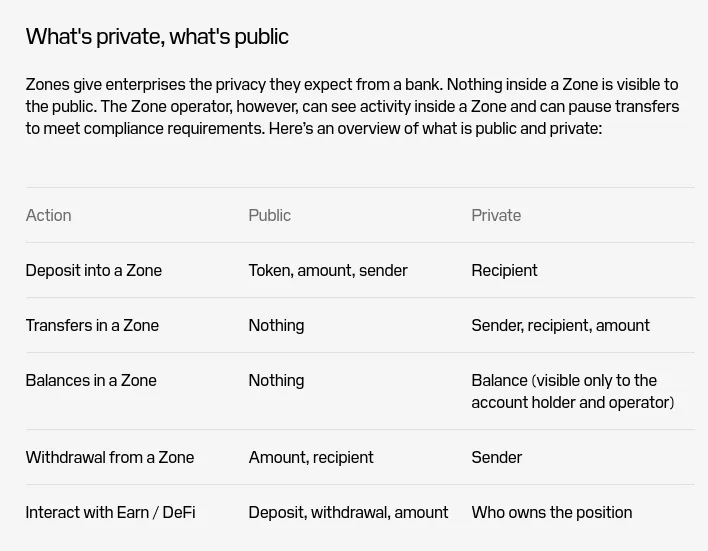
Inside the Zone, all internal payment allocations are entirely hidden from external observers: no one can see the sender, receiver, or specific amounts. Each contractor’s wallet balance is visible only to the account holder and the Zone administrator, rather than being displayed openly on the ledger. When a user withdraws funds externally, the amount and destination address appear on the network, but the source account address inside the Zone remains concealed.
Notably, this mechanism does not leave operators blind. Tempo designed Zone administrators to have full authority to audit internal activity for accounting reconciliation, tax reporting, and dispute resolution. Operators even retain the ability to pause transactions upon identifying risks, ensuring strict compliance with regulatory anti-money laundering requirements.
A pragmatic bridge for enterprise payroll flows
Deel’s Head of Crypto, Thierry Edde, stated that workers’ financial data must always be private by default, and information such as payroll history and account balances cannot be exposed on a public ledger. Integrating Zones alongside Privy’s wallet infrastructure allows contractors to maintain the privacy of traditional bank accounts while taking advantage of the instant settlement and low costs of stablecoins.
This represents a pragmatic advancement for the digital asset market: privacy purposefully architected to serve legitimate business needs and regulatory compliance, rather than total anonymity tools that constantly face enforcement clampdowns. Whether this controlled private zone model will soon become the universal standard for multinational corporations adopting cross-border digital payments will be the next real-world test.