The wave of opposition from leading U.S. listed corporations against plans to bring equities onto blockchain networks continues to escalate sharply. A public notice updated on October 30, 2026, by the OKXICE exchange shows that the list of issuers officially submitting formal opt-out notices against stock tokenization has reached 50 companies, raising major questions about the ambition to merge traditional finance with decentralized technology.
Wave of Opposition from Leading Tech and Consumer Brands
According to published legal filings, major corporations recently joining the opposition list include chipmaker Nvidia, sportswear giant Nike, retail chain Costco, memory chipmaker Micron, and social media platform Reddit. Previously, major entities such as Alphabet (including both GOOG and GOOGL tickers), Broadcom, and CoreWeave had also submitted opt-out notices. The cautious stance of leading semiconductor makers comes shortly after Nvidia and AMD invested $4 billion in Meta to build computing infrastructure, underscoring their priority to maintain tight control over traditional equity value.
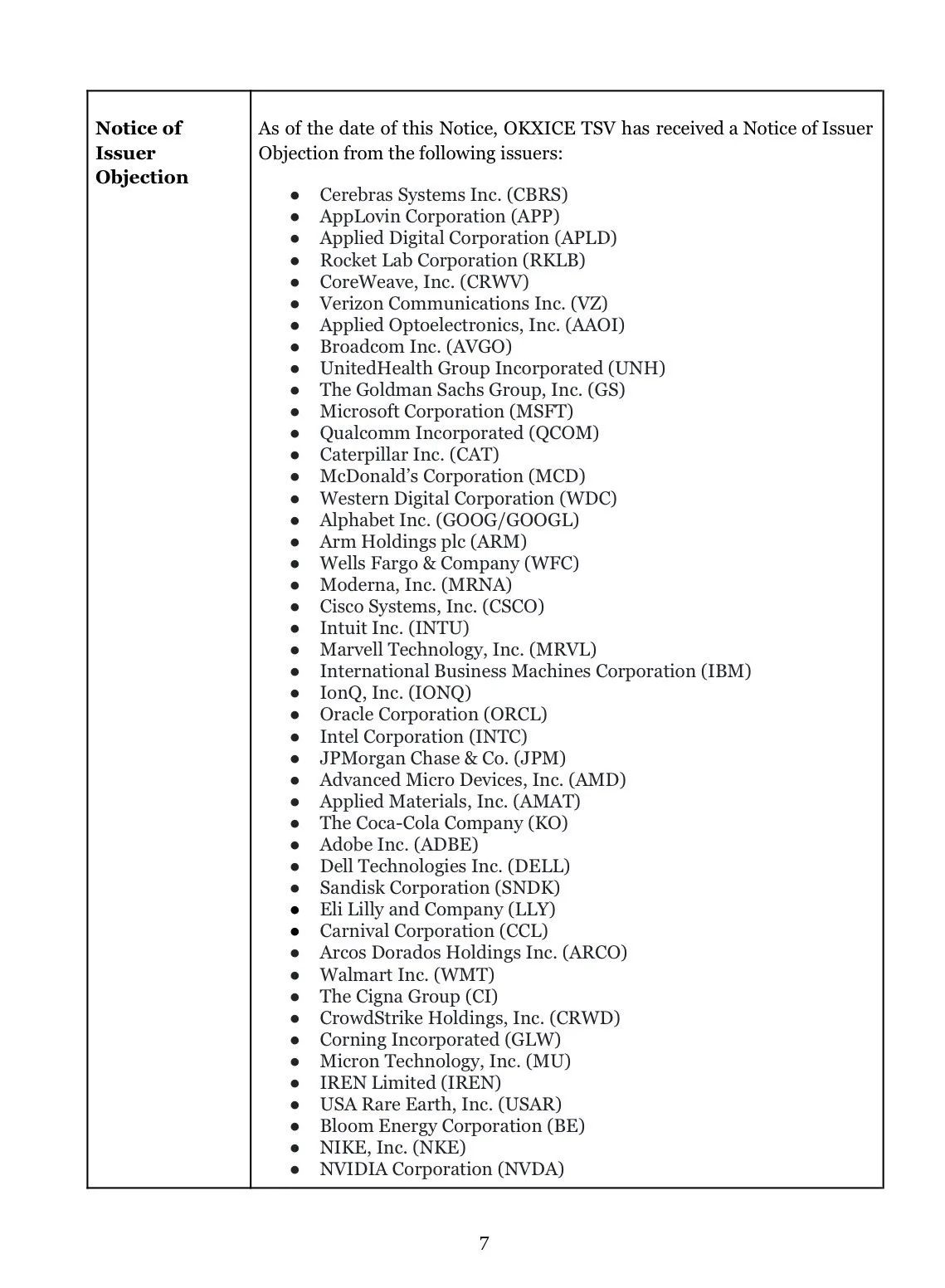
Cross-referenced data from The Defiant indicates that this wave of opposition now covers 44 out of 63 stock tickers in OKXICE’s initially proposed listing catalog from October 4, 2026. This means that only 19 equities have yet to record a public objection, including Apple, Amazon, and Tesla. Notably, seven companies filed objections even though their names were not on the original proposed list.
OKXICE is a 50-50 joint venture between Intercontinental Exchange Holdings (the parent company of the New York Stock Exchange, NYSE) and OKC USA Holding. The project was designed to allow verified institutional and retail investors who have completed identity verification to trade stock tokens through permissioned Uniswap v4 liquidity pools on the X Layer network.
Legal Veto Mechanism Under the SEC’s Exemption Framework
To understand why companies can so easily block these listings, one must look at the underlying regulatory framework. When the SEC opened the door to tokenized U.S. stock trading under a conditional exemption order issued on September 17, 2026, the regulator established a special protective clause specifically for corporate issuers.
Under this mechanism, a tokenized securities venue (TSV) is required to deliver written notice to a company before enabling trading in tokens representing its shares issued by an unaffiliated third party. Trading can only commence after a minimum of 30 calendar days from the date notice is received. If the company submits a written objection within that window, the venue completely forfeits the right to list that stock ticker under the exemption.
This framework grants companies an absolute, legally binding opt-out veto without requiring them to provide a specific justification. Although OKXICE maintains that all tokens are backed 1:1 by real shares held at an SEC-licensed broker-dealer, corporate giants clearly remain deeply apprehensive about legal, reputational, and control risks associated with on-chain derivative trading markets.
The Gap Between Tech Ambition and TradFi Legal Realities
Developments at OKXICE lay bare a stark reality: consensus from traditional financial markets cannot be achieved through purely technical solutions. While blockchain infrastructure stands ready to support 24/7 trading with instantaneous settlement, resistance from listed corporations demonstrates that they are not yet prepared to relinquish control of their equities to smart contract protocols.
With most of its highest-liquidity equities now pulled from the table, OKXICE will have to scale back its launch or renegotiate directly with issuers. The battle to tokenize real-world assets (RWAs) will be a protracted one, and the key to success lies not in deploying smart contracts, but in establishing legal trust with global corporations.