A report on October 10 by CoinDesk Research reflects the uneven recovery of market liquidity one year after the crash that saw more than $19 billion in leverage positions liquidated. Although market makers have returned to Bitcoin and Ether, the altcoin sector has yet to receive similar capital inflows.
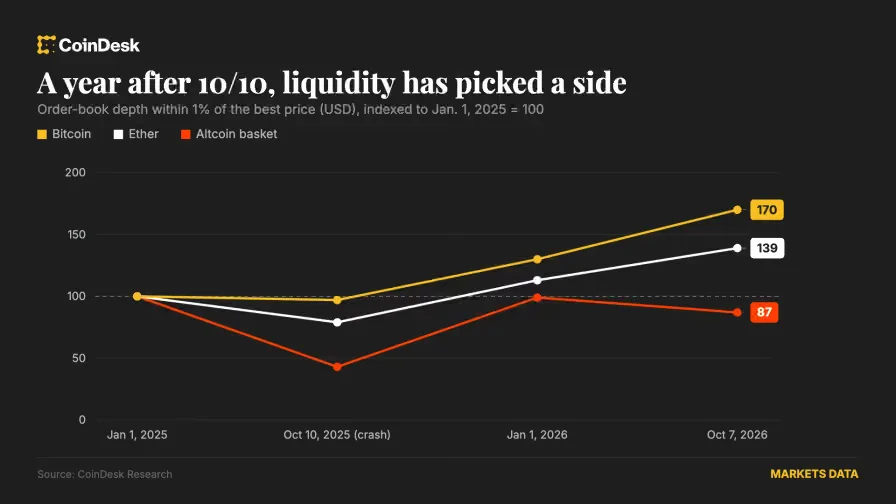
This divergence emphasizes that price movements do not signify that the market is capable of absorbing large trades. To accurately assess the extent of recovery, the actual capital scale resting on order books is the decisive metric, rather than price chart trajectories.
BTC and ETH Order Books Deepen Thanks to Real Capital Inflows
To measure the ability to limit the price impact of large-scale trades, CoinDesk assessed order book depth—the total value of bid and ask orders surrounding prevailing prices—across major centralized exchanges across 4 points in time: January 1, 2025, October 10, 2025, early 2026, and the past week.
Data recorded positive shifts for the two leading assets:
- Bitcoin (BTC): On October 7, the value of pending orders within a 1% range around the market price reached approximately $11.7 million. This level is up about 75% compared to the crash a year earlier, while surpassing the marks of $6.9 million (early 2025) and $9 million (early 2026).
- Ethereum (ETH): Order book depth within the 0.5% price band more than doubled compared to the day of the crash, reaching about $4.2 million; within the 1% range, total pending orders reached approximately $5.3 million.
CoinDesk researcher Saksham Diwan noted that this growth in USD value reflects the direct participation of fresh market-making capital, rather than merely being a consequence of the tokens’ own price fluctuations.
However, the above indicators do not guarantee that liquidity will remain stable in the face of market turbulence. Evidence of this was seen during the recent sell-off, where BTC order book depth in the 1% range dropped by about 12% just from October 7 to October 8.
Altcoins Have Yet to Record a Corresponding Recovery
In contrast to the positive trend among major coins, the group of altcoins within CoinDesk’s survey scope recorded a significant decline. Specifically, market depth converted into USD within approximately 5% of the trading price fell by about one-third compared to the beginning of 2025, down to only around $2 million. Although the number of tokens on the order book may increase due to declining market prices, this reality by no means reflects an increase in committed capital.
At the same time, spot market liquidity has also been unable to approach prior levels. Average weekly trading volume over the four-week period ending on September 27 reached only nearly $279 billion, vanishing by nearly two-thirds when compared to the $801 billion recorded during the highly volatile week. Although there have been signs of warming up since the August trough, trading activity remains far removed from its peak period.
Assessing this trend, CoinDesk Head of Research Joshua de Vos suggested that the widening divergence between the top assets and the rest of the market will likely persist into next year. He further noted that this forecast is derived from current data observations rather than being a definitive outcome.
Rising Liquidity Has Not Yet Eliminated Leverage Risks
In commentary delivered the same day, Mark Connors of Risk Dimensions pointed out that the root causes leading to the sharp drawdown have not disappeared: excessive long-position speculation, the prevalence of derivative contracts, and elevated leverage levels. Although market structure tracking has improved thanks to more transparent data, volatility-amplifying instruments continue to be present.
Therefore, the market has by no means returned to a safe state. The reality demonstrates that capital flows are primarily concentrated in BTC and ETH, leaving the trade absorption capacity of altcoins quite thin. The key factor to observe in upcoming bouts of turbulence is whether this liquidity will truly remain on the order books when sell-off pressure erupts, or immediately evaporate at the exact moment the market needs support the most.