DeepSeek has just launched V4.1 Flash, the smallest model in its new architecture lineup, featuring native image understanding and a one-million-token context window. This is no ordinary upgrade: V4.1 Flash uses a completely different architecture from previous models and, according to benchmarks published by DeepSeek, outperforms its Pro predecessor on most agent tasks.
New architecture with upgrades
DeepSeek V4.1 Flash possesses a total of 552 billion parameters but operates on an entirely new Causal Encoder-Decoder (CED) architecture, distinct from traditional Transformer blocks. Thanks to a split structure of 20 encoder layers and 20 decoder layers, in which the decoder’s global KV cache is directly projected from the encoder’s final hidden state, the model achieves impressive optimization: activating only 8 billion parameters during input processing and 16 billion parameters during output generation.
This reduction in active parameters delivers substantial practical value. In agent systems, most computational resources are consumed during the prefill phase (reading long contexts, processing image data, calling tools). Bringing the number of active parameters during prefill down to 8 billion instead of 49 billion, as in the V4 Pro version, optimizes operations and significantly reduces operating costs when handling large volumes of input.
Optimizing the KV cache is the core improvement most emphasized by DeepSeek. Specifically, the global KV cache size of V4.1 Flash has been reduced to 890 bytes per token, just one-fourth that of the V4 Flash generation. When operating in conjunction with the SWA Bounded Replay mechanism, the amount of KV memory required for long-term storage is reduced to just 1/8 of what was previously required.
The technical foundation for this reduction lies in the Compressed Sparse Attention 2 (CSA2) architecture, in which each attention layer is statically assigned to one of three modes (Full, Reindex, or Reuse) to share primary KV data and reuse sparse attention indices. This solution, combined with FP4 caching technology, significantly lowers cache storage costs. However, these figures are currently based solely on DeepSeek’s announcements and have not been independently verified.
Because cache hits account for a massive share of the budget when deploying agent systems, compressing cache size provides practical value by directly lowering API usage costs for users.
Outperforming the Pro model at a lower price
The benchmark results published by DeepSeek on Hugging Face record impressive achievements for V4.1-Flash (at maximum reasoning effort) across a range of tasks:
-
Terminal-Bench 2.1: Scored 90.6%, surpassing Opus-5.0 (89.1%).
-
DeepSWE v1.1 (code agent): Scored 74.2 points, on par with Opus-5.0 (74.0).
-
HLE (with tools): Leads with 63.9 points, beating Opus-5.0 (63.6).
-
Other agent & security benchmarks: Captured the top spot on Codeforces (rating 3,471), CyberGym (88.1), AutomationBench (54.8), and Agent’s Last Exam (31.8).
Looking specifically at pure reasoning tests, V4.1 Flash still trails large model families such as Opus 5 or GPT-5.6 Sol on certain criteria (such as GPQA Diamond at 90.9 compared to 94.1; HLE at 36.8 compared to 56.3). Nonetheless, for a Flash series version inherently optimized for cost and speed, keeping pace with or outperforming flagships on agent tasks is a noteworthy achievement.
Replacing predecessor models
The V4.1-Flash version is now available on the DeepSeek API under the name deepseek-flash, supporting both text and image processing. This event marks the deprecation of previous-generation models, V4 Flash and V4 Flash Vision Exp; furthermore, starting September 14, requests sent to the V4 Pro model are also temporarily redirected to V4.1 Flash at this Flash model’s pricing until V4.1-Pro is released.
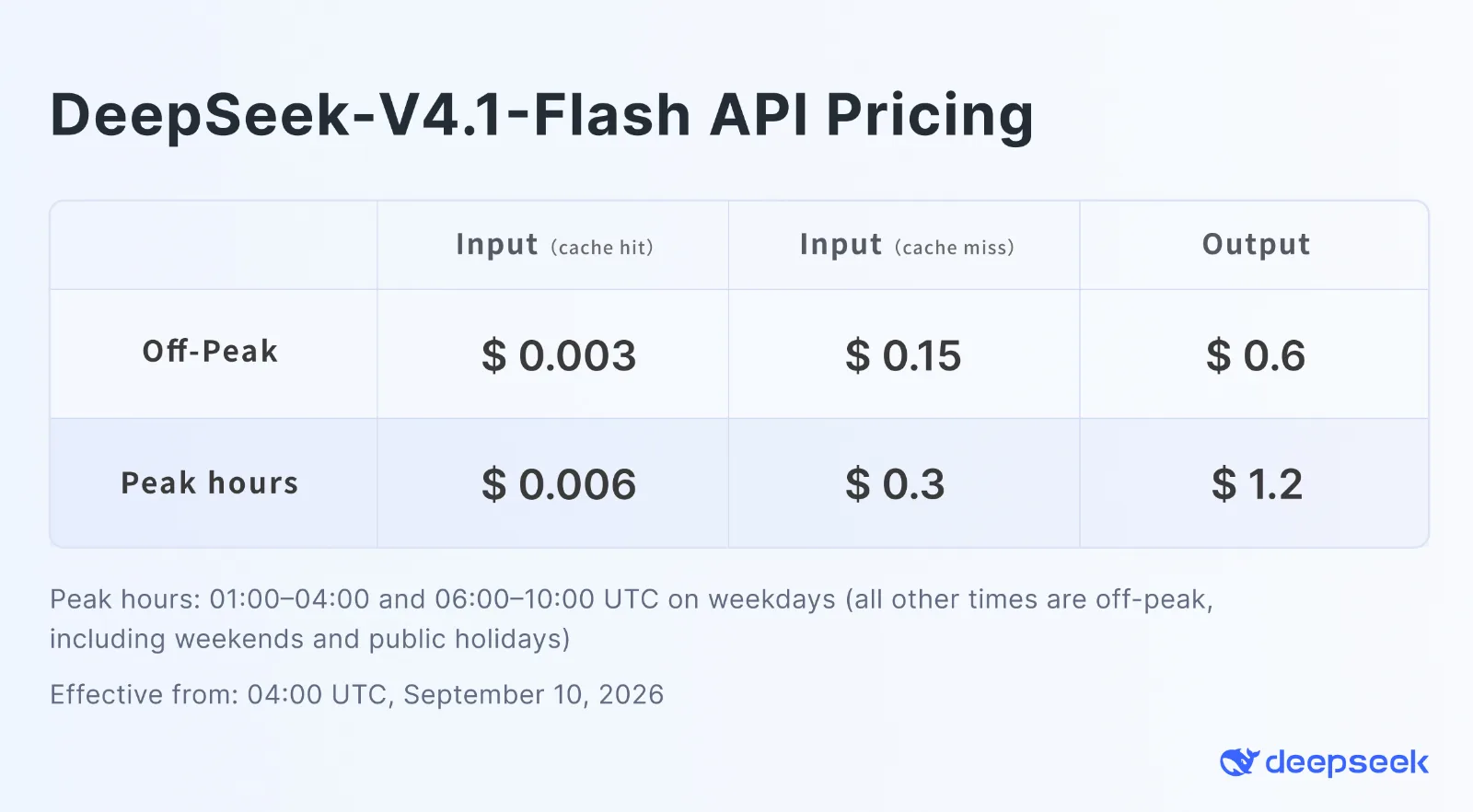
Regarding pricing policy, the new API price schedule takes effect from 04:00 UTC on September 10, offering a 50% discount during off-peak hours. Specifically:
- Off-peak price: 0.153 USD/M input and 0.6 USD/M output.
- Peak hours price: 0.306 USD/M input and 1.2 USD/M output.
DeepSeek has also open-sourced the model and released its weights on Hugging Face under the MIT license, along with a detailed technical report.
Overall, V4.1 Flash demonstrates DeepSeek’s distinct direction by avoiding the race to simply scale up parameter counts. Thanks to the asymmetric CED architecture that reduces active parameters during prefill, the company achieves cost efficiency while still maintaining output quality. Directly replacing a Pro model with a Flash model on the API proves a sustainable price reduction strategy driven by architectural innovation rather than merely slashing margins on older infrastructure. Because the model’s weights have been publicly released, the community can verify these claims through independent benchmarks. The key question going forward is whether the V4.1-Pro version, upon its release, will demonstrate a clear, decisive advantage over this Flash model.