Anthropic has officially filed its initial public offering registration statement (S-1) with the U.S. Securities and Exchange Commission (SEC) on October 26, preparing to list on the stock exchange under the ticker symbol ANT. The move follows months of speculation and leaked drafts, paving the way for one of the most closely watched public debuts in the history of the artificial intelligence industry.
The first public financial filing provides a direct look into both the revenue scale and the cash burn rate of this AI lab, following a period where the market only valued it based on the value of investment funds’ Anthropic shares prior to the IPO.
Soaring revenue alongside accounting net losses
In the first six months of 2026, Anthropic generated $16.3 billion in revenue, an increase of more than 13 times compared to $1.2 billion in the same period of 2025. The company’s core operations recorded an operating loss of $693 million, a significant improvement from the $2.1 billion loss in the first half of last year.
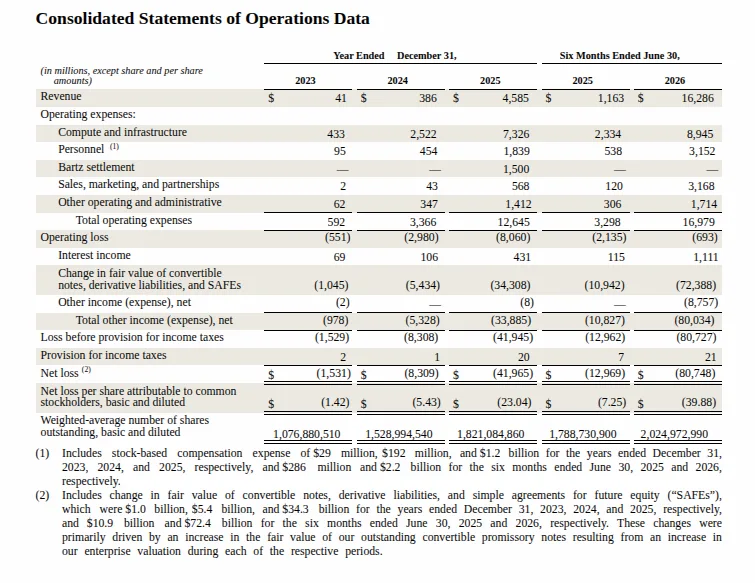
However, the income statement recorded a net loss of up to $80.7 billion. This was primarily driven by non-cash accounting adjustments to the value of convertible debt as the company’s valuation surged. This is an accounting loss on the books rather than a reflection of actual cash consumed during the period. Even so, Anthropic candidly noted in its risk factors that the company may not achieve or sustain profitability in the near future.
Application ecosystem retaining enterprise customers
Anthropic’s primary growth driver comes from large enterprise customers, with a net revenue retention rate of approximately 900% by the end of quarter 3. As of September 30, the company had more than 11,900 customers spending $100,000 or more annually, including over 1,900 customers contributing from $1 million and about 250 enterprises paying $10 million or more.
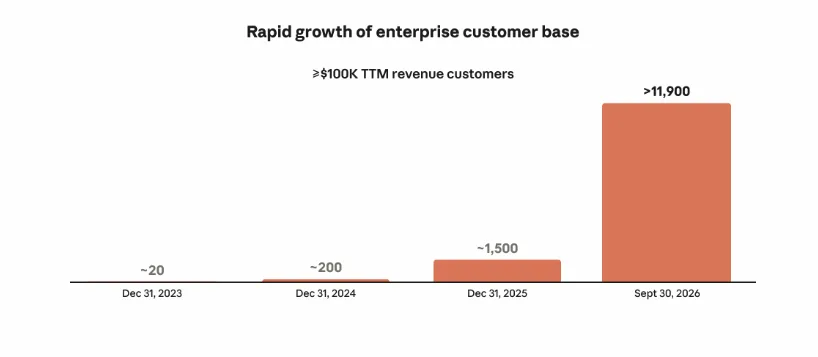
More than half of the customers in the $100,000 spending tier currently use both the Claude application programming interface platform and at least one specialized application such as Claude Code or Cowork. Notably, the top 5% of enterprise customers by spending who use Claude Code recorded monthly billings approximately 20 times higher than typical enterprise users. This cross-selling strategy mirrors how Amazon once expanded its cloud infrastructure, helping reduce reliance on any single product.
Governance structure concentrating voting power
In terms of corporate control, Anthropic continues to maintain a distinctive power structure designed to safeguard its technology safety mission. The group of seven co-founders—Dario Amodei, Daniela Amodei, Tom Brown, Jack Clark, Jared Kaplan, Sam McCandlish, and Christopher Olah—will participate in a shared entity holding 50.1% of total voting power.
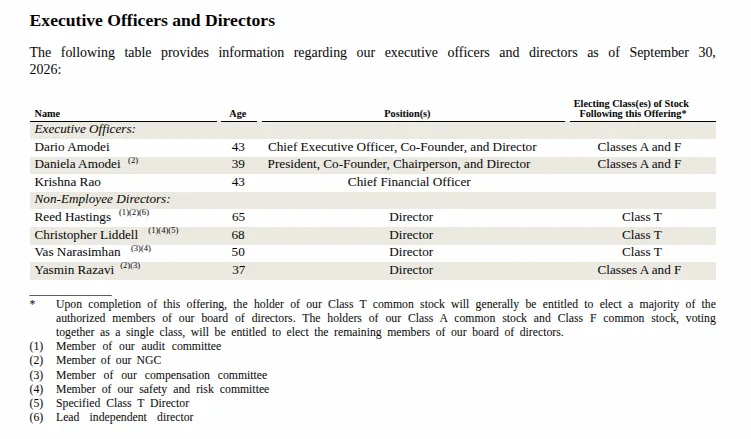
This model enables the founders to retain strategic control even if their economic ownership declines, similar to how the long-term benefit trust was previously established. Additionally, the risk factors highlight complex relationships with cloud partners such as AWS, Google Cloud, and Microsoft Azure, as these providers simultaneously distribute services and compete for compute resources.
Anthropic has not yet announced a target price or the total capital it expects to raise in the offering, leaving open the question of its official valuation when the market opens to ANT shares.