Anthropic is preparing for one of the largest IPOs in history, with a valuation that could reach $2,000 billion. But what catches the attention of analysts and investors most is not the valuation figure, but a detail in its governance structure: Who will run the company after the stock begins trading?
The answer is the Long-Term Benefit Trust (LTBT), a small board of outsiders who hold no equity, yet possess the power to appoint and remove the majority of Anthropic’s board of directors. For a company about to sell shares to the public, this is an uncommon structure.
How Does the LTBT Work?
The trust currently has three members: Neil Buddy Shah (of the Clinton Health Access Initiative) serving as chair, former Federal Reserve Chairman Ben Bernanke, and Richard Fontaine (head of the Center for a New American Security). The LTBT’s mechanism is rather unusual: members own no Anthropic stock, derive no financial gain from the share price, and theoretically answer only to the “long-term benefit of humanity” rather than to shareholders.
In terms of actual power, the trust has already selected 4 of the 7 members of Anthropic’s current board of directors, including Reed Hastings (co-founder of Netflix) and Vas Narasimhan (CEO of Novartis). Anthropic has stated it will retain this structure after going public.
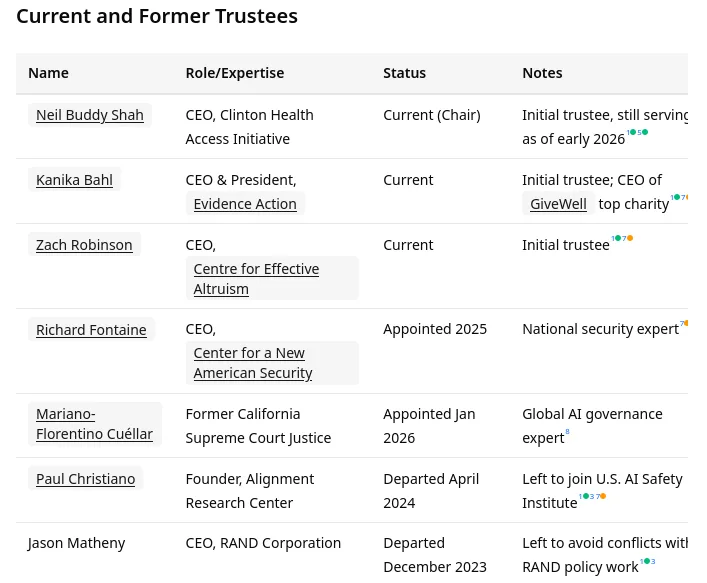
This mechanism did not simply emerge for the IPO. Anthropic designed the LTBT in its early days as an answer to the question: How do we ensure that a company building increasingly powerful AI is not steered away from safety goals by short-term market pressures? When the company was private, few paid attention to this setup. As it heads to the public market, it becomes a genuine legal and financial question.
What Are Public Investors Buying Without Commensurate Rights?
The issue analysts are emphasizing is the misalignment between rights and economic interests. Investors buying IPO shares put real capital into the company but have no vote to elect leadership. Typically, such an arrangement would be read as an extreme signal of “founder control,” akin to the Class A/B share structures used by Meta or other founder-controlled companies.
With Meta, however, control still rests with equity holders. At Anthropic, control lies with a group of people who hold no equity at all. There is no direct precedent for a multibillion-dollar company going public under such a model.
Supporters will argue that this is precisely what gives Anthropic its value: an AI company committed to not being pulled away from safety goals by the market, with preserving the structure through an IPO serving as a strong commitment. Critics will counter that there is still no clear, public mechanism governing to whom the trust is accountable, how its members are elected, or what happens if power is abused. When a mechanism of “accountability to humanity” is tested for the first time at a scale of $2,000 billion, the outcome will shape future AI companies.
What to Watch
This is one of the most noteworthy governance experiments in the AI sector right now because its implications extend beyond a single company. If Anthropic completes a successful listing with the LTBT intact, other AI labs will have a reference model for maintaining control in the midst of public markets. If this structure triggers a governance crisis, runs into opposition from institutional shareholders, or faces regulatory scrutiny, the “mission-controlled” model will be difficult to replicate.
Currently, the LTBT structure is established and the trust has already selected 4/7 board seats, with Anthropic stating it will remain unchanged after the IPO. Yet whether the market accepts it, how proxy advisors evaluate it, and how this mechanism actually functions when at odds with short-term business performance all remain unanswered questions. These are scenarios that have yet to unfold, not proven realities.
In the coming months, Anthropic’s IPO filings will reveal the legal details of this structure: who holds what powers, how trust members are replaced, and what commitments investors receive. That will be the most compelling reading of all, far more than any report on valuation.