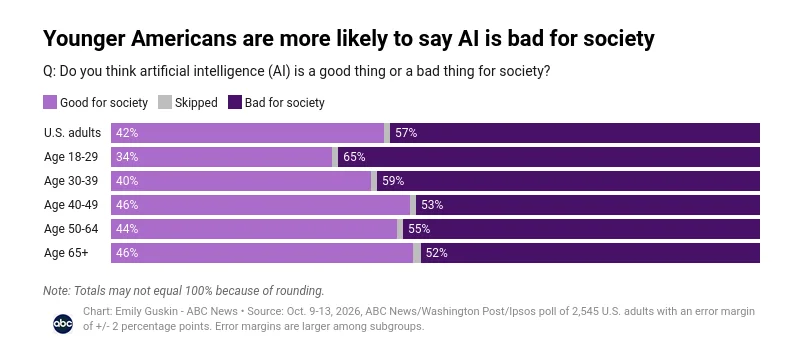
A comprehensive survey conducted jointly by ABC News, The Washington Post, and Ipsos has revealed deep public skepticism across the United States toward the artificial intelligence boom. According to findings published on October 21, 2026, as many as 57% of Americans believe AI has a negative impact on society, while about 66% oppose building more data centers nationwide.
A Wave of Opposition to Local Data Centers
The study was conducted on a representative sample of 2,545 adults nationwide from October 9 to October 13, 2026, with a margin of error of two percentage points. When asked about deploying computing facilities directly within their own communities, the opposition rate surged to 72%.
This resistance reflects a broad consensus across demographic and political lines:
-
Approximately 81% of Democrats, 76% of independents, and 58% of Republicans oppose housing data centers locally.
-
Opposition peaked in rural areas at 78%, followed by suburban communities at 72% and urban areas at 69%.
-
Young adults under 30 voiced the strongest opposition, with 80% rejecting these infrastructure projects near where they live.
Despite government industrial rhetoric aimed at expanding infrastructure for tech dominance, local residents are increasingly worried about power grid strain, noise from cooling towers, and the risk of depleting municipal water reserves.
Fears of Job Losses and Skepticism over Economic Benefits
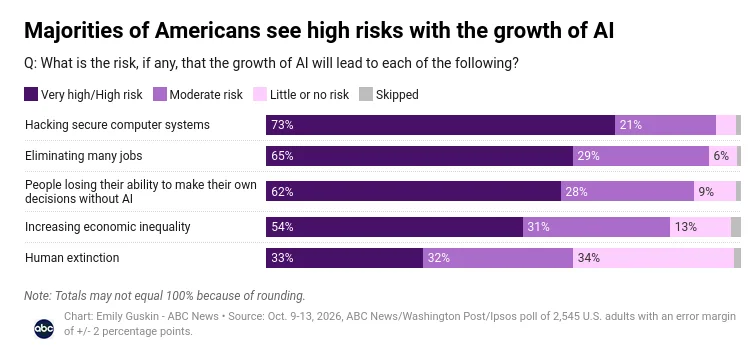
Regarding potential threats, most respondents ranked AI’s negative consequences as high-level risks. Specifically, 73% fear the threat of hackers attacking critical computer networks, 65% worry about widespread job cuts, and 62% fear that humans will gradually lose the ability to make independent decisions due to overreliance on machines. Notably, 33% of Americans view the existential threat of human extinction as a realistic, high risk.
Conversely, trust in promises of productivity gains remains meager. Only 20% of respondents believe AI is very likely to help workers become more productive, whereas 38% see virtually no chance of that happening. Similarly, a mere 13% expect the technology to create many new jobs for the economy, in contrast to 52% who believe AI will not yield significant employment gains.
The Gap Between Policymakers and the Public
The poll results highlight a widening gulf between policymakers in Washington and the public’s concerns. Up to 66% of Americans believe the federal government lacks adequate regulations to manage the advancement of AI technology. In parallel, 66% disapprove of how the federal government currently handles AI policy.
While political figures attempt to calm voters with collaborative measures like signing an AI safety self-regulation accord or brushing aside existential warnings to prioritize the race for technological dominance, nearly half of Americans (49%) state that they trust neither political party to steer the technology. This pervasive skepticism is poised to become the most formidable political hurdle facing plans to scale up server clusters and power plants for frontier models in the years ahead.