On October 21, 2026, artificial intelligence startup Recursive, led by former Salesforce Chief Scientist Richard Socher, officially announced its first open-source model, named Flint. This lightweight coding model is released completely free on Hugging Face under the Apache 2.0 software license.
What makes Flint particularly eye-catching to the tech community is not only its ability to run offline directly on personal computers, but also that the model is a real-world test of the concept of AI participating in recursive self-improvement.
Optimizing a mixture-of-experts architecture to run directly on laptops
Rather than joining the bulky size race requiring expensive server infrastructure, Flint is designed around a Mixture-of-Experts (MoE) architecture. The entire system has a total of 40 billion parameters, but at each processing step, the model activates only a small slice of 2.5 billion parameters.
This mechanism allows Flint to run smoothly on standard laptop hardware, enabling developers to keep internal source code completely confidential while avoiding per-token charges from cloud service providers.
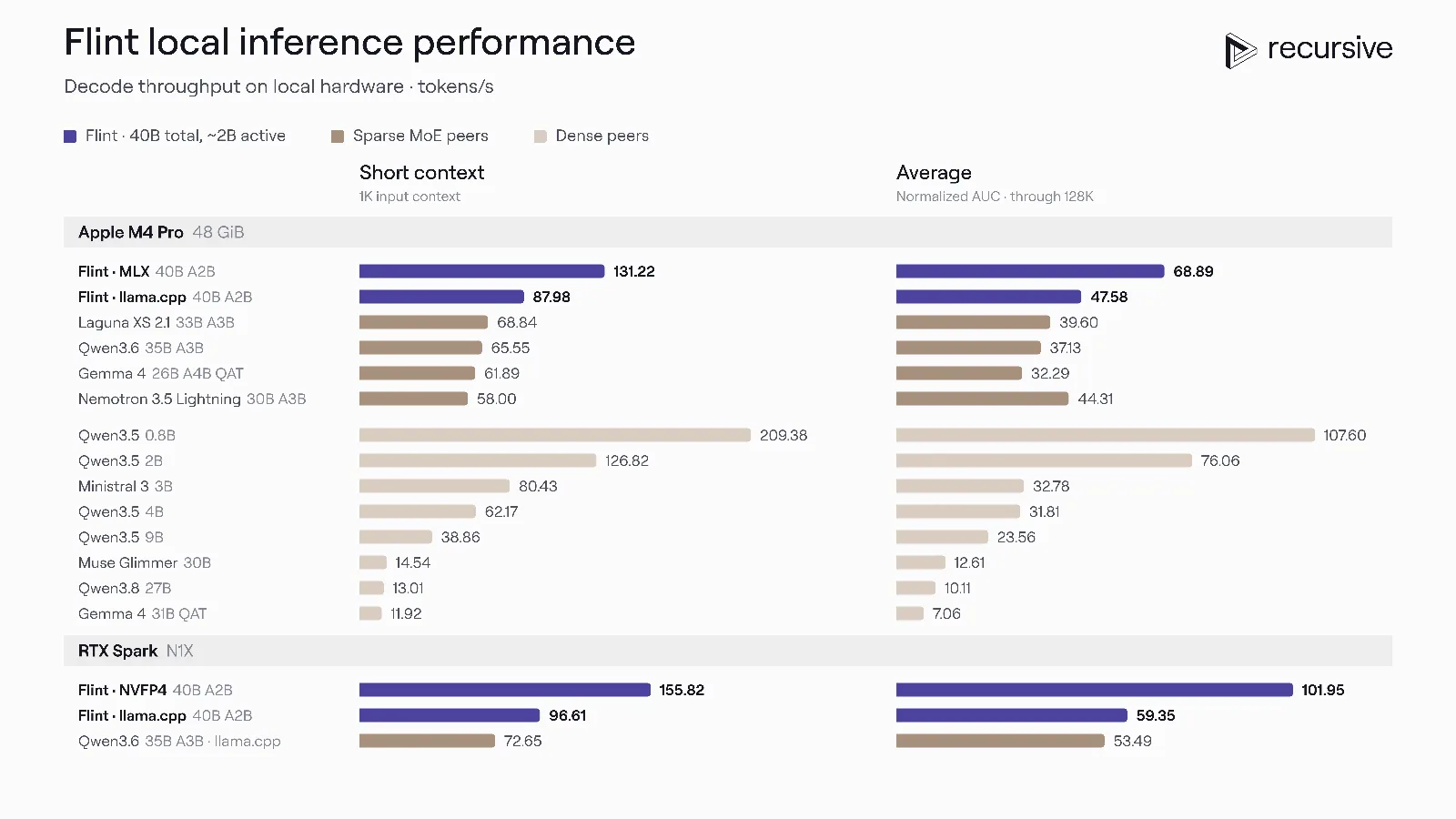
According to figures self-reported by Recursive, Flint achieves code generation speeds of up to 131 tokens per second on a MacBook Pro powered by an Apple M4 Pro chip. That is twice as fast as the 58 to 69 tokens per second recorded by similarly sized models running on the same hardware, such as Google’s Gemma 4 or Nvidia’s Nemotron 3.5 Lightning. On dedicated workstations equipped with Nvidia RTX Spark graphics cards, response speeds can exceed 150 tokens per second.
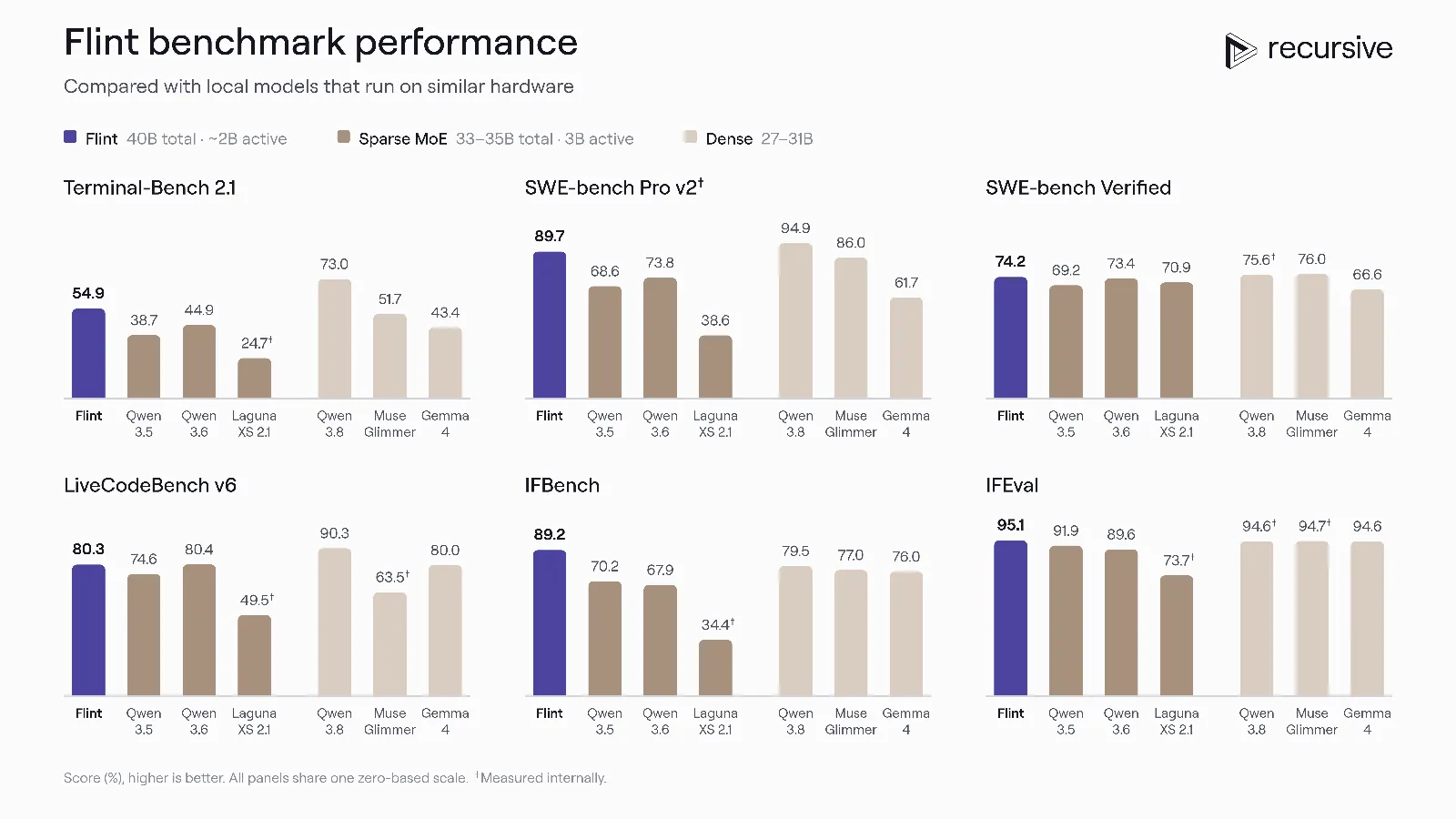
On the SWE-Bench Verified benchmark, which evaluates real-world software bug-fixing capabilities, the company states that Flint outperforms all open-source models under 50 billion parameters on the market, trailing only Alibaba Group’s Qwen3.8 27B in overall aggregate scores.
The imprint of the automated research engine Eureka Machine
The development team stated that the automated research system named Eureka Machine participated in nearly every phase of Flint’s development, from designing pre-training datasets and post-training fine-tuning to building specialized compute kernels. Thanks to this agentic system, a small engineering team was able to complete the entire model from scratch in under four months.
Automated quantization and weight compression techniques proposed by the machine helped reduce Flint’s memory footprint by 71% with almost no degradation in logical reasoning quality.
Even so, the company acknowledges that running a compact model on a laptop requires users to break down tasks and provide more detailed prompts compared to massive cloud services. Empowering AI to participate deeply in the creation of subsequent model generations promises to shorten software development cycles, but human oversight remains crucial to keeping these self-improving systems under control.