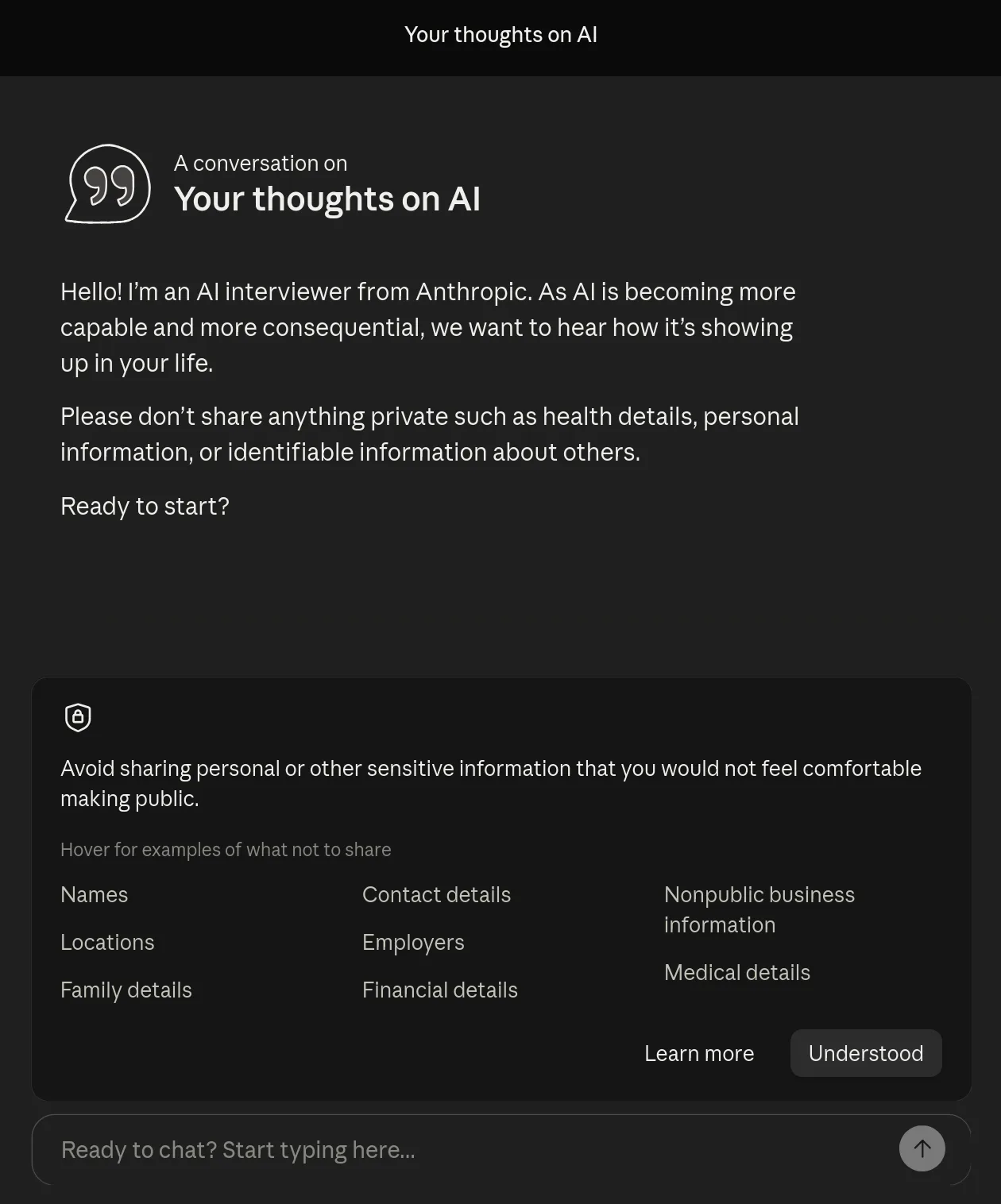
Anthropic has just launched a new study on AI user experience via Anthropic Interviewer, featuring a key distinction from previous projects: allowing participants to proactively make their entire interview public. The program runs from September 29 to October 6, 2026, and is open to Claude and Claude Code users on Free, Pro, and Max tiers whose accounts have been active for two weeks or more. Each interview session is expected to take around 15 minutes.
Three major questions raised
The study focuses on three core areas: identifying the most memorable AI experiences (both positive and negative); exploring key sectors such as work, education, healthcare, and public administration where users hope to see AI bring improvements; and gathering specific expectations for the developers behind this technology.
Compared to the technical aspects, the context highlighted by the company carries a more serious tone. They point out that AI stands at a major turning point: as capabilities broaden and utility increases, the risks of misuse escalate in tandem. While this technology helps accelerate scientific and medical breakthroughs, the fallout from misuse is growing increasingly unpredictable—to the point where a single isolated security incident could inflict damage far exceeding the scale seen just a year earlier.
This survey builds upon a project launched in December 2026 that drew 81,000 participants, helping shape the Anthropic Institute’s agenda at the World Economic Forum and continuing to guide research into socioeconomic impacts. However, while the previous study only shared high-level aggregate data and a few brief quotes, this time the company hopes to pave the way for participants’ individual perspectives to be shared more broadly.
Making answers public is the hardest part!
Anthropic issued a candid warning regarding the risks associated with identity exposure.
Because they do not edit answer contents, they cannot guarantee absolute privacy for participants, even though account details such as Claude user names or email addresses are not published. Seemingly harmless individual pieces of personal data—such as age, profession, city, or school—can, when combined, significantly narrow down someone’s identity. Research by Anthropic Interviewer itself has confirmed the feasibility of this.
This threat does not end with the present moment. Publicly released interview data carries the risk of being exploited for purposes beyond anyone’s control, including fraudulent activities. Although Anthropic will assist in removing archived copies from its systems upon request, it cannot delete data that has already been saved by third parties; users are therefore advised to weigh their choices carefully before opting to make their responses permanently public.
For those who do not consent to publication, the submitted information will still be used for analysis in aggregate or de-identified form. In addition, participants can withdraw from the process at any time by selecting “End interview,” after which all incomplete data will be entirely purged and will not be stored, analyzed, or published in any form.
An objective look at the limitations
Anthropic itself acknowledges three major limitations in this study. First, the survey sample is restricted to Claude users and is not representative of the broader community. Second, the answers published publicly make up only a small fraction of the total responses, as the group willing to share may possess distinct characteristics compared to those who decline. Finally, the phrasing of the interview questions inevitably steers and shapes the responses received.
Looking at the broader landscape, OpenAI recently published a report on infrastructure safety, while Anthropic released findings showing that the GLM-5.3 model is capable of autonomously developing end-to-end cyber exploit tools. Both companies face the dilemma this survey aims to examine: as models grow increasingly capable, balancing the value they deliver against the risks they introduce becomes exceptionally complex.
The key question going forward is whether the gathered data will genuinely influence real product roadmaps, or merely serve as a channel for corporate messaging.