Anthropic has announced the unification of the memory system between Claude chat and Claude Cowork to allow Claude to maintain context across platforms, turning the AI into a seamless assistant rather than two separate products under one roof.
Another notable change is that Claude now displays what is stored in its memory, allowing users to review, edit, or delete information across any topic. Furthermore, Claude adds topics to memory during conversations rather than summarizing after a chat ends, helping information update and sync between the two environments faster.

In terms of privacy, Claude by default does not store personal or sensitive data such as health, race, religion, political opinions, or gender. Users can enable the “include sensitive topics in memory” feature if they choose, and the app will notify them whenever a sensitive topic is saved. Certain data will never be stored by Claude, such as official government ID numbers, Social Security numbers, criminal records, or anything that violates usage policies.
The feature is enabled by default across Free, Pro, and Max plans, on web, desktop, and mobile.
From the perspective of general users, this is considered Anthropic’s most valuable improvement yet, addressing an inherent pain point of current AI tools: having to constantly re-explain what the AI previously knew whenever switching to a new tool or chat session.
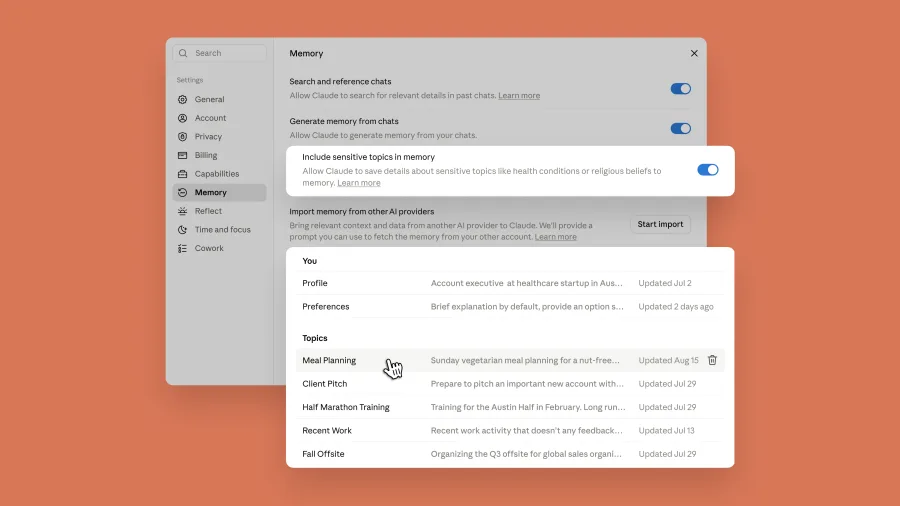
Also noteworthy are the default privacy safeguards, where all sensitive topics are not remembered by default unless you actively opt in. This is how Anthropic balances continuous utility with the risks of an assistant that “remembers too much,” a challenge competitors are grappling with in a similar race.