Anthropic has just released Claude Sonnet 5.5, the second model in the Claude 5.5 family following Opus 5.5. It is reported to be 30% faster with per-task costs up to 30% lower than Sonnet 5, while keeping token-based pricing unchanged. However, on the very morning of its launch, the model faced criticism after another user’s illustration was used without permission.
A leap in coding capabilities
The most striking aspect of Sonnet 5.5 is that the coding gap with the higher-tier model has been almost completely eliminated. On Terminal-Bench 4.0, the launch post reports that Sonnet 5.5 reached 70.6% compared to 10.3% for Sonnet 5, even edging out Opus 5.5 at the highest effort setting (66.4%). Across knowledge work tasks, Sonnet 5.5 scored 1,844 points on GDPval-AA, nearly matching Opus 5.5 (1,846) and surpassing Sonnet 5 by about 400 points.
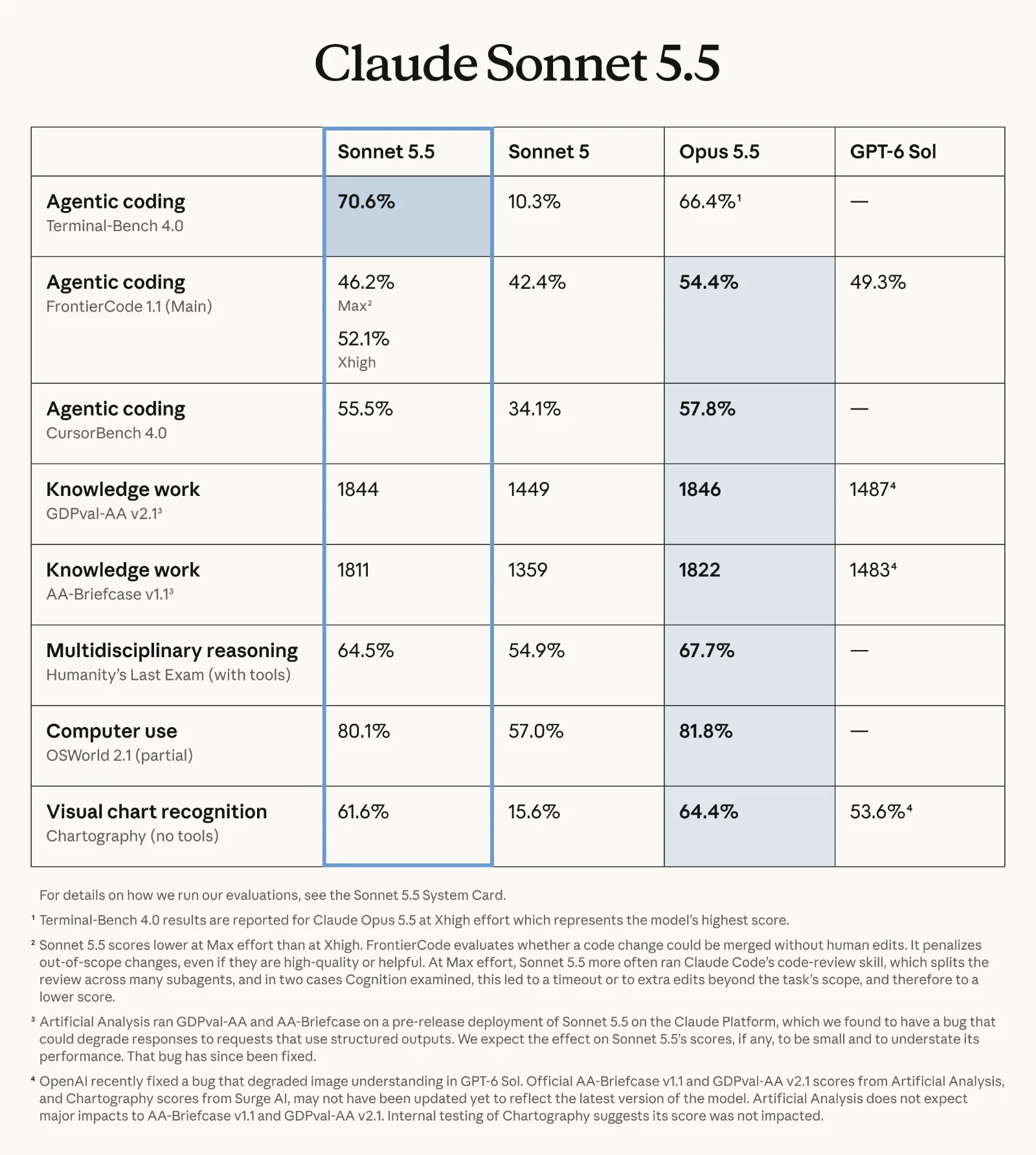
Anthropic also explicitly highlighted an important point: the pre-release test build used for the GDPval-AA and AA-Briefcase scores had encountered a bug that degraded performance on structured output prompts. That bug has been resolved. In other words, actual figures may be slightly higher, though readers should not treat minor differences as significant.
Over 30% token savings compared to the previous generation
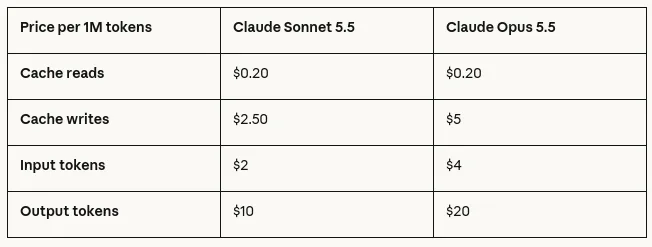
Pricing for Sonnet 5.5 is identical to Sonnet 5: $2 per million input tokens, $10 per million output tokens, and $0.20 per million tokens when reading from cache. The cost savings come from the model finishing tasks with fewer tokens. Anthropic also introduced a new effort level parameter, allowing users to balance speed, cost, and depth.
Early testing partners have also demonstrated the cost efficiency of the new model: Slack reported an approximate 14% reduction in output tokens, Box recorded speeds 2.4 times faster using 12% fewer total tokens, and Atlassian saw tasks in Rovo Agent execute up to 30% faster.
The first Sonnet model equipped with new safeguards
Matching Opus 5 in cybersecurity capabilities, Sonnet 5.5 is the first Sonnet model shipped with dedicated cybersecurity safeguards, fallback mechanisms, and a classifier designed to block reasoning hijacking. Anthropic has also expanded its retention mechanism for thinking data tied to the originating account, minimizing scenarios where reasoning trails become separated from their owner during account switching. The model is accessible on AWS, Google Cloud, and Azure. The unreleased Claude Haiku 5.5 will join the family in the coming weeks.
Embroiled in controversy from day one
Lance Martin, an employee at Anthropic, shared a video demonstrating Sonnet 5.5 recreating an image by writing, running, and self-correcting code. In the accompanying blog post, the reference image belonged to the account IceSolst but was uncredited. The creator posted their reaction on X, noting that Anthropic is already entangled in multiple lawsuits concerning unauthorized content usage.
Martin later apologized, stating this was an oversight and subsequently adding proper credit to the blog post. While the incident caused no tangible harm, it remains noteworthy: a company championing a serious commitment to safety made a fundamental error regarding usage rights and attribution during a high-profile product rollout.
Is Anthropic contradicting its own message?
Both Opus 5.5 and Sonnet 5.5 were introduced shortly after CEO Dario Amodei published an article urging the wider AI industry to slow the pace of deploying new capabilities, citing increasingly unpredictable behavior from autonomous models. Both of these 2 models notably surpass prior generations, whereas OpenAI and SpaceXAI seem to be adhering to that sentiment, as their recent offerings (GPT-6 Sol/Luna and Grok 4.7) have focused primarily on cost improvements rather than outpacing earlier benchmarks.
This raises the question: is Anthropic genuinely following its own advice, or is it striving to protect its leadership position to sustain an IPO valuation above 2,000 billion USD?