On October 14, 2026, during Singapore International Cyber Week, Google DeepMind and the Government Technology Agency of Singapore (GovTech Singapore) announced a collaborative project that successfully developed a specialized artificial intelligence model to detect sophisticated scam tactics, operating entirely locally on user devices based on the open-source Gemma model.
According to statistics from Singapore, scam cases account for more than 50% of all reported crimes in the country, causing estimated losses exceeding 4 billion SGD since 2019. More critically, attack tactics have evolved substantially from crude phishing links to prolonged social engineering scenarios spanning multiple conversational turns, which now account for up to 80% of victims’ total financial losses.
Two-stage processing pipeline optimized for mobile power efficiency
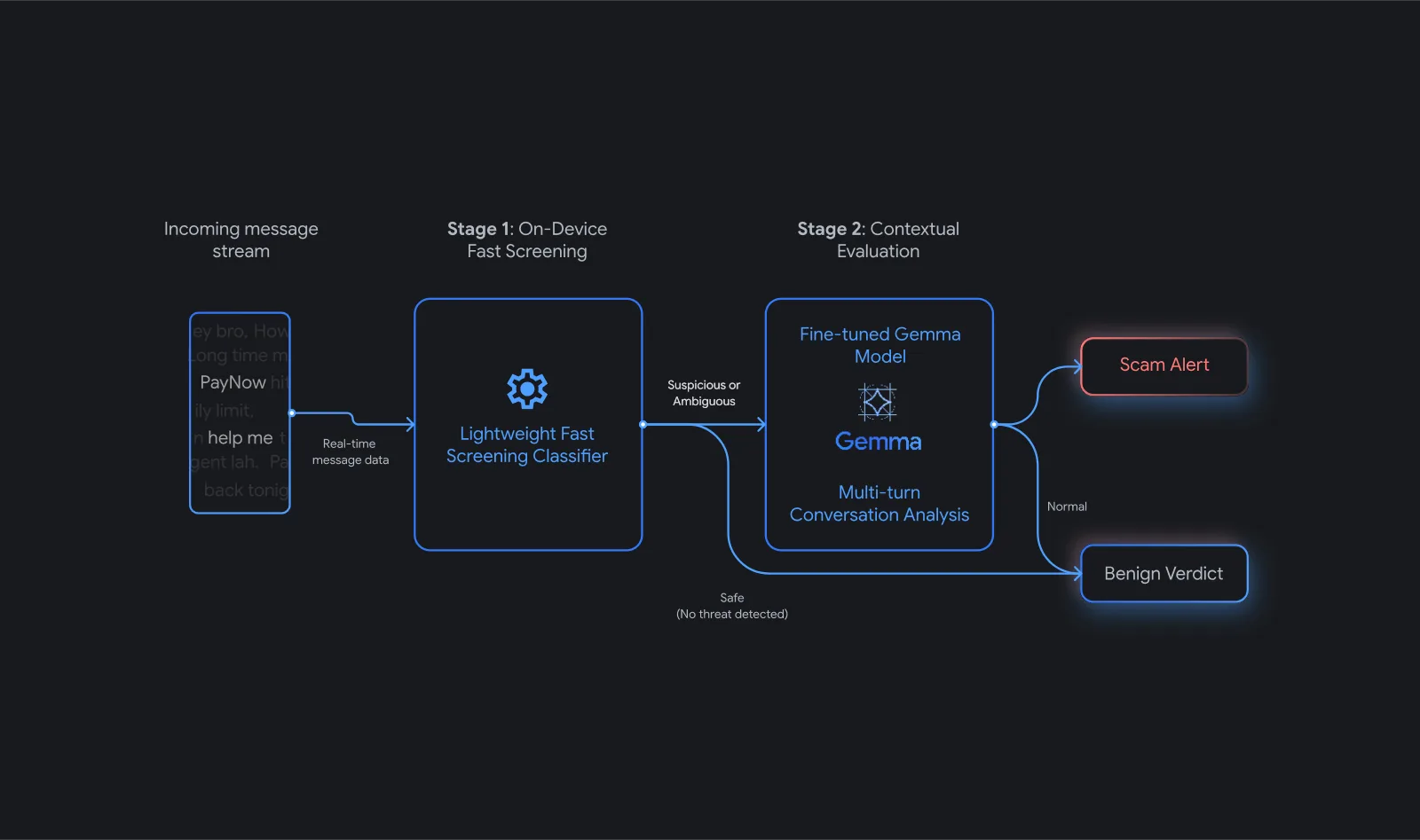
Running large language models on smartphones typically faces difficult challenges regarding battery capacity and computational resources. To overcome this hurdle, DeepMind and GovTech Singapore implemented a tiered processing pipeline architecture consisting of two independent stages:
First, an ultra-lightweight classifier continuously screens incoming text messages with negligible power consumption, serving as a gatekeeper to catch suspicious patterns. Only when a risk signal is detected does the system activate the second stage: the fine-tuned Gemma model analyzes the broader context of the entire conversation thread to confirm psychological manipulation or eliminate false alarms.
If a clear threat is identified, the device issues a real-time alert, prompting the user to pause before transferring money or sharing personal information. The entire scanning and inference process takes place directly on the phone’s hardware, meaning neither Google nor government agencies have any ability to read citizens’ private communications.
Isolated training mechanism in a sovereign sandbox
The model was specially trained on a repository of local scam reports stripped of all personal identifiers, covering scenarios involving impersonations of government officials, commercial banks, and regional influencers. The fine-tuning process took place within an isolated cloud environment called the Sovereign Sandbox, directly managed by GovTech Singapore on Google Cloud infrastructure, ensuring no real citizen data was leaked outside.
Mark Chen, Director of Trust and Safety at GovTech Singapore, emphasized that combating cybercrime cannot come at the expense of personal privacy. The new model will be integrated into public-facing civil applications following a phased roadmap and will strictly require active user consent.
Although neither party has disclosed precise specifications regarding memory footprint or real-world false alarm rates, the project sets a valuable precedent: putting artificial intelligence that protects digital borders directly into the hands of individual users without compromising end-to-end encryption.