On September 30, 2026, Google officially unveiled Gemini 4 Argon, its first frontier model since the Gemini 3 release. Notably, the company chose cybersecurity experts participating in the Fairwind program as the initial users instead of paying customers. On the same day, Artificial Analysis ranked Argon 8th out of 223 with an intelligence index score of 53, placing it on par with GPT-6 Astra.
Highlights
The most groundbreaking and obvious technical upgrade in Argon is its output capacity ceiling: expanding from 64K up to 1 million tokens, a figure Google claims leads the entire industry. According to the company’s explanation, providing enough headroom for the model to generate hundreds of thousands of reasoning tokens in a single turn unlocks a new layer of depth, fundamentally resolving complex problems that previous single-pass methods could never conquer.
Regarding input capabilities, Argon supports multimodal input, including both text and images, and returns responses in text format. Paired with a context window of up to 1 million tokens, the model can process massive volumes of information, equivalent to approximately 1,500 A4 pages of text.
Benchmarks
According to Google’s official announcement, Gemini 4 Argon achieves superior performance across multiple complex tasks, posting impressive detailed scores on leading leaderboards:
-
DeepSWE v1.1 (Real-World Software Engineering): Achieved 77.9%, taking the lead in solving practical programming problems.
-
Vals Index (Economic Impact): Ranked at the top across the combined domains of finance, programming, legal, and tax.
-
AutomationBench (Task Automation): Reached 51.3%, demonstrating the ability to execute complex workflows.
-
LVBench (Long Video Understanding): Reached a record 91.7% in processing and analyzing large-scale video contexts.
-
CWE-bench v1 (Defensive Cybersecurity): Scored 68% in automatically detecting and fixing critical security vulnerabilities.
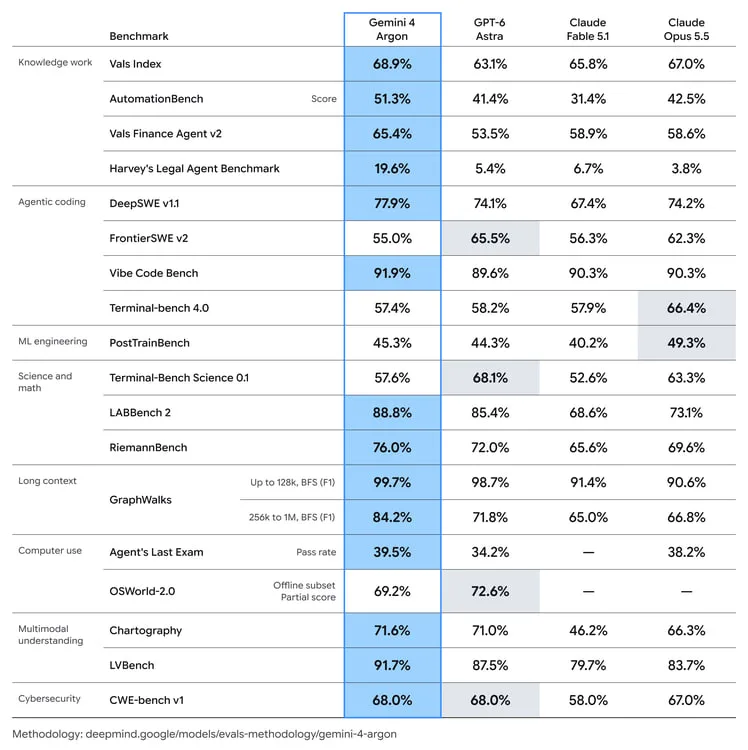
According to data published by Artificial Analysis, Gemini 4 Argon scored an overall intelligence index of 53, matching OpenAI’s GPT-6 Astra, while completely outperforming it in output processing capabilities with a 1 million reasoning token ceiling and long-video analysis capabilities (LVBench 91.7%).
Meanwhile, compared to Anthropic’s Fable, Argon maintains a substantial advantage in automated software engineering tasks (DeepSWE v1.1 77.9%) and defensive cybersecurity, although some sources report Fable is improving faster in real-world front-end coding experiences.
API Pricing
Initial pricing for the Gemini 4 Argon API is set at $2/M input tokens and $10/M output tokens. Following the introductory promotional period, standard rates will double to $4/M input and $20/M output, matching the current pricing of Claude Opus 5.5. Notably, Google is offering a discount of up to 95% on cached input data, lowering the cost of cached inputs to just $0.10/M tokens.
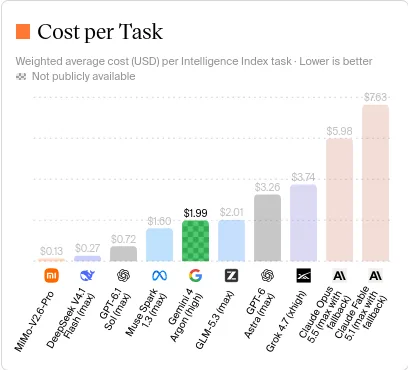
In terms of Cost per Task on the Artificial Analysis Intelligence Index, Gemini 4 Argon achieves an average cost of $1.99/task. This represents an exceptionally competitive price point within the frontier model tier, significantly lower than rivals in the same performance bracket:
| Mô hình (Model) | Chỉ số trí tuệ | Chi phí / Tác vụ |
|---|---|---|
| Gemini 4 Argon (High) | 53 | 1.99 USD |
| GPT-6 Astra (Max) | 53 | 3.26 USD |
| Claude Opus 5.5 (Max) | 58 | 5.98 USD |
| Claude Fable 5.1 (Max) | 53 | 7.63 USD |
| Claude Sonnet 5.5 (Max) | 56 | 7.62 USD |
Google Uses It to Optimize Its Own Infrastructure
Rather than relying solely on pure benchmark metrics, the most persuasive evidence in Google’s announcement comes from three real-world case studies backed by concrete figures directly from the company’s internal systems.
In quantum algorithm optimization, Argon assists researchers in refining spacetime resources for subroutines; notably, the model once outperformed published baselines by 40% in just a few minutes. For memory efficiency challenges, a fleet of Argon agents analyzed system-wide profiling data, automatically identifying and deploying optimization measures across Google’s entire data center infrastructure.
This initiative reclaimed more than 300 TiB immediately after rollout, with projected overall savings between 500 TiB and 1 PiB. In codebase migration initiatives, Argon agents are currently handling conversions from C/C++ to Rust at an impressive scale: from tens of thousands of lines of code across core libraries like re2 or libgav1, to over 800 thousand lines of code in the Fuchsia Zircon kernel.
Among these, libgav1 serves as the most prominent and instructive reference case. Starting from an existing Rust implementation, the agent replaced 32 thousand lines of SIMD code through iterative cycles guided by profiling and compiler feedback analysis, generating safe Rust code that allowed the compiler to auto-vectorize effectively. As a result, the memory-safe video decoder delivered a 2.7-fold speedup over the legacy Rust version while maintaining bit-exact video output—bringing it significantly closer to the performance of the original C++ implementation.
Google also affirmed that all large-scale modifications must pass through automated and manual review pipelines, as well as rigorous simulation testing, before being promoted to production environments—a mandatory requirement when altering core kernel infrastructure.
Internal Concerns That Numbers Do Not Show
On launch day, Bloomberg cited several Google employees with early access stating that Argon’s real-world performance is substantially lower than benchmark testing results. This limitation is most pronounced in front-end development, an area that directly impacts user experiences across web and mobile applications. According to one employee, Gemini’s coding capabilities still lack consistency, while several others noted that competitors such as Anthropic’s Fable or OpenAI’s Astra are advancing at a faster pace.
Google rejected this characterization. A source familiar with the project’s progress maintained that there is broad internal consensus regarding Gemini 4’s leadership position, stressing that the system underwent exceptionally rigorous testing regimens. However, because both perspectives originate from anonymous sources, neither has been independently verified.
Additionally, Bloomberg reported notable details regarding Google’s decision to cancel Gemini 3.5 Pro, a version previously committed for release at the I/O conference back in May 2026. An analysis from Bloomberg Intelligence noted that training costs per run can reach $400 million, making mid-stream project cancellations immensely costly in terms of both time and capital. Furthermore, Bloomberg’s report noted that Argon’s massive scale translates to high operating costs, presenting potential headwinds for the company’s profit margins.
Not Yet for the General Public
At present, Gemini 4 Argon has not been released widely and remains restricted to a select circle of trusted partners. Through Fairwind—Google’s security and cyber defense program dedicated to government agencies, critical infrastructure operators, and strategic partners—participants can test Argon with safety guardrails entirely removed to maximize defensive capabilities. Notably, this represents a rare instance where a frontier model has had its safety constraints deliberately stripped by the creator prior to reaching initial users, even while adhering to voluntary pre-release vetting mechanisms with the U.S. government. The coexistence of these two realities makes observing the model’s actual operational boundaries far more valuable than standard benchmark figures alone.