Google DeepMind and Google Research on September 3 launched WeatherNext 3, a global weather forecasting model they describe as Google’s most advanced and accurate to date. This assertion is based on independent direct evaluations operated by Brightband, where the model is currently ranked against other forecasting models worldwide.
The biggest leap lies in the learning data. Most current AI weather models, including Google’s own WeatherNext 2, are trained on output data from numerical weather prediction (NWP) models: physical simulations running on supercomputers that carry a 6-hour delay. That delay causes inaccuracies for rapidly changing variables like precipitation or surface temperature. WeatherNext 3 learns directly from hourly-updated global geostationary satellite mosaics, generating a new forecast every hour based on the latest available observations.
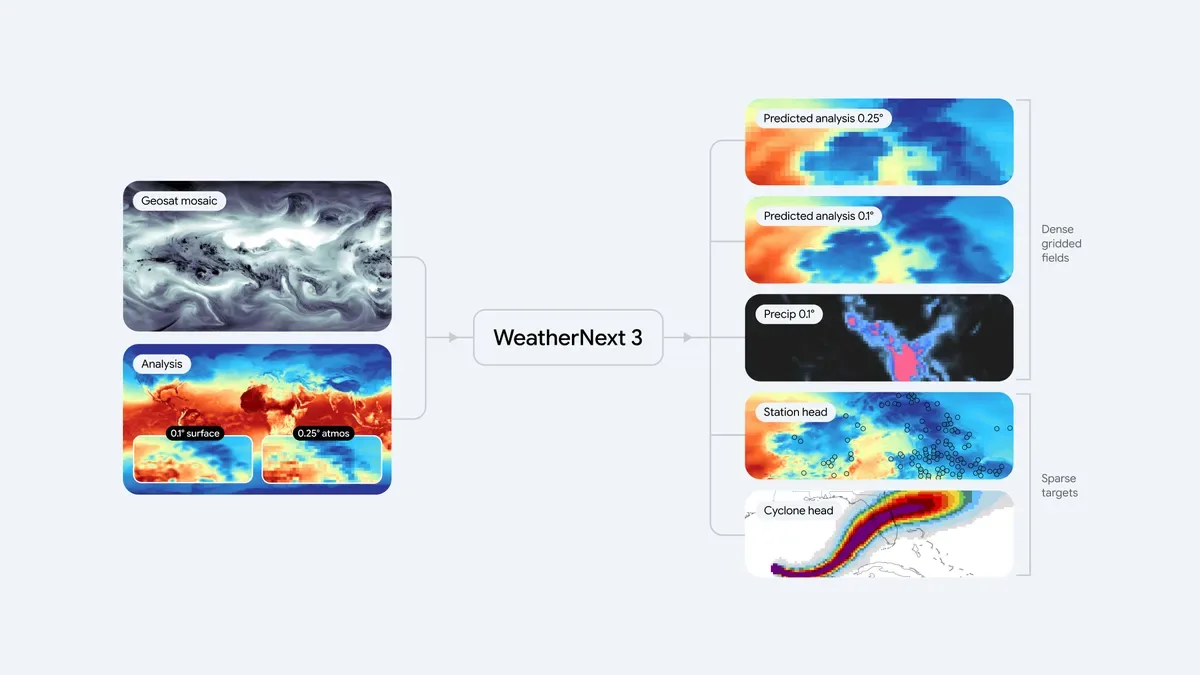
WeatherNext 3 also significantly increases resolution. Forecast maps are divided into grid cells where each cell carries a value, with cell sizes varying by metric type: temperature and humidity use 5 km cells because these two metrics vary over just a few kilometers; other surface variables use 10 km cells; while wind and atmospheric variables use 25 km cells.
Compared to WeatherNext 2, which plotted all metrics on a single 25 km grid on a 6-hour cycle, the global weather picture is now about 5 times sharper. The model also learns directly from observational data from scattered weather stations, allowing forecasts to account for local terrain: coastal areas, valleys, and mountainous regions.
For precipitation, where physical simulations often produce blurry results, WeatherNext 3 was trained on two high-quality data sources: NASA’s IMERG and a global precipitation analysis dataset built by Google itself from satellite radar. According to figures released by Google, the CRPS score—a measure of probabilistic forecast quality—improved by up to 60% compared to IMERG, 30% compared to MRMS, and 10% compared to station-measured rainfall at early lead times. In user-facing products, users will see precipitation forecasts that are up to 50% more accurate when planning a day or more in advance.
Two other user groups are also noteworthy. For renewable energy, the model forecasts wind speed at a height of 100 meters—close to the hub height of wind turbines—along with cloud cover and solar irradiance so solar farms can estimate output. For regions that have historically lacked high-resolution forecasts due to supercomputing costs, such as Latin America, Africa, and Asia-Pacific, this marks the first time a global model delivers this level of detail without requiring a supercomputer.
Regarding deployment, WeatherNext 3 began rolling out in Google Search, the Gemini app, Google Maps, the Maps Platform Weather API, and Google Earth Engine starting on its launch day. Forecast data can be queried via BigQuery, Earth Engine, or downloaded from Google Cloud Storage.
This is one of the clearest and most practical applications of AI in daily life. Instead of just looking at weather forecasts, we can now directly ask AI about the weather conditions in specific areas.