On October 19, artificial intelligence startup MiniMax officially unveiled its new multimodal model called M3.1 Flash, confirming it as the finalized version of the anonymous test model Space Bunny, which had topped multiple community leaderboards while serving more than 200 trillion tokens. Accompanying the model is M-Code (MiniMax Code), a command-line agent that runs directly in the terminal to address challenges in cost and control during automated programming.
According to plans shared by the company, all model weights for M3.1 Flash will be released as open source on the Hugging Face platform on October 23.
Breakthroughs in Cost and Inference Speed for Agents
Unlike model upgrades that focus solely on boosting benchmark scores, MiniMax positions M3.1 Flash as a solution that restructures the economics of AI agents. Compared to the previous M3 version, M3.1 Flash has been optimized to cut operating costs down to one-third, while boosting response speed by 3 times.
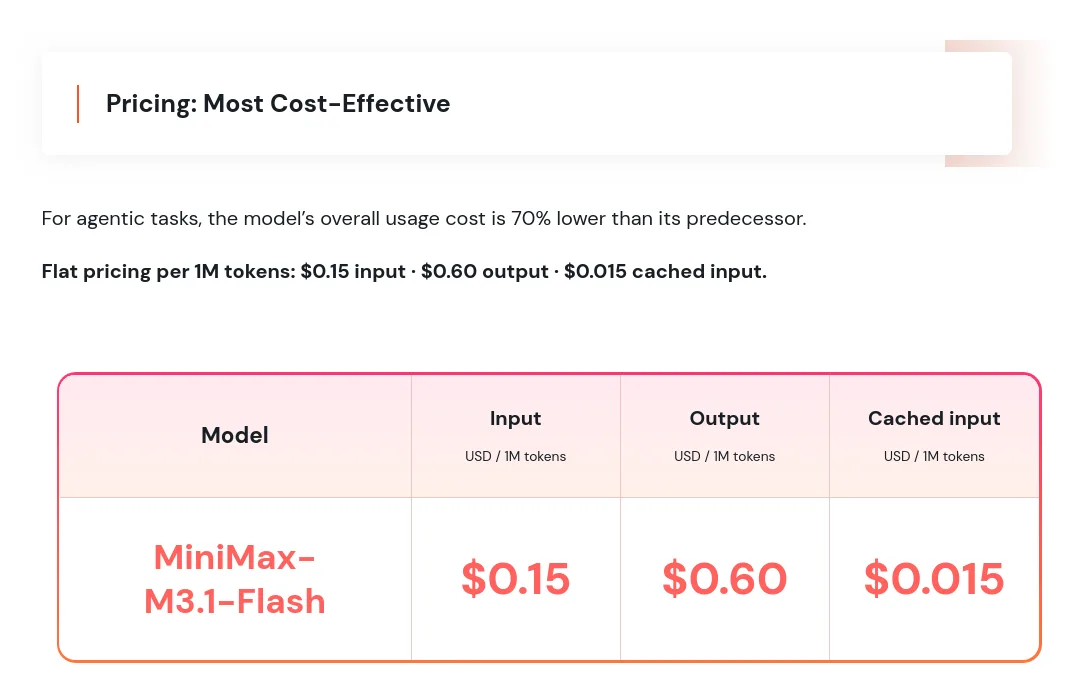
The model’s application programming interface (API) pricing is listed at a fixed rate: $0.15 per 1 million input tokens and $0.60 per 1 million output tokens. Notably, cache reads cost just $0.015 per 1 million tokens, representing a 90% reduction compared to standard input pricing. This pricing structure enables the execution of long task chains and repeated code testing cycles without excessively inflating operational budgets.
Technically, M3.1 Flash supports a context window of up to 1 million tokens, enabling it to ingest entire codebase project structures or massive technical documents within a single session. The model also allows developers to flexibly adjust thinking depth from low to maximum mid-session, offering a versatile trade-off between response latency and analytical depth depending on the specific task step.
Benchmark Performance and Real-World Debugging Tests
Across standard benchmark datasets, MiniMax reported that M3.1 Flash achieved top-tier performance milestones in the lightweight model class: an agentic automation score of 62% on Automation-Bench and 30% on the ALE test; software engineering bug-fixing capabilities of 74% on DeepSWE; and visual reasoning of 91% on BabyVision.
Independent empirical evaluations by MindStudio on early previews of the model and the M-Code tool also demonstrated notable real-world results:
-
Complex system debugging: In a test locating a hidden bug within a legacy DB2 database query involving 6-table joins—where an exchange-rate date boundary calculation error only occurred on rare days of the year—M3.1 Flash identified the flaw almost instantly and perfectly matched the standard fix.
-
Conflicting multimodal decision-making: When acting as a drone navigation controller based on a single camera frame paired with conflicting signals (battery down to 18%, power lines across the path, and a person waving an alarm), the model accurately analyzed safety priority protocols, decided to make an emergency landing at a designated pad instead of proceeding, and outputted precise JSON data.
-
Automated product generation: In a task creating a 3D game from scratch using Blender scripts and the Godot engine, the agent completed the entire codebase for movement, jumping, and obstacle mechanics in 30 minutes without user intervention, although the camera angle still required manual adjustments to polish the experience.
The M-Code Command-Line Agent and Developer Intervention
A key highlight of this release is the M-Code command-line tool. Operating directly from the terminal rather than a browser interface or an integrated development environment extension, M-Code provides a multi-step execution mechanism that includes creating files, running test commands autonomously, and verifying results.
Unlike many coding agents that fall into endless execution loops when encountering errors, M-Code supports a pause mid-task feature. This capability enables engineers to directly intervene, review the logs of completed steps without sifting through complex record files, and adjust the approach before letting the system resume.
The combination of a low-cost, high-speed model and a command-line tool offering execution flow control shows that MiniMax is shifting its focus toward the practical utility of agents in everyday workflows. When the weights are released on October 23, the open-source community will have another compelling option to self-host and build production-grade agent systems.