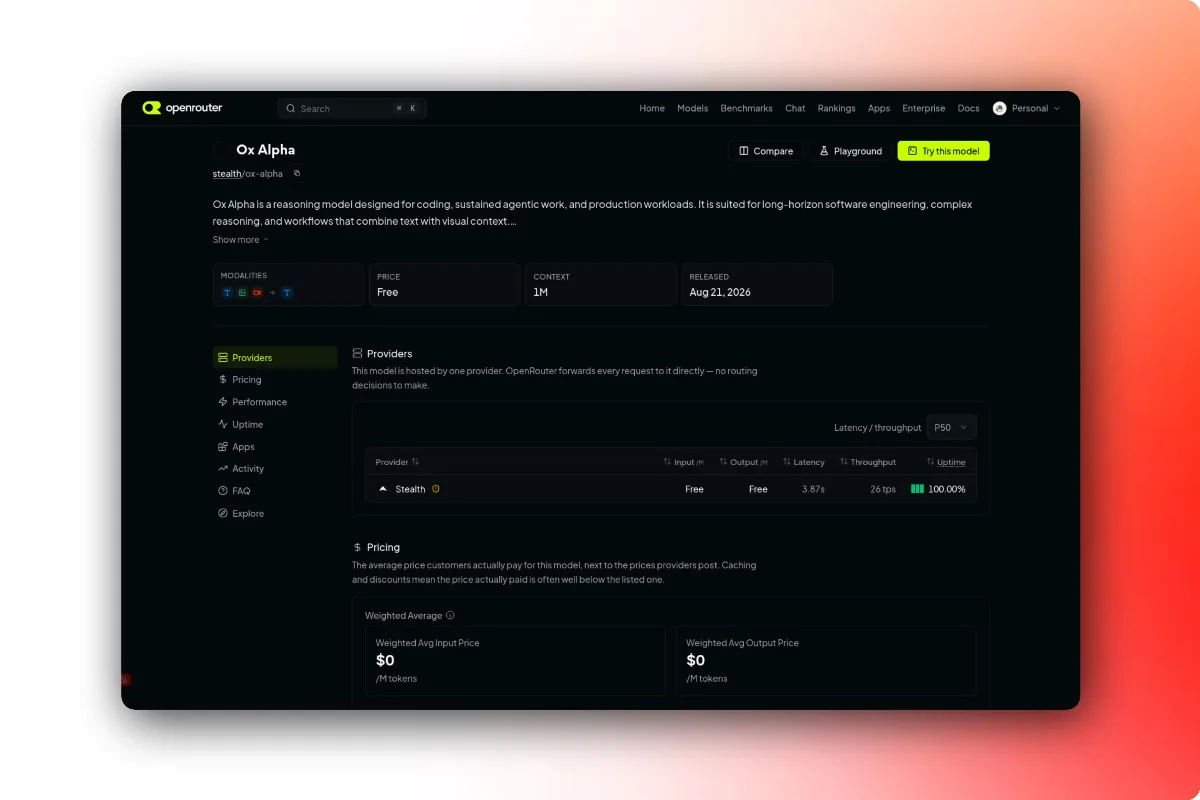
On August 20, a model named Ox Alpha surfaced on OpenRouter as a stealth model—a model developed and operated by an anonymous third party without publicly disclosing its identity. OpenRouter serves solely to route requests and maintains that it neither developed nor owns the model.
This is not the first time OpenRouter has hosted such a release. Stealth models are typically new offerings from major labs deployed under codenames—previous instances include Owl Alpha and Quasar Alpha—to undergo real-world testing prior to an official announcement. The goal is to gauge performance, gather community feedback, and, in most cases, log both prompt and response data to fine-tune the model. Consequently, it is a playground far better suited for side projects than for serious production workloads.
In terms of positioning, Ox Alpha is a reasoning model targeted at coding, long-horizon agentic tasks, and production workloads, making it well suited for extended software engineering and workflows that blend text with visual context. It accepts text, images, and video as inputs and returns text, boasting a context window of up to 1,048,576 tokens (roughly 1 million) and a maximum output of 131,072 tokens. On the integration side, it supports tool calling and structured JSON output via response_format, although it currently lacks a schema enforcement mechanism.
The most striking aspect is its cost: Ox Alpha is currently offered for free, for both inputs and outputs. OpenCode reported that the model is available on OpenCode Go with virtually unlimited usage over the next 6 days without counting toward Go quotas, announcing a serving capacity of up to 100 trillion tokens per day—averaging roughly 1.16 billion tokens per second. This massive scale of compute raises an obvious question: where does an anonymous entity source such vast resources?
Regarding performance, comprehensive independent benchmarks are not yet available, but initial community testing is stirring debate. According to reports from several testers, Ox Alpha scored over 80% across 10 DeepSWE tasks—where a community comparison noted Claude Fable scored around 65% and GPT-5.6 Sol around 52%—alongside roughly 87.5% across 80 Kingbench tasks. The model has drawn praise for agentic coding, long-horizon software engineering, and multimodal tasks. It should be noted that these figures are self-reported community results and have not been independently verified.
Data handling, however, calls for careful scrutiny. OpenCode advertises Zero Data Retention, yet OpenRouter’s Stealth Model terms explicitly state that prompts and completions are retained by the provider, only exempt from being used for training. Meanwhile, the general description of stealth models suggests a primary objective is collecting prompts and responses for pre-release fine-tuning. Because these three points do not fully align, enterprise users should verify the details thoroughly before relying on any “zero data retention” claims.
On paper, the metrics look relatively solid: OpenRouter recorded speeds of 25 tokens per second, a latency of 3.85 seconds, and 99.40% uptime over three days. User feedback, however, suggests the infrastructure is straining: some users have complained of lag, dropped connections mid-stream, real-world speeds lingering around just 20 tokens per second, and occasional instances where the model stalled mid-task without completing.
In terms of early adoption, the list of applications routing the most traffic to Ox Alpha on OpenRouter is led by Nous Research’s Hermes Agent with around 276 billion tokens, followed by omp, Claude Code, and DeepSeek Harness—all coding and agent tools capitalizing on the free window to run heavy workloads.
What the community wants to know most is the model’s true identity. OpenCode has not disclosed which lab is behind it, but several researchers have conducted technical cross-checks, and the most widely cited candidate is Zhipu AI / Z.ai, the lab behind the GLM family. Identified similarities include a tokenizer that matches GLM-5.3 across numerous test strings, API parameters and default configurations identical to GLM-5.3, a video encoder fingerprint aligned with GLM-5V-Turbo, and support for video without audio that mirrors GLM-5V. Some observers estimate the probability of Ox Alpha being a new internal model from Z.ai at roughly 90%. Other conjectures have pointed to Kimi (Moonshot), MiMo (Xiaomi), or Ilya Sutskever’s SSI. All of this remains purely speculative, with no official confirmation from any lab.
Overall, this is both a classic free preview strategy—offering a model for free for a week under anonymity to stress-test capacity and attract the agentic developer community—and an intriguing puzzle regarding compute: an unnamed lab serving hundreds of trillions of tokens daily clearly possesses substantial infrastructure. If early benchmark figures hold up, this could stand as one of the most notable previews in recent memory; nonetheless, confirmation will have to wait for independent benchmarks and official announcements. The model can currently be tested via the ID stealth/ox-alpha on OpenRouter or directly within OpenCode.