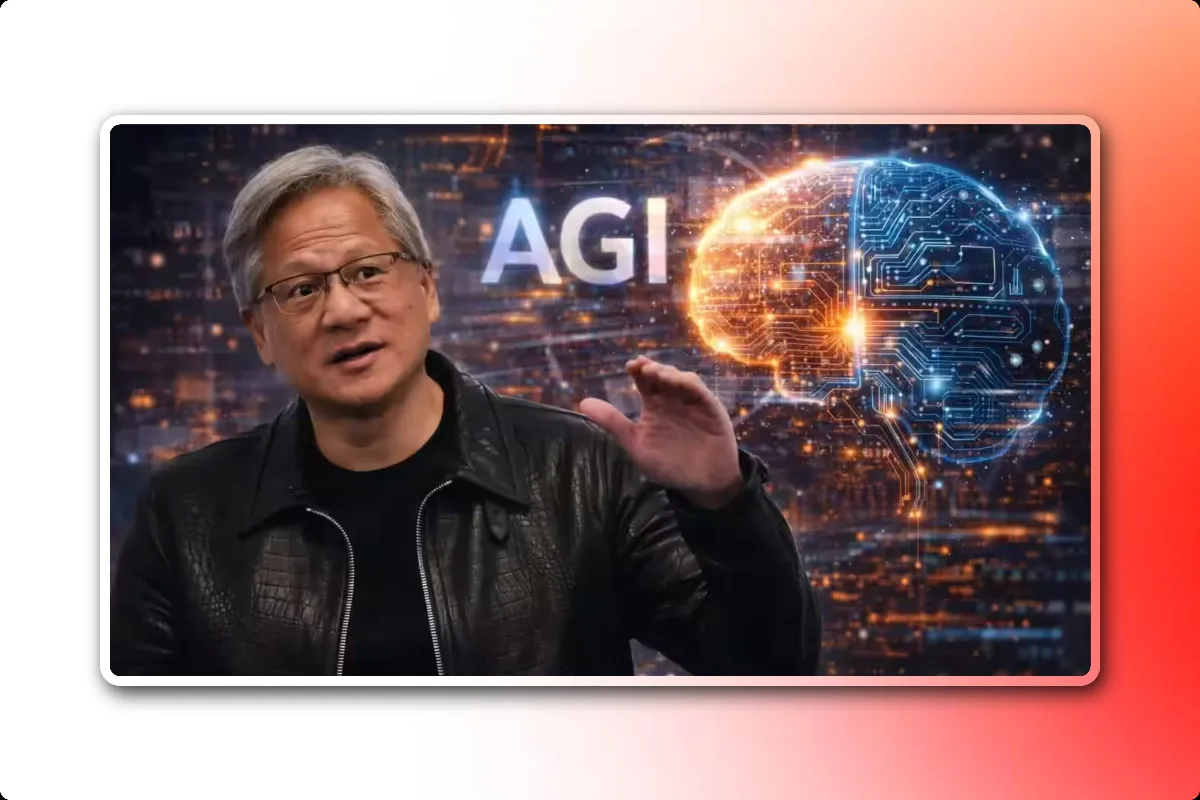
On Sunday afternoon, September 6, US time, Nvidia CEO Jensen Huang posted congratulations on X to OpenAI on the successful launch of GPT 6 Astra, the latest and most powerful model in AI today. According to him, over the past 4 years, AI has developed at an extremely rapid pace, from ChatGPT to o1, and with the arrival of Astra, the race to AGI is over. He also made sure to mention that Astra was trained on Nvidia chips, adding that another 400,000 GPUs are about to go online.
This statement echoes OpenAI’s own tone. The company launched GPT-6 Astra on Thursday, calling it the “smartest and most aligned model in the world,” capable of taking on the “hardest professional work with superior speed, accuracy, and judgment.” At the launch press conference, President Greg Brockman said, “Welcome to the AGI era,” predicting that people will look back and see that AGI was born “around this time, quite possibly with this very model.” He concluded: “For me, I think we are there.” OpenAI defines AGI as highly autonomous systems that outperform humans at most economically valuable work.
However, Huang’s statement immediately drew mixed reactions. Researcher Gary Marcus argued that Huang provided “no evidence and no definition,” and that it felt like an “attempt to seize a scientific question by corporate fiat.”
Marcus compared it to the 10-point definition of AGI proposed by him and several other researchers, including Yoshua Bengio, noting that Astra only meets one or two items on it. He also pointed out a notable detail: Huang had declared a similar victory about six months ago, before Astra was even released, with an older model.
Publicly available benchmark evidence tells a more modest story than the Nvidia leader’s claim. On ARC-AGI-3, a benchmark operated by the non-profit ARC Prize, Astra scored 62.7% under the standardized evaluation setup for all model makers, but reached 99.9% in an evaluation setup where the model is allowed to use its own memory management tools.
Same weights, same problem set, yet a 37-percentage-point difference simply due to how the model is allowed to remember its own work. ARC Prize emphasized that the two measurement methods answer two different questions, and that maxing out the benchmark is not proof of AGI.
François Chollet, creator of ARC, also confirmed on X that his team has never claimed that solving ARC 3 is synonymous with AGI. From a practical usage perspective, some early users have noted that Astra is not significantly better than Fable 5.1 in their day-to-day work. Even Sam Altman once called AGI “a very poorly defined term,” even close to “an irrelevant marketing term.”
From a personal perspective, Jensen Huang’s statement comes from the party that benefits most directly when the world believes in AGI. Nvidia sells chips to virtually every leading AI lab, with latest quarterly revenue reaching $96.2 billion, doubling from the same period last year, of which the data center segment accounted for $89 billion. OpenAI calls Nvidia its “underlying infrastructure.” When the gasoline vendor says the race is over and 400,000 GPUs are on the way, it should be taken with a healthy dose of skepticism.
For users, the question “Has AGI arrived?” is not the most useful one. A more practical question is: What can this model actually do for your work? How does its pricing compare to existing alternatives? And how reliable is it? Currently available independent data shows that Astra is a genuine step forward, but it is a step along a familiar incline, not the quantum leap that the term AGI suggests. When AGI truly arrives, we will not need to squint at results, nor will we need someone to declare it official.