Based on an independent calculation model, a report from SemiAnalysis indicates that Claude’s (Anthropic) $200 plan achieves roughly 5 times higher equivalent API value than OpenAI’s tier in the same price bracket for medium-volume workloads. It should be noted that this is a third-party assessment rather than official specifications released by the companies.
What happened on both sides?
Although OpenAI and Anthropic employ similar pricing structures—with $100 and $200 plans offering 5 and 20 times the usage allowances of their Pro plans, respectively—recent moves by the two companies have created a stark divide in real-world value:
- OpenAI: Cut the equivalent value and usage quota of its $200 plan in half, while introducing a new $500 Pro tier to meet the demanding requirements of power users.
- Anthropic: Raised Opus rate limits by roughly 20% on the Max tier and 50% on the Pro tier, allowing users to maximize task volume without increasing monthly costs.
This strategic divergence has made Anthropic’s $200 plan deliver roughly 5 times higher equivalent API value than OpenAI’s equivalent tier on average workloads. This makes Anthropic’s subscription a far more economical option for developers and high-density enterprise users.
Brutal unit economics
For Anthropic, offering a $200 subscription running the Opus 5.5 model exposes the company to extreme financial risk: gross margins can plunge to a record negative of -369% when users fully max out their allowed quotas (by comparison, the Fable 5.1 model maintains a modest positive margin of 1%).
Conversely, if users consume only about 20% of their allocated allowance, the financial picture becomes significantly brighter, with gross margins reaching 6% for Opus 5.5 and jumping to 80% for Fable 5.1.
This wide discrepancy means the question of “which plan is more cost-effective” cannot be resolved with a single fixed figure, as actual economic viability depends entirely on each user’s utilization rate.
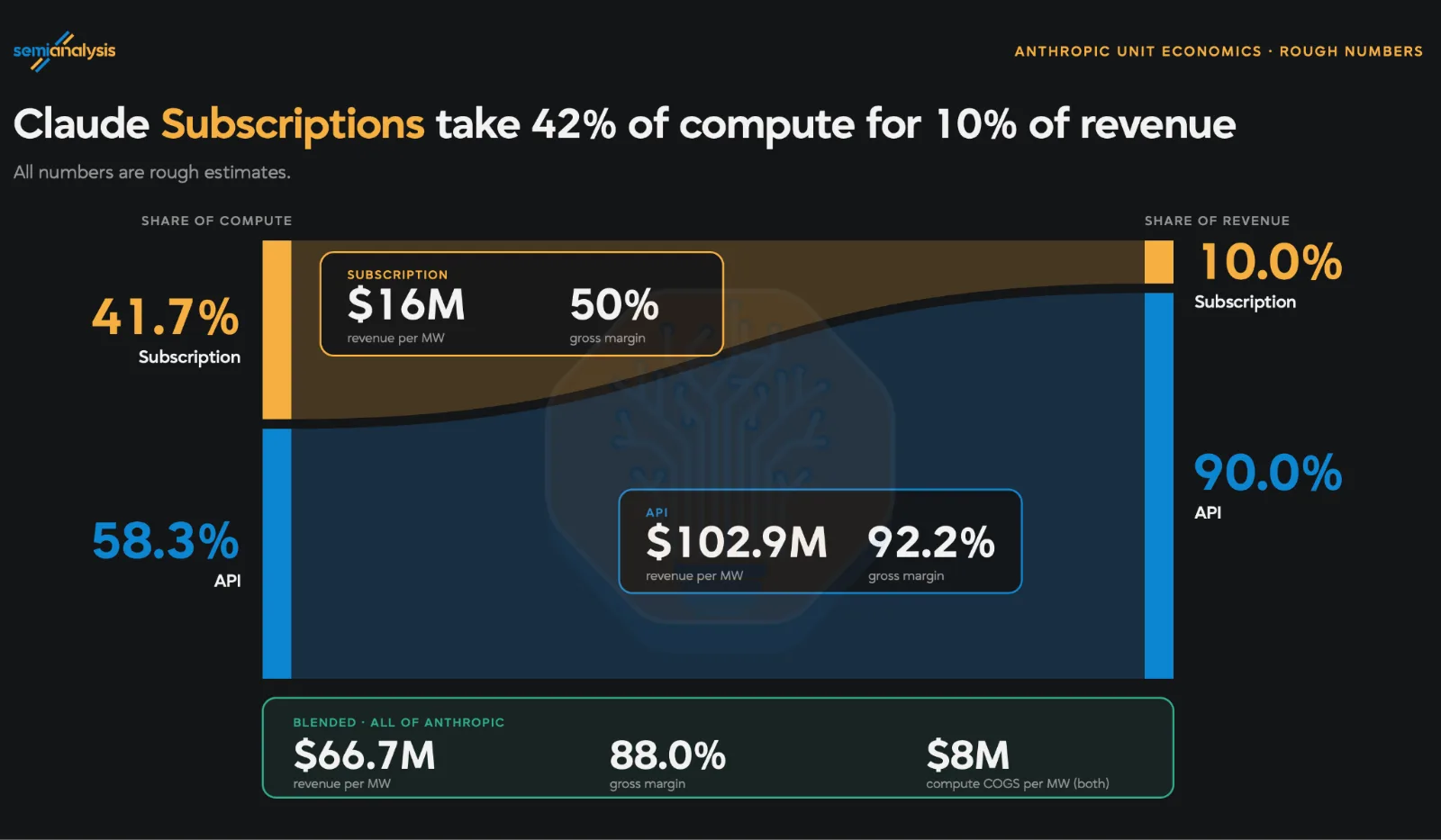
On a macro level, the financial impact is even more visible. Despite accounting for just 10% of total revenue, subscription tiers can consume more than 40% of inference compute capacity, driving an estimated blended revenue loss of roughly $36 million per megawatt for Anthropic.
Perspectives to keep in mind
First, the report emphasizes that the true value of a subscription cannot be assessed in isolation; it is always tied to a triad of factors: tier type, model used, and specific workload. The conversion rate from subscription tokens to API pricing is purely an estimate calculated by SemiAnalysis and depends on their chosen benchmark models.
Furthermore, the broader landscape reveals mixed signals. Just as the subscription is being hailed as a “bargain,” reports suggest that Meta and Microsoft are scaling back their deployment of Claude for internal teams. This reflects the reality that enterprise-level adoption decisions involve far more intricate considerations than cost alone.
Ultimately, the real-world validity of this 5x comparison will hinge on OpenAI’s next moves, such as whether it restores previous allowances to the $200 tier or adjusts policies around its newly launched $500 tier.