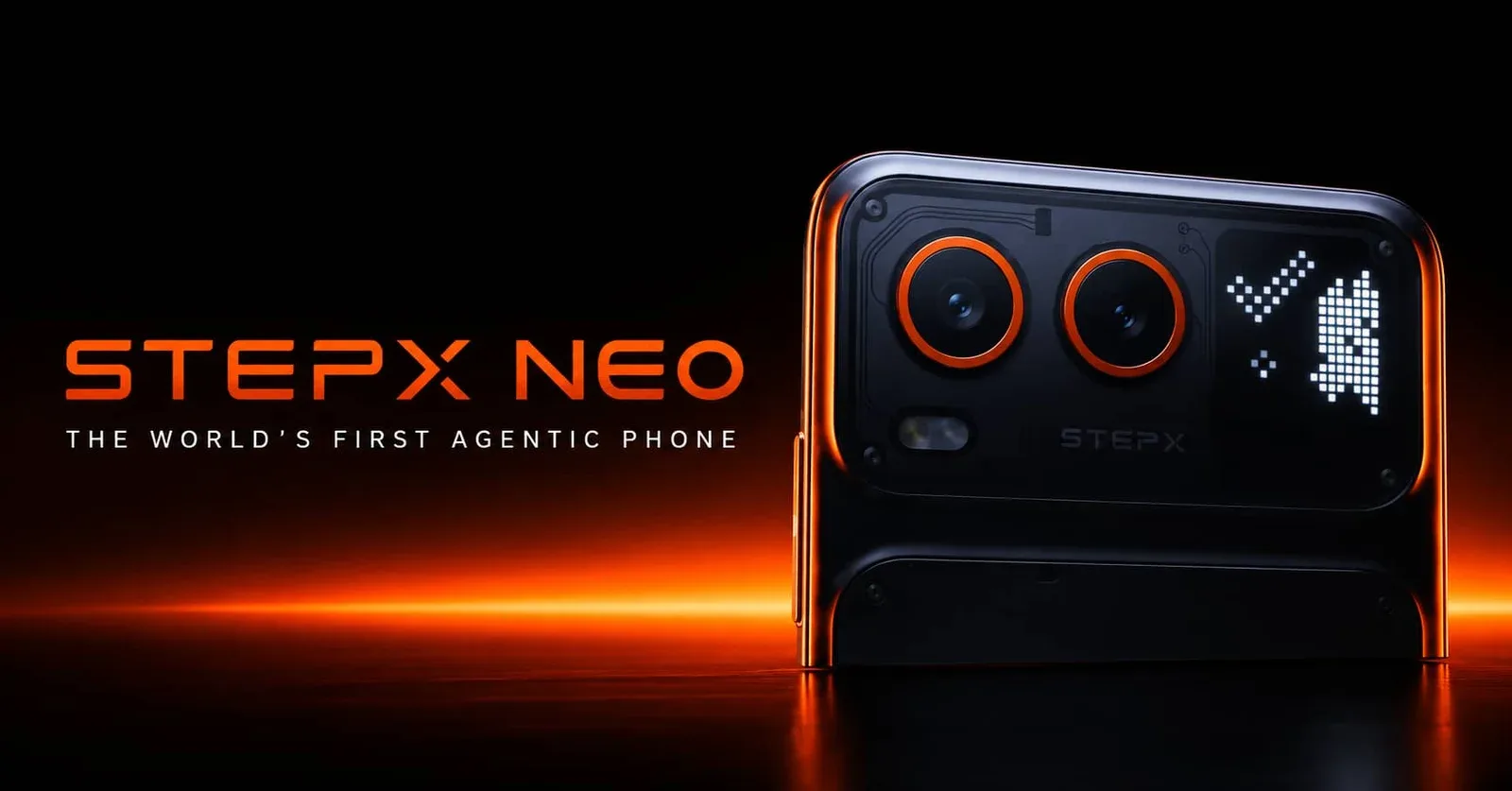
On October 13, StepFun, a Tencent-backed Chinese artificial intelligence startup, officially unveiled the STEPX Neo smartphone. The core highlight of the device lies in integrating an AI agent directly into the phone’s operating system, rather than running it as a standalone app installed on top. The phone is available for pre-order at 3,999 yuan (around 560 USD) on e-commerce platforms such as JD.com, Tmall, and Douyin, ahead of its first official sale on October 16.
The retail price of the device includes 12 months of the STEPX Token Plan service package with a quota of 100 billion tokens per month. StepFun, founded in 2023 by former Microsoft Vice President Jiang Daxin, asserts that in the agent era, AI is no longer merely a supplementary feature but has become the core product shaping the entire hardware.
Embedding the agent at the platform layer to avoid simulation errors
Most smartphones labeled as AI phones today merely install an intelligent chatbot (such as Siri on iOS or Gemini on Android) that overlays the application layer. When users assign these assistants a complex series of tasks across multiple applications, the system often has to read the screen and simulate finger-tap gestures. This approach is highly prone to breaking when software interfaces change button positions, and it was previously blocked from access by Chinese super-apps in December 2025.
To overcome this hurdle, StepFun developed the Step AOS 1.0 operating system, combining components of Android, Linux, and a real-time operating system. At the heart of this system lies an agent named Amoo, embedded directly at the platform layer. Instead of opening ride-hailing apps individually, entering addresses, and selecting vehicle types, users only need to provide a voice or text command, leaving Amoo to handle the remaining steps.
The Step AOS operating system breaks down features such as sending messages, opening apps, managing files, and adjusting settings into independent command blocks. The Amoo agent connects to and calls these blocks via the Model Context Protocol (MCP) standard, an open protocol developed by Anthropic to link AI models with external tools. By communicating through this standard, the agent can trigger services directly without needing to read screens or simulate finger taps.
Hybrid processing architecture and dual independent memory mechanism
To ensure performance and battery conservation, StepFun adopts a split-processing architecture between the device and cloud servers. Simple commands such as setting alarms or looking up contacts are assigned to a small model running locally on the device, with some tasks functioning normally even without an internet connection. Conversely, complex requests requiring coordination across multiple partner applications are sent to a cloud-based large language model, epitomized by the Step 5 Preview model featuring a total of 600 billion parameters and a 1 million token context window.
On the front, the device maintains two distinct spaces: a familiar app grid and a dedicated area for the agent, ensuring users are not forced to perform everything through AI. In terms of memory capabilities, Amoo operates with two separate storage systems: one dedicated to storing personal facts, habits, and lifestyle preferences of the owner; the second storing execution experience accumulated by the agent after each completed task.
Hardware customized for the agent and detailed technical specifications
Alongside the Step AOS software platform, the STEPX Neo features multiple hardware details custom-designed to support the continuous interaction needs of the agent:
-
Hearing enhancement system: The device is equipped with an array of 6 recording microphones (the highest on any commercial smartphone to date), combined with an independent low-power audio sensor chip and the Whisper 1.0 sound pickup algorithm. The system achieves a signal-to-noise ratio (SNR) of 70 dB and an acoustic overload point (AOP) of 130 dB SPL, enabling accurate voice recognition in noisy environments. Thanks to the auxiliary chip operating separately from the main processor, listening for voice commands in the background 24/7 consumes only about 1.2% battery per day.
-
Dedicated AI physical button: Located on the side of the device, it allows a single light tap to wake up conversations with Amoo or a long press for continuous voice command input.
-
Dot-matrix MiniLED secondary display: Positioned independently on the back, it serves as an “emotional window” displaying Amoo’s real-time operating status (awake, thinking, or calling execution tools), while supporting user customization of displayed text and graphics. The back adopts a “retro-futuristic” design language with transparent glass embedding 5 hidden details symbolizing AI history: the number 42, the code string “user_potential”, the binary code of the Turing test, the Deep Blue chessboard, and the Transformer architecture diagram.
Regarding overall hardware specifications, the STEPX Neo is powered by the Snapdragon 8 Gen 5 processor, paired with 16 GB RAM and 256 GB of internal storage. The main display is a flat 6.36-inch OLED panel with 1.5K resolution (2670 x 1200 pixels), a 120 Hz refresh rate, and an integrated 3D ultrasonic fingerprint sensor.
The optical system comprises a 50 MP main camera (1/1.55-inch OmniVision OV50E40 sensor with optical image stabilization OIS), an 8 MP ultra-wide-angle camera (OmniVision OV08F10), and a 32 MP front camera. Supplying power to the device is a 6,145 mAh battery (with some real-world tests recording 6,260 mAh) supporting 80W wired fast charging.
Although running the Step AOS 1.0 operating system, the device remains backward compatible with Android 16 and comes with the built-in Step Studio development toolkit, enabling users to create agents or new skills using natural language.
Wide partner network, but cost questions remain unresolved
StepFun stated that nearly 100 major partners and products in China have integrated into Amoo’s ecosystem, including Alipay, Tencent, Ctrip, Didi, and Meituan. However, sensitive operations involving financial payments, hotel bookings, or content creation are still completed within the platforms of those respective partners. The device is programmed to pause and seek user confirmation during high-risk steps, such as approving payments or deleting data.
Nonetheless, the release of the STEPX Neo leaves multiple questions unanswered. Foremost is the ongoing cost: StepFun has yet to announce the price users must pay after the free 12-month package of 100 billion tokens per month expires. In addition, the MCP connection standard faced several security warnings regarding tool poisoning risks in 2026, where a malicious application could embed hidden instructions to hijack control of an agent. Furthermore, the Step AOS operating system currently lacks an independent security audit report from a third party.
Additionally, the device currently supports only domestic services within the Chinese market. Embedding the agent deep within the operating system layer enhances response speed and service invocation stability, but it also grants AI direct access to personal messages, finances, and location data. The trade-off between automated convenience and control over private data will serve as the greatest test for StepFun as this phone reaches everyday consumers.