Typesafe AI has launched Jev—the first model in its “System One Models” lineup. Instead of generating token-by-token text as usual, this model directly outputs structured decisions accompanied by probabilities and confidence scores. The project is led by Diego Almeida, a former OpenAI employee who departed after 4 years and co-authored the RLHF methodology that laid the groundwork for ChatGPT, now pursuing a new research direction.
Why Not Use Chatbots for Automation?
With language models having surpassed humans in conversation for years, Almeida wondered: “Why hasn’t automation arrived yet?”. According to his analysis, RLHF—the process that optimizes LLMs for communicating with users—is the very root of inherent limitations: overconfidence, instability, and the risk of hallucination. These exact shortcomings make human supervision necessary, rendering the integration of LLMs into fully autonomous systems impossible.
To address this issue at its root, Jev was developed along a new path. Rather than generating text strings and then parsing them into formatted data, Jev takes an input state and directly outputs a decision: a typed value accompanied by a probability and a confidence score. This advanced output structure completely prevents type errors, and Typesafe asserts that the model cannot hallucinate when executing structured tasks.
RLCD: A New Training Method
Rather than following the well-worn paths of RLHF (reinforcement learning from human feedback) or RLVR (reinforcement learning with verifiable rewards), Typesafe developed RLCD (Reinforcement Learning for Calibrated Decisions). This method aims to help the model accurately assess its level of confidence in each response, rather than merely producing answers that sound persuasive to human evaluators.
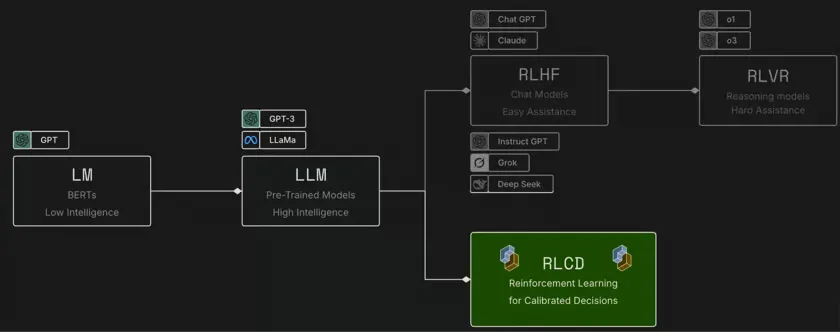
Notably, Almeida openly acknowledged that he once believed RLHF would be the key to unlocking AGI. However, his hands-on experience building ChatGPT helped him realize the inherent limits of that path. Instead of following the prevailing trend like other AI startups, the Typesafe founder deliberately pivoted to an entirely new approach.
How Much Faster, How Much Cheaper?
According to Typesafe’s announcement, the model achieves superior performance with processing speeds 193.6 times faster and costs 444.6 times more efficient than traditional LLMs on “System One” tasks. Jev’s latency ranges from just 70ms to 500ms, a stark contrast to the 3 to 329 seconds required by today’s leading frontier models.
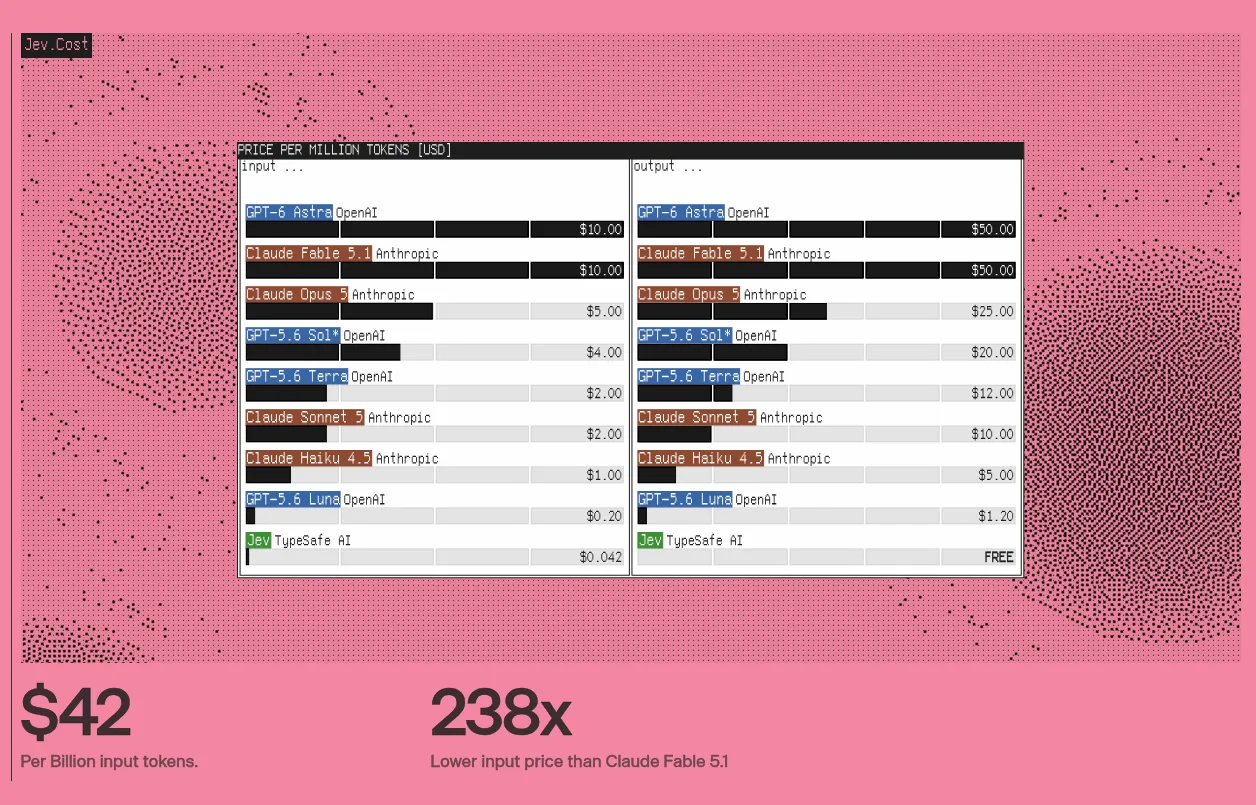
Regarding operating costs, input token pricing is listed at 0.042 USD per million tokens, more than 238 times cheaper than Claude Fable 5.1. Output tokens are provided completely free due to negligible overhead. For example, the Doom demo running at 10 queries per second for 2 minutes costs only about 7 USD per hour.
Experiments with Doom, Minecraft, and Wikiracing
Initial demonstrations focused on showcasing the model’s response speed and real-time reflexes. For the game Doom, Jev receives game state information as structured data and continuously makes decisions every 100 microseconds; as a result, the bot flexibly interacts with enemies and terrain without relying on hard-coded rules.
Similarly in Minecraft, the bot updates context (such as time of day, health points, or surrounding enemies) to query Jev for instructions; the model then chooses an appropriate course of action, such as automatically fleeing when encountering zombies, without anyone hardcoding this behavior.
Meanwhile, the Wikiracing experiment highlighted another strength: tackling problems with hundreds to thousands of candidate links at each step. Here, the combination of exceptional processing speed and the total elimination of hallucinations enables Jev to make accurate decisions across a complex search space without generating nonexistent links.
Who Is Jev For?
The Jev model is optimized for three primary application areas:
- Repetitive automation workflows: Well-suited for systems requiring continuous decisions and actions within pipelines, such as classification, routing, or data evaluation.
- Large-scale data processing: Highly effective for map-reduce-style parallel processing tasks.
- Real-time systems: Built for applications demanding ultra-low latency to maintain user experience.
Conversely, Jev is completely unsuitable for tasks that require open-ended content generation, such as chatbots, drafting text, or writing long codebases. Almeida emphasizes that deliberately omitting open-ended text generation is the key factor enabling Jev to achieve its extraordinary processing speed and high reliability.
Nevertheless, it is worth noting that all current tests with Jev have been conducted solely in simulated environments. Operating the model on real-world hardware—such as robots, autonomous vehicles, or drones with complex sensor suites and safety standards—remains an unsolved challenge. Although it has demonstrated rapid reflexes in controlled settings, a substantial gap remains before Jev can be deployed in the real world.
Placing Jev in a Broader Context
Unlike models such as GPT or Claude, Jev is engineered for a distinct purpose: rather than generating text responses, it focuses on making decisions. This core distinction matters far more than conventional benchmark scores, because most real-world automation tasks do not need a chatbot; they require a “fuzzy if-statement” that can operate reliably thousands of times per second.
The name Jev is inspired by William Stanley Jevons, the economist who observed that gains in steam engine efficiency did not decrease coal consumption, but instead caused it to skyrocket. Typesafe expects a similar phenomenon to unfold with AI costs: each time costs drop by an order of magnitude, countless new applications will be unlocked.
One aspect that warrants close attention is that Jev is currently only in early access. All performance and cost figures were released by Typesafe and have not undergone independent verification. Whether the model can maintain its speed and reliability when handling complex, asymmetric data or adversarial scenarios remains an open question for the developer community over time.