Right after Anthropic officially filed for an IPO under the ticker ANT with U.S. securities regulators, in-depth analyses of the S-1 prospectus dated October 27 revealed an unusual ownership structure at the AI lab. In contrast to traditional tech listings where venture capital funds hold substantial control, the single largest financial beneficiary of the offering is e-commerce and cloud computing giant Amazon.
The financial filing reveals a complex symbiotic relationship between foundation model developers and infrastructure providers, following large-scale server lease commitments like the $45 billion deal to rent Vera Rubin chips that stirred the market.
Convertible Note Value and Amazon’s Equity Stake
According to the S-1 filing, no prominent venture capital firms such as Menlo Ventures, Sequoia, or Spark Capital reached the 5% ownership threshold to appear on the list of major shareholders. With a private valuation reaching $965 billion, even Menlo’s position, valued at approximately $14 billion, accounts for only 1.5% of the company.
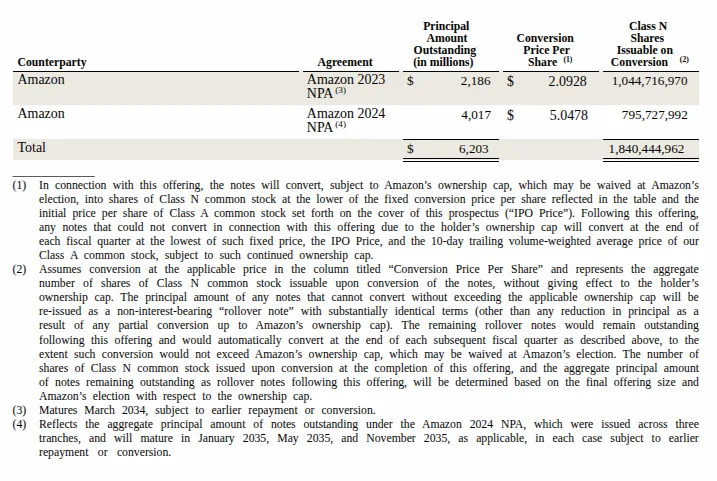
Instead, financial leverage is concentrated entirely among strategic partners. Amazon currently holds all of Anthropic’s debt obligations in the form of convertible notes with a principal value of $6.2 billion. Thanks to continually surging funding rounds, Amazon’s own Q2 report valued these notes at a fair value of $97.9 billion. This debt tranche can convert into up to 1.84 billion shares, although the contract specifies a partial dilution ownership cap of 12% that Amazon has the right to unilaterally waive. Combined with the recently purchased $10 billion in non-voting preferred shares, the total amount of money Amazon has poured into Anthropic reaches approximately $18 billion.
Cash Flowing Back into Cloud Infrastructure
Amazon’s economic benefits extend beyond its equity portfolio to direct service revenue. The prospectus reveals that Anthropic signed a binding agreement committing to spend at least $110 billion on the AWS platform over the next 10 years. This model of investment money flowing back into cloud infrastructure is also mirrored with Alphabet, as Google currently holds about a 5.6% stake and secured a $114 billion cloud services contract running through 2033.

This very structure explains why Anthropic’s accounting books showed a technical loss of up to $72.4 billion in the first half of 2026. This is entirely an accounting adjustment to the value of convertible debt under accrual accounting principles as the company’s valuation soared, rather than actual cash draining from the business.
Competitive Paradox and Multi-Tiered Governance Structure
Beyond the impressive financial figures, Anthropic’s risk disclosures also candidly acknowledge a dilemma: its largest cloud partners are the very competitors developing directly rival models. The profit-maximization goals of server providers are not always aligned with the lab’s mission of technological safety.
To hedge against the risk of takeover or policy control, Anthropic established an intricate public benefit corporation governance structure. The power to appoint a majority of the board of directors is granted to the Long-Term Benefit Trust (LTBT), while the 7 co-founders retain super-voting shares with 50.1% of voting power. This structure ensures that public shareholders and even strategic investors holding tens of billions of dollars like Amazon have virtually no ability to interfere in the company’s core development decisions.