Nieman Lab has documented more than 15 cases where ChatGPT attached the signatures of real The New Yorker cartoonists to AI-generated images without permission or compensation. The issue is not merely that the model mimics an artistic style, but that it attributes real people’s names to work that is not theirs.
A Viral Cartoon and an Illegitimate Signature in the Corner
A prime example began with an image that circulated widely on X, Facebook, Instagram, and Bluesky shortly after the deaths of two entertainment stars in late August. The most prominent post on X garnered around 25,000 likes. The cartoon depicted Dolly Parton in a glittering outfit standing next to Tim Curry (in character as Dr. Frank-N-Furter), telling God at heaven’s reception desk that she believed she had chosen the right companion.
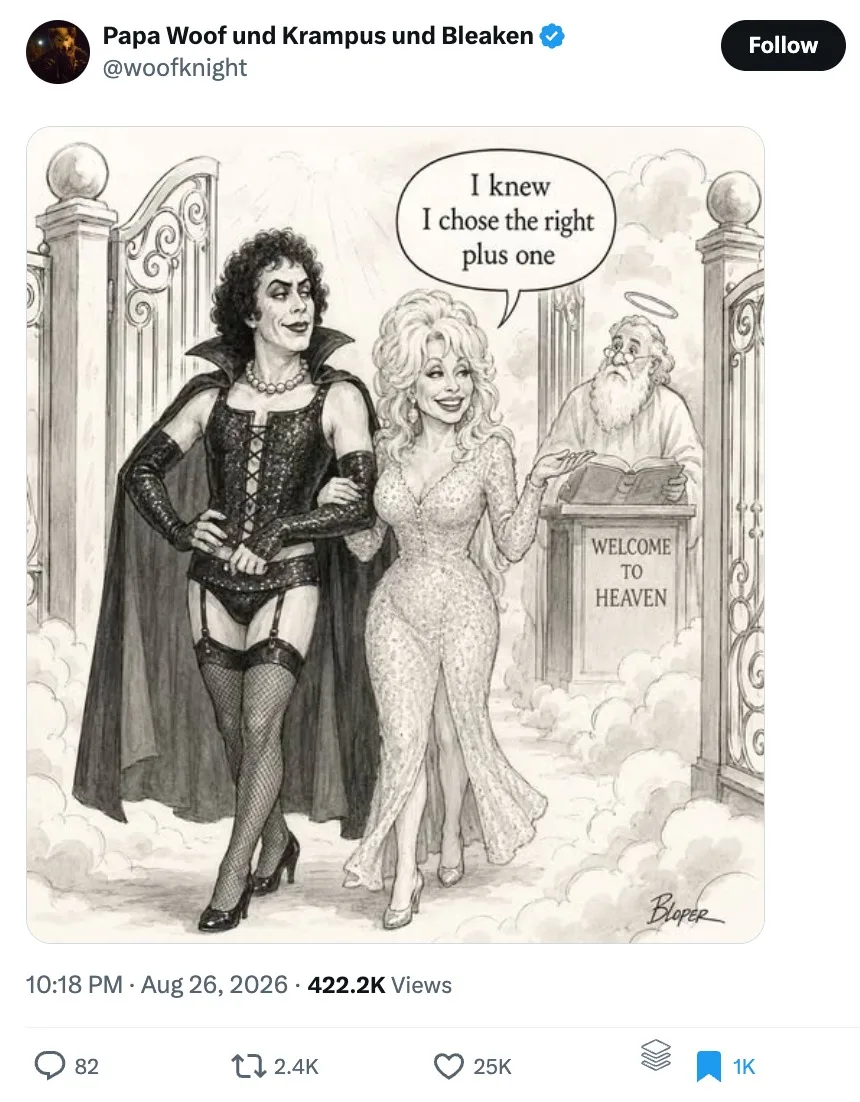
The notable detail appeared in the bottom right corner of the image: the pen name “BLOPER,” the signature mark of cartoonist Brendan Loper. However, Loper neither drew nor signed the piece. In reality, the cartoon was created by a Dolly Parton fan using ChatGPT simply by requesting a “New Yorker-style cartoon” and then sharing it on Facebook.
Loper said he began receiving messages asking whether the drawing was his, and the first person to reach out was his twin brother. “Very bizarre,” Loper said. This was not an isolated incident: earlier in May, a stranger on Instagram warned him that his signature was being automatically appended to images by the chatbot; by summer, he discovered more instances on Reddit.
While already aware that his work had likely been scraped to train AI models, Loper felt having his personal signature forged was far more invasive. “I’m not a squatter, but my name is my name,” he said. “It felt like a violation of me as a person.”
The Core Importance of a Signature
In an environment where cartoons are easily stripped of their context and shared across social networks and blogs, Loper noted that a signature serves as far more than just a credit line. It acts as an authentication mechanism, directly linking the artwork to its creator. “To me, it’s a seal of authenticity. I only sign pieces shared online when I truly want to stand behind them as something I made myself,” Loper emphasized.
The experience of Pat Byrnes illustrates the model’s remarkably detailed pattern recognition. Since his debut cartoon in The New Yorker in 1998 under the moniker “P.Byrnes,” he has used that signature across decades of his career. Ever since his teenage years, he has consistently added a period to the end of his signature. “It’s like signing off on a letter. It’s a note, a gift to the viewer,” Byrnes said. Notably, all of the more than ten ChatGPT-generated cartoons bearing Byrnes’s signature identified by Deck accurately reproduced that distinctive period.
Licensing Agreements and AI Training Mechanisms
Independent tests along with Nieman Lab’s reporting showed that numerous well-known cartoonists published in The New Yorker have had their names co-opted by the AI. The roster includes Harry Bliss, Emily Flake, Joe Dator, Pat Byrnes, Peter Vey, Jason Adam Katzenstein, George Booth, Liza Donnelly, Ellis Rosen, Saul Steinberg, and Warren Miller—whose work dates back to the 1960s.
Looking at legal and contractual considerations:
- Agreements with publishers: Although Condé Nast (parent company of The New Yorker) entered into a multi-year content licensing deal with OpenAI in 2024, magazine representatives stated that they have never granted permission to any AI developer to train models on cartoon artwork. The appearance of the magazine’s iconography on AI-generated images also falls outside any agreed terms.
- Artists’ ownership: Standard contributor contracts between The New Yorker and freelancers do not include clauses licensing AI training. The magazine purchases only first publication rights for commissioned works rather than forming an employer-employee relationship, leaving copyright ownership fully with the cartoonists.
- Training data sources: Court filings in the lawsuit between The New York Times and OpenAI showed that OpenAI systematically bypassed paywalls to scrape web content for ChatGPT. When asked to clarify how the model learned and reproduced individual signatures, an OpenAI spokesperson declined to comment.
Legal Challenges and New Precedents
From a legal standpoint, James Grimmelmann, a digital information law expert at Cornell Law School, observed that while signatures serve as evidence of authenticity, attribution plays only a minor role in fair use analysis. The primary hurdle is that ChatGPT rarely copies an entire specific work verbatim, instead largely mimicking an overall artistic style.
However, Grimmelmann noted that artists might bring claims under the right of publicity—state statutes designed to prevent unauthorized commercial exploitation of an individual’s name or likeness. Even so, plaintiffs would need to establish that the AI-generated images were used for commercial gain rather than mere personal entertainment. Deck stated that he found no evidence of these AI-generated cartoons being commercialized or sold.
The actual impact on artists’ livelihoods remains an open question. Last year, The Baltimore Sun laid off Kevin Kallaugher, a Pulitzer-nominated editorial cartoonist who had worked at the paper for over three decades. Soon after, the publication began routinely running AI-generated illustrations in its opinion section. Notably, OpenAI’s watermark detection tool confirmed that those images were produced using its technology.
In response to this trend, Marc Murphy, president of the Association of American Editorial Cartoonists, stated in an open letter published in September: “We strongly condemn the misuse of AI, as it is an infringement and theft of artists’ labor, a waste of natural resources, and a direct threat to the value of original creative thought.”
The critical question moving forward: After receiving inquiries, ChatGPT began displaying warnings stating that “this request may violate guidelines regarding generating content similar to third parties.” Nonetheless, at the time of publication, the system still occasionally automatically inserted the signatures of real magazine cartoonists onto some of its generated drawings.