Muse, Meta’s latest AI assistant, garnered more downloads and daily active users than ChatGPT during the same initial 12-day launch window on mobile. That is a new estimate from analytics firm Apptopia, published by TechCrunch on September 21. While the figures have not been confirmed by Meta, if they are even approximately accurate, it marks the first time a Meta AI application has been compared directly to ChatGPT right from the starting line.
Comparing the First 12 Days on iOS in the US and Canada
The two apps launched under different rollout strategies, so Apptopia attempted to balance the comparison by analyzing iOS data exclusively from the US and Canada for both. When ChatGPT arrived on mobile, it launched globally but only on iOS, whereas Muse launched across both the App Store and Google Play but was restricted to the US and Canada. Within the iOS dataset for these two markets, Muse reached 1.8 million downloads compared to 1.3 million for ChatGPT.
In terms of daily active users in the US, Muse recorded 642,000 compared to ChatGPT’s 231,000 at the corresponding point post-launch. Looking strictly at the iOS platform, Muse still came out ahead with 359,000 daily users. In total, Muse registered approximately 2.8 million global installs over its first 12 days.
These are third-party estimates: Apptopia does not have access to Meta’s internal metrics, and Meta declined to share official numbers. The figures should be treated as approximations—sufficient to identify a broader trend rather than to scrutinize individual digits.
Muse Surges to No. 1 on the US App Store
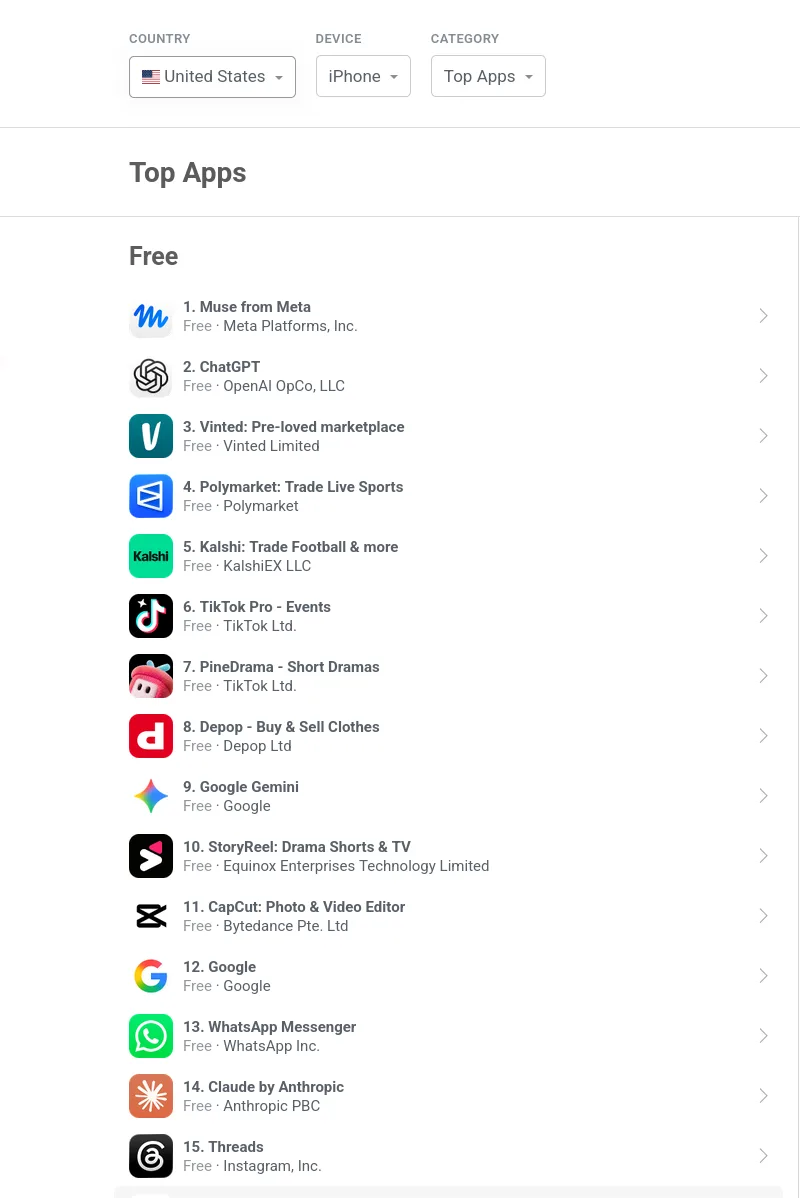
Muse debuted at No. 2 among free apps on the US App Store, and according to a report by Business Insider published on September 21, the app climbed to No. 1, outpacing ChatGPT. Earlier data from Appfigures showed Muse crossing the 1 million download threshold in its earliest days. User data indicates that more than 95% of Muse users are also Facebook users and 63% use Instagram, suggesting that Meta’s established distribution channels are effectively driving adoption.
Muse Is Meta’s Big Bet
Muse launched on September 11 as Meta’s first productivity-focused AI assistant: capable of connecting to Gmail to batch-delete emails, shopping on Amazon, and planning trips. A point of controversy from the outset has been the sheer volume of personal data Muse automatically surfaces, prompting The Verge to describe the experience as both useful and chilling. Prior to Muse, Meta primarily pursued AI centered around entertainment and social networking, making this its first direct wager on users’ everyday productivity routines.
Meta possesses a unique edge when it comes to accelerating reach. The company previously propelled Threads past the 500 million user mark through cross-promotional hooks on Instagram and Facebook. Because Muse comes natively integrated with WhatsApp, Facebook, and Instagram, it is highly likely to receive a similar push in the near future.
What the Numbers Don’t Reveal
Comparing the “first 12 days” evaluates starting points, not current positions. ChatGPT had already amassed a massive user base before arriving on mobile in 2022, whereas Muse entered a crowded market teeming with dozens of chatbots. A faster download pace in the opening phase does not automatically forecast strong retention. That remains an interpretation, not a proven outcome.
The real question is not who won the first 12 days, but what percentage of Muse users return by week three once the initial curiosity wears off. Apptopia and Appfigures have yet to publish user retention data, and that will be the decisive metric for Meta’s productivity gamble.