Meta has released Muse Spark 1.3, the newest model in the Muse family, focusing on improved performance in agentic tasks (agents autonomously carrying out long-horizon work) and coding. The model is available today in Muse Code and the Meta Model API; previous reasoning modes are accessible today, while max reasoning will arrive after completing additional safety checks.
Agentic strengths
Muse Spark 1.3 is designed to better sustain long-horizon work: when given open-ended goals, the model uses tools to autonomously build context from multiple complex sources, proactively fix flaws in its plans, and track what it has learned to produce the final output.
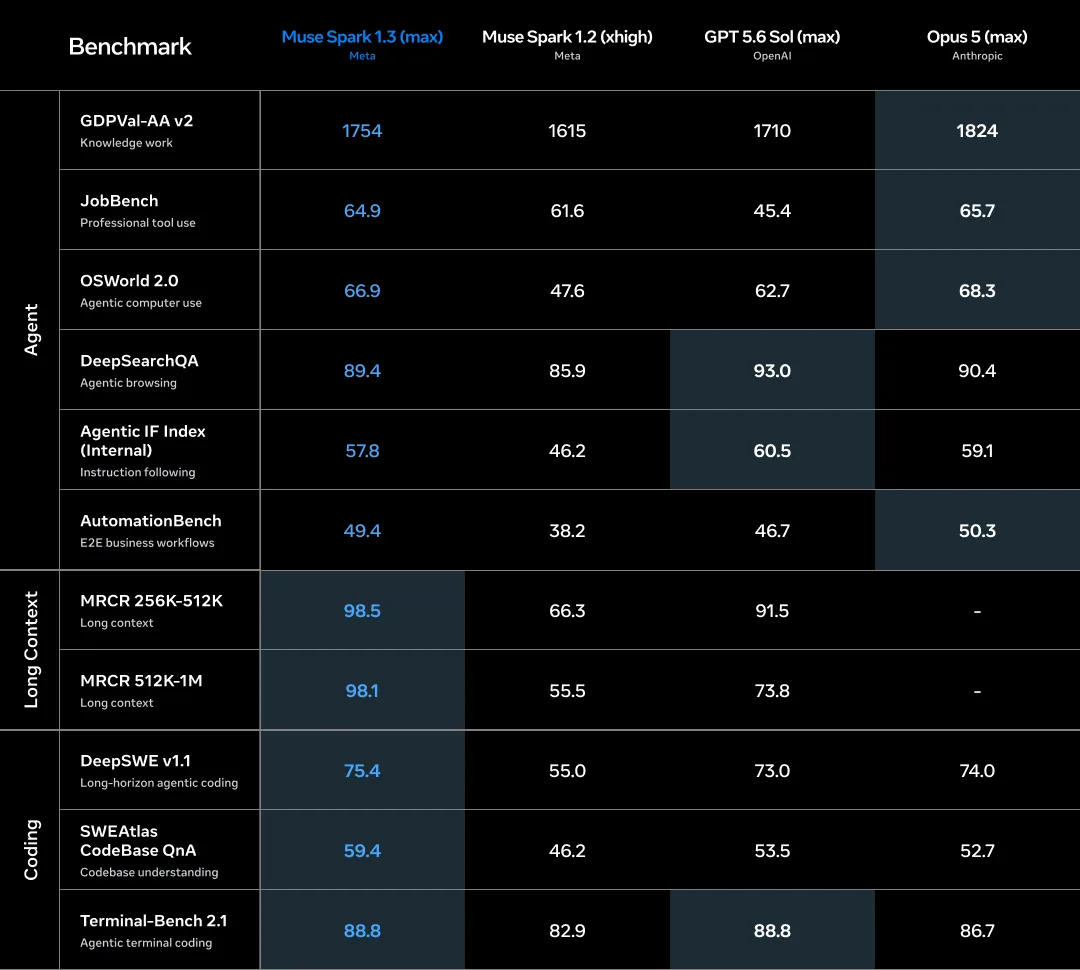
Muse Spark 1.3 also features enhanced collaboration capabilities: it can ask clarifying questions when prompts are ambiguous, request user assistance when stuck, seek confirmation before critical actions, and adapt to user preferences during extended tasks (such as providing regular updates or running quietly in the background). The model follows complex multi-step instructions more reliably, without dropping constraints or drifting off-process. Multitasking has also improved, accurately mapping prompts to the appropriate tasks within cluttered chat threads, even when interrupted by the user.
More efficient coding
Muse Spark 1.3 underwent additional training on long-horizon coding tasks, improving its usability in everyday engineering workflows. According to Meta’s internal comparisons against 1.2, the model uses ~20% fewer tool calls and ~25% fewer tokens—with fewer unnecessary loops, less verbosity, and a cleaner coding style.
Safety. The model exhibits improved robustness against adversarial attacks (adversarial inputs and prompt injections) and is better calibrated regarding what constitutes an irreversible action during complex agentic tasks.
According to independent data from Artificial Analysis published on September 2:
-
Muse Spark 1.3 (max): 62 points on the Artificial Analysis Intelligence Index, ranking #6/636, ahead of GPT-5.6 Sol (61), Grok 4.6 (60), Kimi K3 (60), GLM-5.3 (60), and Gemini 3.8 Flash (59); tied with Nemotron 3 Ultra (62); and behind Claude Opus 5 (63) and Fable 5.1 (66).
-
Muse Spark 1.3 (xhigh): 61 points, ranking #10/196, with a speed of 208.6 tokens/second (among the fastest in its class), a 1-million-token context window, and support for text, image, and video inputs.
-
xhigh pricing: $1.25 per million input tokens, $4.25 per million output tokens—significantly cheaper than the median for reasoning models in the same tier (output median of $10).
-
Meta has not disclosed the parameter count; the model is proprietary.
Meta stated that its upcoming roadmap includes larger models and an open-weights release of Muse Spark.