At DevDay 2026, OpenAI is relaunching an earlier experiment, but on a much larger scale: turning ChatGPT into a direct platform to discover, install, and experience applications instead of requiring users to search for and download them manually. According to TechCrunch, this move directly challenges the traditional App Store model of Apple and Google.
This new strategy is shaped by a trio of breakthrough features announced simultaneously:
- Sign in with ChatGPT: Allows users to connect and share their personal AI allowances with third-party applications.
- Expanding plugin architecture to support Extensions: Integrates flexible interactive controls, bringing software from native apps or browsers directly into the chat interface.
- Contextual app suggestions: ChatGPT proactively recommends relevant software solutions right in the conversation based on the task the user is performing.
OpenAI’s own app store
Although the initial scale of participation remains modest, the list is steadily expanding. The Sign in with ChatGPT feature officially launches with the first 16 partners, including Notion, Vercel, T3, OpenClaw, Dactyl, and Devin from Cognition, while OpenAI pledges to continue integrating new names. Similar to Apple’s App Review model, the review process for developers has also been optimized: allowing them to directly track progress, review bugs that need fixing, and respond directly to reviewers instead of having to resubmit the entire application.
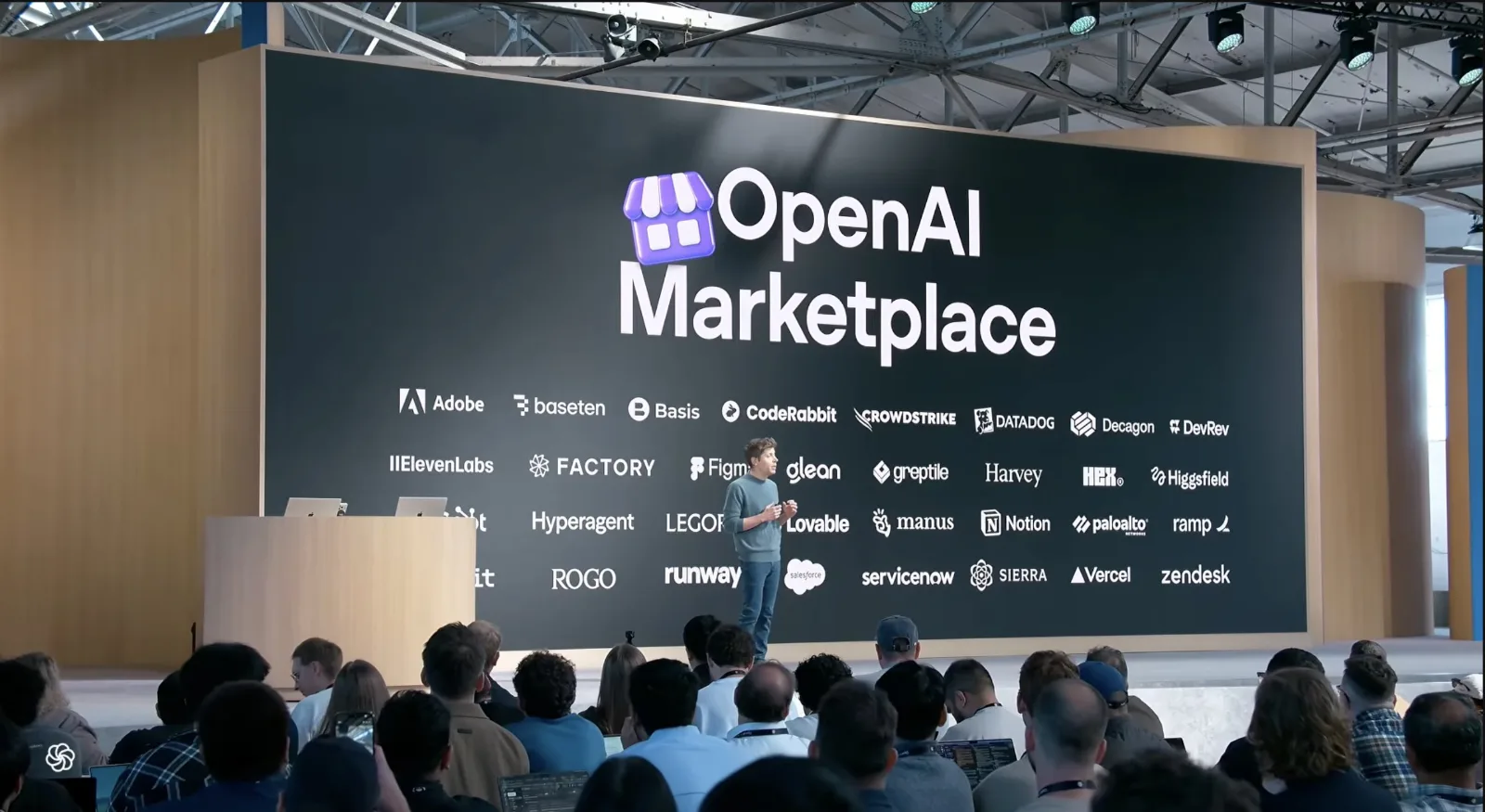
In addition, OpenAI introduced OpenAI Marketplace aimed at enterprise customers, bringing together more than 30 major partners right from its debut, such as Figma, Adobe, Salesforce, ServiceNow, CrowdStrike, and Palo Alto Networks. Eligible enterprises can allocate a portion of their spending commitments with OpenAI to pay for software in this catalog. Although serving the enterprise segment, the Marketplace’s operating model is entirely akin to a standard app store.
The core factor that sets this rollout apart is the scale of its user base: ChatGPT currently reaches 1.2 billion weekly users, according to figures released by OpenAI. On a conversational platform with 1.2 billion users, the value of every app placement is on a vastly superior scale compared to traditional mobile app stores.
Agents change who finds apps
The core differentiator in this experiment is Dots, background agents introduced by OpenAI at the same time. Equipped with both an independent cloud computing environment and an independent browser, each Dot possesses the capability to connect with more than 4,000 applications in the OpenAI ecosystem.
The software distribution process is thereby completely transformed: instead of users having to find tools themselves, Dot receives tasks, proactively evaluates, and selects the right application to execute them. As noted by Sarah Perez on TechCrunch, users simply subscribe directly on the developer’s website and then link their account to ChatGPT or Codex, bypassing reliance on the App Store entirely.
Even so, OpenAI has not clarified whether this new model will completely replace traditional service fees or subscription models. Many implementation questions remain unanswered: will the agent spin up a cloud server replica when an application already exists on a personal device, and how will data flows be handled when tasks move from mobile phones to enterprise cloud infrastructure?
However, the playing field this time has clearly changed. OpenAI’s strategy is shaped by a coherent roadmap: turning ChatGPT into a primary distribution hub, setting the stage for agents to freely access and operate software. Browsers or app stores might not disappear overnight, but their role is gradually shifting to serve as an underlying layer for ChatGPT to interact on behalf of users.