At the Hot Chips conference, OpenAI released benchmark results for the first time for Jalapeño, its AI chip co-developed with Broadcom. On SemiAnalysis’s InferenceX benchmark, Jalapeño recorded higher tokens per user (tokens/user) and throughput per kilowatt (throughput/kW) than Blackwell, NVIDIA’s most advanced computing system currently available.
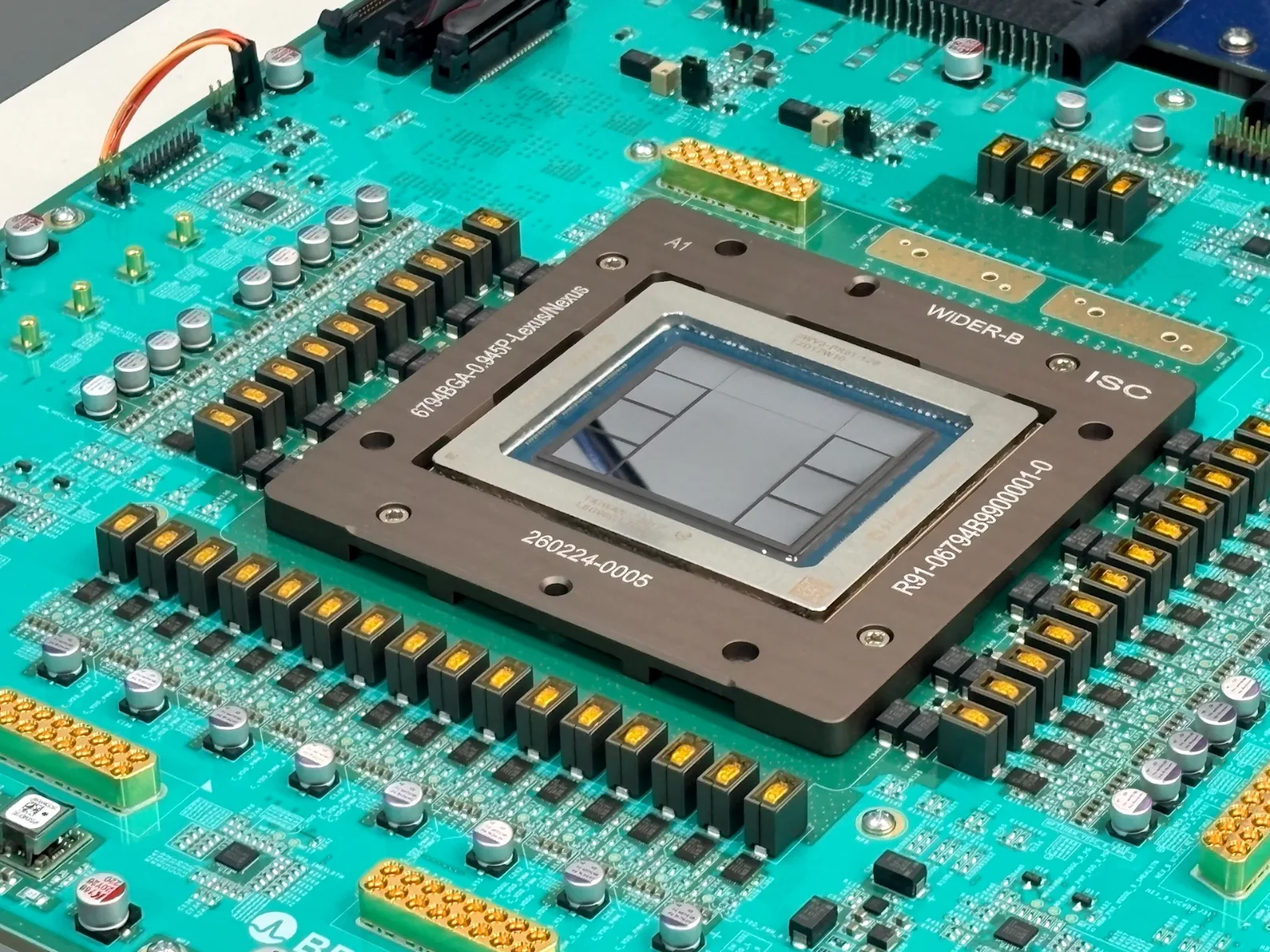
“The results show a very, very significant performance leap over the current state of the art,” Richard Ho, OpenAI’s head of hardware, said during a press briefing. “Jalapeño serves more AI workloads per unit of power, while still delivering faster responses.”
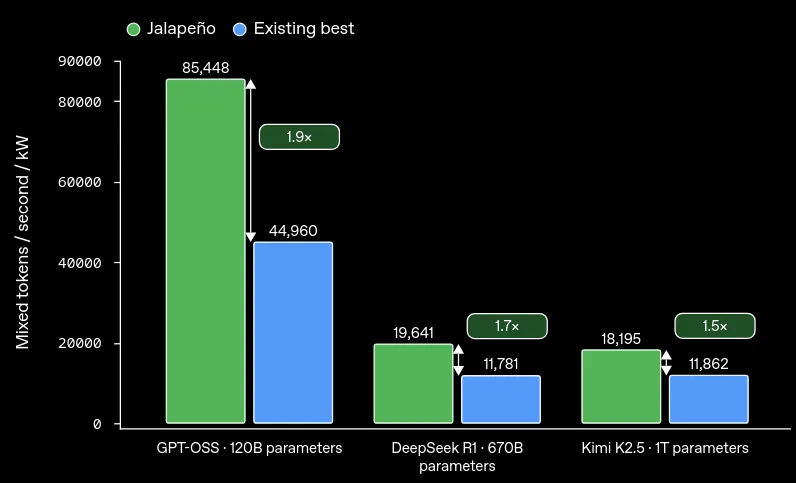
Specific figures were reported across three public models:
- On the 120B open-weight model (GPT-OSS), Jalapeño achieved approximately 85,448 tokens per second per kilowatt at peak blended throughput, compared to 44,960 for the Nvidia GB200—roughly 1.9 times higher; at identical throughput levels, latency dropped by about 4.2 times.
- On DeepSeek R1 670B (compared to the GB300), performance per watt was approximately 1.7 times higher, with latency reduced by roughly 3.6 times.
- On Moonshot’s Kimi K2.5 1T, the largest model in the test suite, the advantage was about 1.5 times in performance per watt.
The chip carries a power rating of 700W, but actual measurements during the test workloads ran at only around 550W. Notably, these results were achieved without multi-token prediction or prefill-decode disaggregation, two techniques vendors commonly employ to inflate paper figures.
However, it must be clarified that this comparison is made against the current Nvidia Blackwell system. By the time Jalapeño is fully deployed, other chipmakers may have launched newer, more powerful generations. Ho estimated that Jalapeño will see very small-scale deployment in late 2026 and expand significantly in 2027.
Jalapeño was first announced in October 2025, developed with assistance from OpenAI’s own models during the design process. OpenAI plans to build it into a multi-generational platform, co-designing AI products, models, silicon, and memory in lockstep. On the hardware side, the chip uses HBM4 memory with roughly 15.4 TB/s of bandwidth per package, and the B0 stepping currently in production is expected to improve performance per watt by an additional ~25% compared to the A0 revision under testing.
Thanks to a full-stack approach, OpenAI targeted specific bottlenecks in inference, particularly prefill latency and communication between compute blocks. The company said Jalapeño was designed to “minimize data movement and communication latency,” keeping the KV cache local while the system activates the appropriate combination of compute, memory, and networking for each inference phase.
In terms of broader impact, this is a clear signal of OpenAI’s intent to reduce its dependence on Nvidia. These figures carry more credibility than a typical self-published announcement, as SemiAnalysis engineers went directly to OpenAI’s lab to verify them. Even so, limitations remain: the InferenceX benchmark only measures an 8k input and 1k output context in isolated serving runs, which does not reflect multi-step agent workloads where chips encounter their true real-world strain.