On October 14, 2026, the protracted legal battle between OpenAI and Apple over trade secrets took a new turn as OpenAI formally filed court documents accusing a former employee of stealing more than 100 highly confidential files related to hardware device development plans before leaving the company to join its rival.
According to the complaint first reported by Reuters, OpenAI claims that this unnamed employee forwarded sensitive internal documents to a personal email account and subsequently presented this information directly to Apple’s leadership team, including the vice president overseeing Apple’s operations in Asia.
Details of the Allegedly Misappropriated Technical Documents and Hardware Designs
OpenAI’s filing lists the misappropriated documents as including prototype design images for at least one line of hardware devices that has never been released to the market. In addition, there is in-depth data on component supplier networks, technical files for experimental projects, product surface finishing standards, and research reports on coating technologies as well as dust- and water-resistant sealing solutions for hardware components.
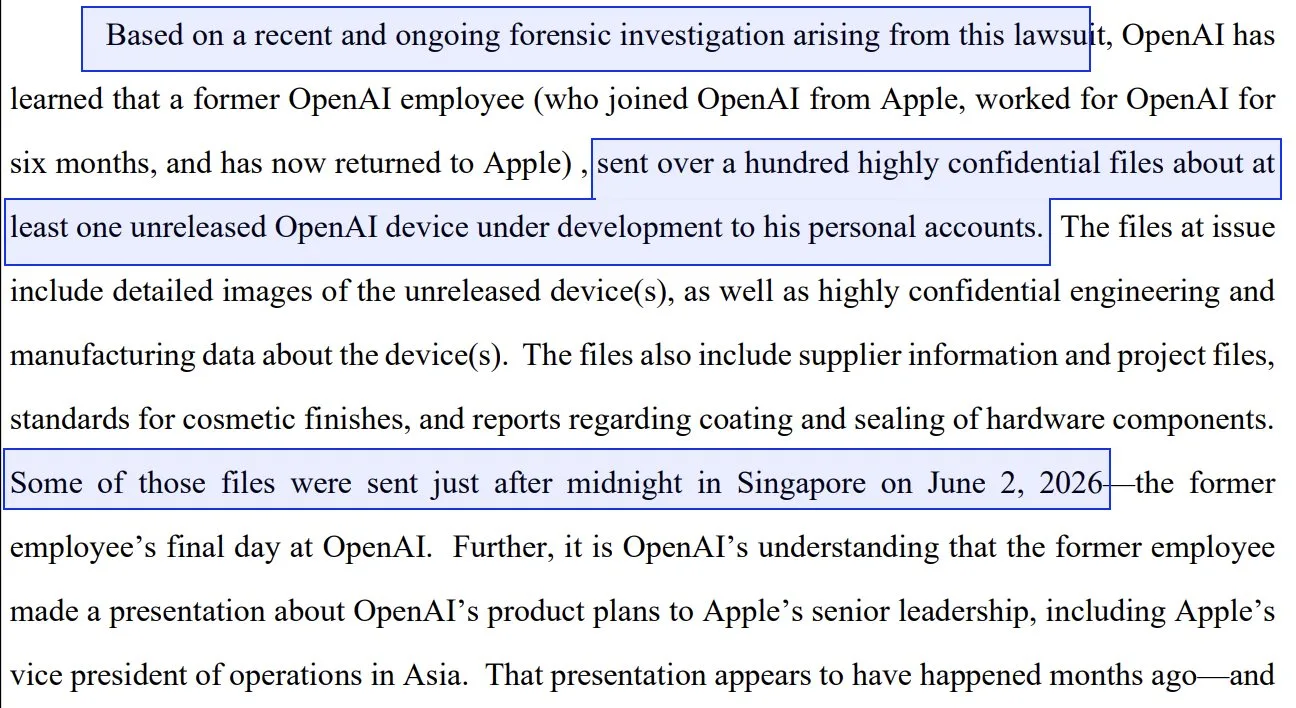
OpenAI even directly linked this matter to the HomeView smart display product line and smart home accessories that Apple launched this week. The company argues that the former employee’s presentation appears to have taken place months ago, helping Apple engineers grasp directions and refine the company’s AI-integrated hardware strategy.
Even so, it should be objectively acknowledged that Apple is well known for multi-year hardware development cycles, and rumors of a smart display integrated with a virtual assistant running a home operating system had surfaced repeatedly before OpenAI began ramping up its physical device research. For its part, Apple had previously filed a countersuit accusing OpenAI of spying on its secret hardware prototypes.
The Confrontation Shifts to the AI Hardware Battlefield
It must be emphasized that everything in the current filing represents only unilateral allegations by OpenAI and has not been affirmed by any official ruling from the court. However, the emergence of this new lawsuit signals a distinct shift within the tech industry: competition among leading AI corporations is no longer confined to software algorithms or the reasoning power of models, but is spilling over into a race to build dedicated physical devices aimed at bringing artificial intelligence into users’ everyday lives.
As the boundaries between AI software companies and consumer hardware manufacturing empires increasingly blur, trade secrets regarding industrial design and component supply chains in Asia are bound to remain a source of intense legal friction in the years ahead.