A sudden sell-off in the crypto derivatives market on Saturday evening international time wiped out nearly $52 million in leveraged positions linked to semiconductor stocks. The incident unfolded entirely while traditional U.S. stock exchanges were closed for the weekend, sending contract values into a freefall without any real-world price reference from the underlying equities.
According to aggregated data from CoinGlass on October 18, approximately $51.6 million in perpetual futures positions tied to chip stocks and semiconductor funds were forcibly liquidated by automated systems in just ten minutes, between 21:22 and 21:32 UTC on October 17. Of this total, roughly $38 million belonged to traders holding leveraged long positions expecting prices to continue climbing.
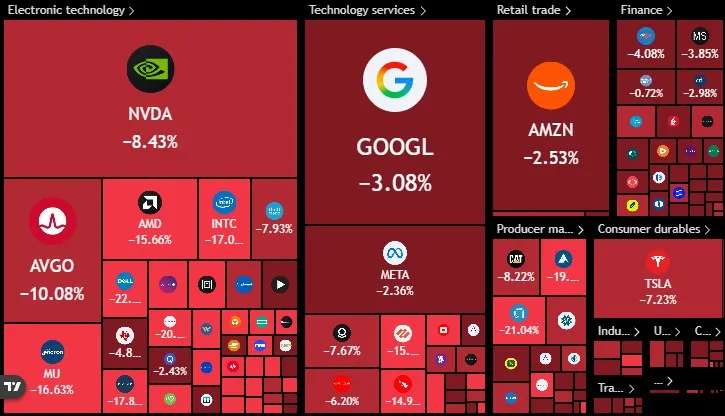
The heaviest losses hit contracts tracking SOXL, an exchange-traded fund that provides triple-leveraged exposure to semiconductor stocks, with liquidations reaching $12.7 million. Derivative contracts linked to shares of SanDisk and SK Hynix suffered a similar fate, with around $10.8 million wiped out for each asset.
Trading activity indicates that the plunge originated from a large sell order on the Binance exchange at 21:21:59 UTC. Less than a second later, selling pressure spilled over to Trade XYZ, a platform operating on the Hyperliquid network that allows 24/7 equity derivatives trading. During the first minute of the dump, trading volume in SanDisk contracts on Binance surged to $21.9 million, while Trade XYZ recorded $3.1 million. Automated hedging algorithms triggered in rapid succession, quickly evaporating the thin weekend liquidity.
In essence, these perpetual contracts are native crypto derivatives that operate around the clock without weekend breaks. However, with Wall Street equity markets closed, there was no real-world stock price for the system to anchor to. Derivative platform rules dictate that contract prices are determined entirely by internal order flow among speculators until traditional markets reopen. Amid spreading bearish sentiment and following a difficult trading week for memory chipmakers facing competitive pressure from China, an initial sell order triggered a cascading chain reaction of forced liquidations.
The episode clearly highlights the downside of trading traditional assets via crypto derivative mechanisms. While uninterrupted trading provides convenience, it also strips away the liquidity cushion of the underlying market during turmoil. Investors are closely watching Monday morning’s Wall Street open to gauge the actual gap between the weekend liquidation prices of these contracts and the trading prices of the stocks on U.S. exchanges.