Xiaomi, the Chinese technology company, has just announced MiMo-V2.6, a new AI model series comprising two versions: Pro and Flash. The Pro version features 1.02 trillion parameters, supports a 1 million-token context window, and is an omnimodal model (capable of simultaneously processing text, images, and other data types).
In terms of specifications, both MiMo-V2.6 Pro and Flash vastly outperform the V2.5 generation thanks to being trained using large-scale reinforcement learning, along with enhanced capabilities in coding, computer use, 3D reasoning, and creativity. Specific evaluations from MiMo and Artificial Analysis include:
-
On the Artificial Analysis Intelligence Index, MiMo V2.6 Pro scored 46.32, nearly double that of V2.5 Pro (26 points), making it the highest-scoring open-source model and surpassing Kimi K3 and Qwen3.8 Max.
-
Compared to Claude Opus 5 and GPT-5.6 Sol, V2.6 Pro performs on par across most agent benchmarks.
-
The V2.6 Flash model also outperforms V2.5 Pro across the board, trailing the Pro version on only a few difficult tasks (Terminal Bench 4.0, exploit/cyber, Agents’ Last Exam).
In terms of pricing, both 2 versions of MiMo V2.6 are extremely affordable, specifically:
-
V2.6 Flash: 0.14 USD/M input tokens, 0.28 USD/M output tokens
-
V2.6 Pro: 0.435 USD/M input tokens, 0.87 USD/M output tokens
- V2.6 Pro UltraSpeed: 20 times faster than Pro, 4.35 USD/M input tokens, 8.7 USD/M output tokens
Notably, the team is publicly livestreaming the process on mimo.xiaomi.com, a rare move for any AI lab.
Six Months of Silence to Study One Question
Fuli Luo, head of Xiaomi’s MiMo team and formerly at DeepSeek, announced on X that the team spent “nearly half a year of silence” studying a specific question: how far can reinforcement learning scale? The answer is MiMo-V2.6, which is not merely a new model but the outcome of a long-term research bet on RL as the primary lever for model improvement, rather than simply continuing to scale compute for pretraining.
This perspective aligns with a broader industry trend: the marginal returns of pretraining are diminishing, and labs are shifting their focus to post-training, particularly RL on agentic tasks. Luo stated: “RL is one of the most scalable and effective paths toward self-improvement.”
Three Scaling Axes: Compute, Environment, Grader
The MiMo development team shared details about three primary scaling axes along with specific parameters:
-
Large-scale compute: Operating fully asynchronously with 1,568 prompts and 16 rollouts per prompt, processing around 2 billion tokens in each training step.
-
Diverse environments & harnesses: Applying multi-task agentic RL, concurrently combining multiple harnesses within the same training run rather than executing them separately and merging them afterward.
-
Intensive grader compute: Utilizing agentic in-group credit assignment, aggregating evaluations from both test cases and rubrics, and leveraging inference compute to assess the quality of each rollout.
Notably, grader compute is the pillar where MiMo invested most heavily. While most current discussions on RL scaling revolve solely around the first two factors (rollout compute and environment diversity), MiMo’s separation and elevation of grader compute into an independent scaling axis indicates that the quality of reward signals is the fundamental hurdle to solve, rather than merely an auxiliary engineering step.
Training Costs of 493,000 USD per Day, Publicly Livestreamed
According to estimates from sources tracking the training process, running RL at this scale costs around 493,000 USD per day. This is a rare, specific figure on the actual cost of training a trillion-parameter model heavily reliant on agentic RL environments.
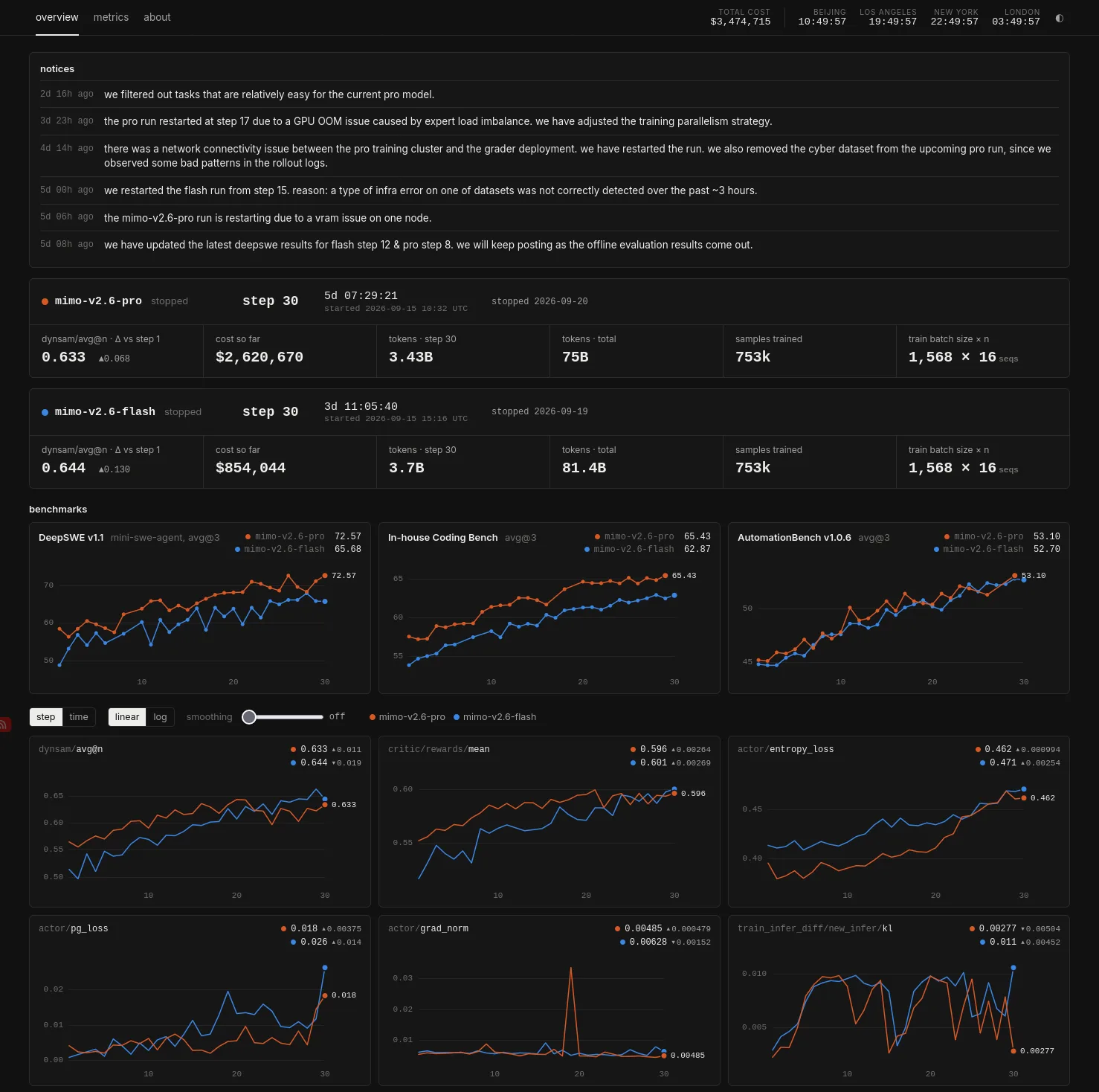
Livestreaming the training process is a rare move. Major labs such as OpenAI, Anthropic, and Google DeepMind typically publish results only after completion, keeping the ongoing training run private. Luo pledged to open-source the methodological details “in pieces over the coming weeks,” rather than in a single technical report.
Not Yet a Finished Model
The MiMo-V2.6 model is not yet finished and remains in its training phase. Consequently, official benchmark results have not yet been announced. The metrics currently visible on HokAI or Artificial Analysis actually belong to the previously released Pro version and do not reflect the final results of the current RL process.
In addition, the development team has remained silent regarding questions raised by the technical community. Specifically, one engineer questioned its “fully async” nature, arguing that total step time still equals trainer time plus sampler time, meaning components remain sequentially dependent on one another.
Whether livestreaming the training of a trillion-parameter model is a media stunt or genuine transparency, MiMo-V2.6 still demonstrates Xiaomi’s strong commitment to frontier AI—not only in the sheer scale of compute power, but also in an unprecedented openness for a consumer technology enterprise.