
Bitcoin trades 24/7, creating the illusion that investors can react to news at any moment, even in the middle of the night or over the holidays. Yet 16 years of data shows that only a handful of days out of the 365 days each year actually determine whether your investment turns a profit or ends in a loss. This analysis from CoinDesk draws on figures from Andre Dragosch, Head of Research at Bitwise Europe, alongside several asset managers.
The Specific Numbers
The starting point is the current year, 2026: Bitcoin is down about 9% year-to-date—a modest decline, not especially catastrophic. But strip out the year’s 5 best-performing days, and that figure plunges to -36%.
A similar pattern repeats throughout history. In 11/18 of the most recent years, missing just the 10 best days (out of ~365 trading days) was enough to flip a profitable year into a losing one. Here are a few notable examples:
-
2019: +94% for the full year, but take away the 10 best days, and that gain turns into a -40% loss
-
2011: +1,474% for the full year, but exclude the 10 best days, and the gain shrinks to just about +2.2%, which is practically zero
-
2013 and 2017: These stand as 2 intriguing exceptions that stayed in positive territory even after removing their 20 best days, pointing to broader, more sustainable rallies rather than a few brief spikes
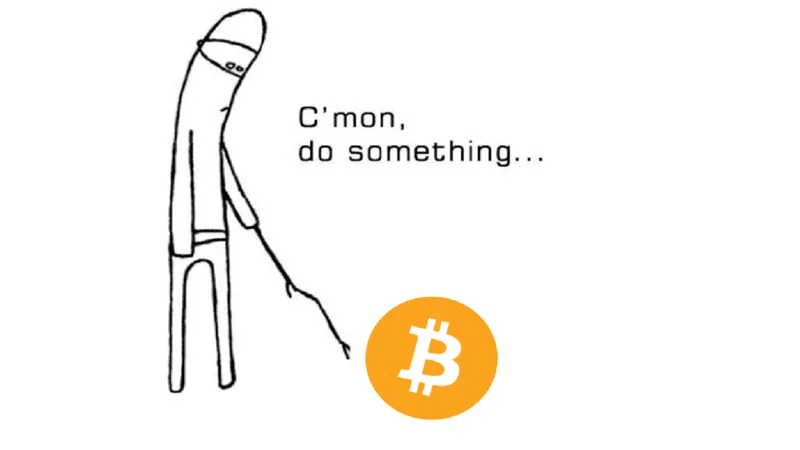
For the vast majority of the time, Bitcoin moves sideways and consolidates. Dragosch describes this as the very nature of the asset: “Bitcoin is actually a relatively boring asset,” with most performance driven by a handful of explosive days. That exact dynamic inspired the “c’mon, do something” meme on crypto Twitter: during long stretches when Bitcoin stays flat, the community prods it to “do something.”
Why Timing the Market Is Nearly Impossible
The logic behind the data is straightforward: If most returns stem from a few explosive days, a trader must establish a position right before the surge begins. Being just one to two weeks late means missing virtually the entire rally.
Consider a real-world case from Adam Haeems, head of asset management at Tesseract Group (which oversees more than 500 million dollars): On February 5, 2026, Bitcoin plunged 14%, one of its sharpest single-day declines, only to rebound nearly 12% the very next day. In other words, anyone shaken out of their position on Thursday had just one day to get back in.
Moreover, holding long enough steadily reduces the likelihood of sitting on capital losses: according to historical data, after 3 years of holding, the probability of dropping below initial invested capital falls under 1%.
But There Is One Big Shift: Volatility Is Declining
The less discussed and perhaps most compelling finding of the analysis is that Bitcoin’s daily volatility has fallen dramatically over time. The best single day reached 294% in 2010 and still hit 53% in 2011. Over the last four years, the single best day each year has compressed to roughly 9-12%.
Haeems attributes part of this shift to market maturation: futures activity, spot ETFs, and corporations holding BTC on their balance sheets. With a broader pool of participants, explosive moves are distributed into smaller increments.
As a result, the penalty for missing the best days has become far less severe. In 2010, missing those days meant forfeiting roughly 98% of potential returns. Today, that figure has narrowed to around one-third and has held steady across 2023-2026.
Tesseract embraced this structural change by “turning timing into a risk we manage, not an edge we chase. The hard work goes into building an allocation clients can actually hold through the drawdowns.”
What This Means for Retail Holders
To be clear, these figures reflect past data rather than financial advice, and historical performance offers no guarantee of future outcomes. While 11/18 years represents a clear majority, it is not all of them, and Bitcoin has endured prolonged losing streaks capable of testing even the most patient investors.
Still, on the question of whether to HODL or trade, the historical evidence leans decisively to one side. Enduring uncomfortable pullbacks and tolerating weeks of sideways churn is the price of admission for capturing sudden upside bursts that no one can anticipate. A long-term holder’s job is not to predict when those days will arrive, but to make sure they are still in the market when they do.
For those determined to trade, Tesseract’s experience outlines a more grounded middle path: Treat timing as a risk to manage—trimming position sizes as volatility climbs while keeping core holdings intact—rather than an edge to pursue. Over the long run, the difference between those two mindsets can mean the difference between surviving in the market or being forced out entirely.