
GSR recently published a study analyzing more than 2,300 token listings on major exchanges from 2013 to date, including dead and delisted tokens, meaning the data is not skewed by survivorship bias. The results are bleak: the average token falls below its listing price within 3 days and loses 50% of its value within 90 days.
This is not theoretical research. GSR is a market maker and listing advisor for projects, so their data directly reflects what happens in the real market.
Circulating supply has halved, but valuations have not
During the ICO era (2017–2018), average circulating supply at TGE was around 38–41%, meaning nearly half the supply was in circulation from the outset. As regulators clamped down, fundraising shifted to private rounds, venture rounds set the valuations, and airdrops/points replaced public sales. By 2020, average float at TGE had dropped to around 13% and only partially recovered in subsequent years, fluctuating in the high teens to low 20s.
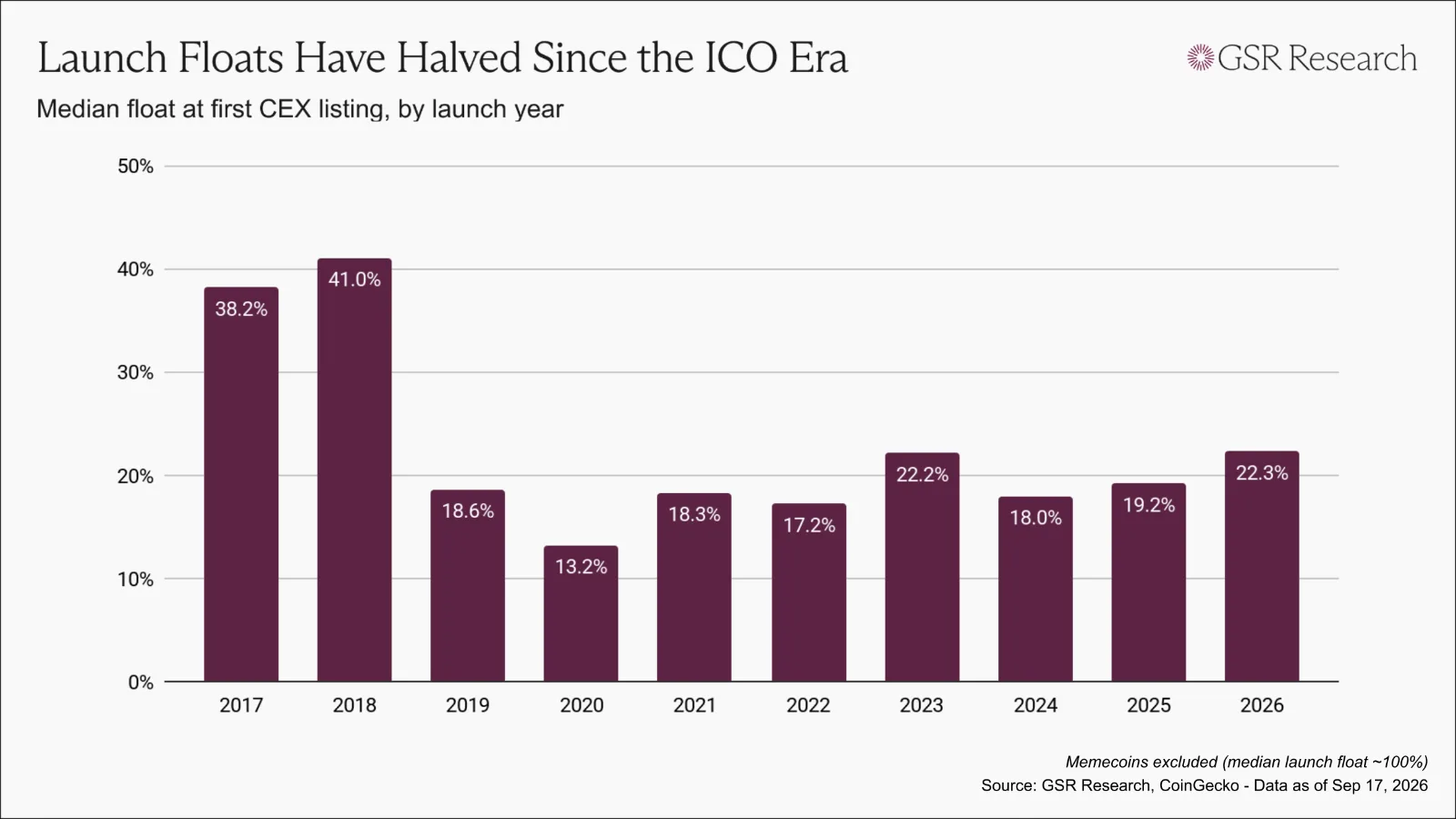
However, looking at the float percentage in isolation does not tell the whole story. This metric must be considered in direct relation to valuation: a 5% float for a token valued at 50 million USD is fundamentally different from 5% of a 1 billion USD project. Data from GSR highlights a clear pattern: the average float percentage is always inversely proportional to FDV size.
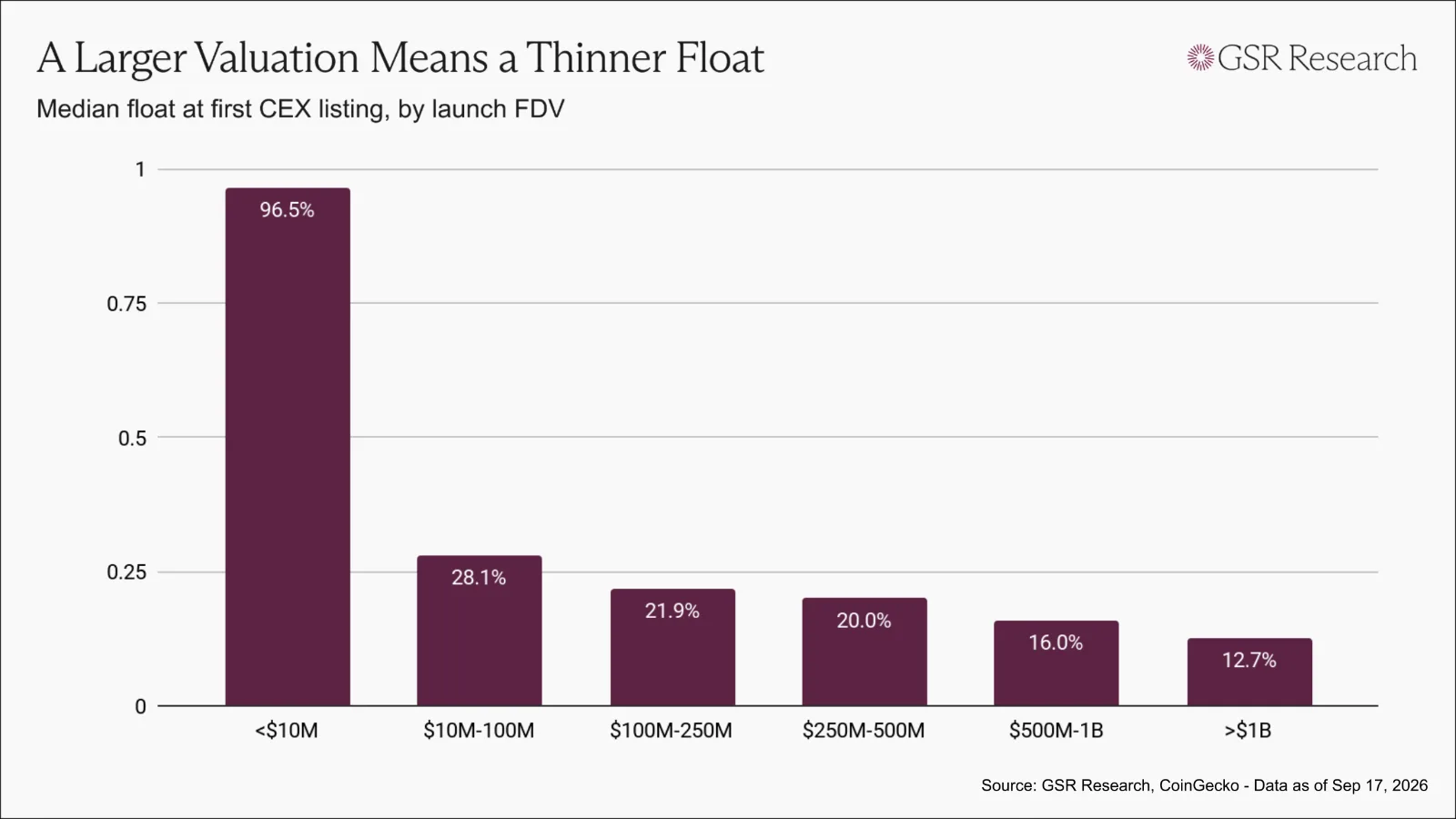
Specifically, float reaches 97% for tokens under 10 million USD, drops to 28% in the 10–100 million USD range, narrows further to 16% at 500 million–1 billion USD, and stands at just 13% for projects over 1 billion USD. In short, the larger the project valuation, the thinner the float released to the market—a structural pattern that has become systemic across the industry.
Why does this model lead to value destruction?
When circulating supply in the market is kept to a minimum, even a small amount of demand is enough to inflate the valuation of the entire project. This structure creates immediate benefits for stakeholders, from development teams and investment funds to exchanges. In contrast, those bearing the greatest risk are the buyers who purchase tokens at those prices.
The real challenge arises when vesting schedules begin. Previously locked tokens are released onto the market and sold off based on sky-high valuations that were established on a modest float. This scenario unfolds not out of bad intentions by anyone, but because the incentive mechanics make it an inevitable outcome.
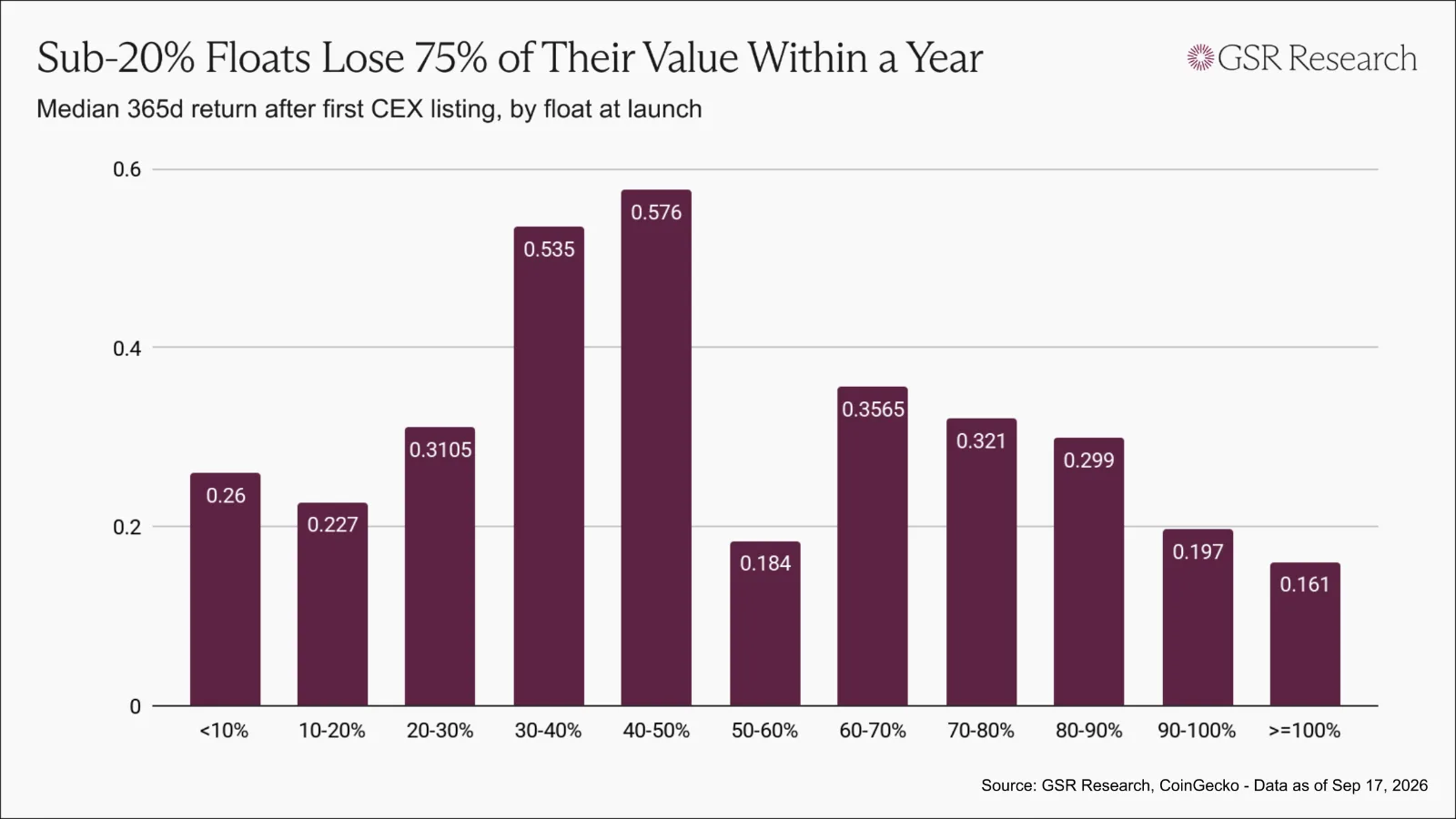
Real-world data from GSR’s research clearly demonstrates this impact: for listed projects with an FDV exceeding 1 billion USD, every 1 USD initially invested is worth only about 0.19 USD after 360 days. For tokens with a float below 20%, the value retained after one year ranges from 0.23 to 0.26 USD. Meanwhile, projects maintaining a 30–50% float preserve around 0.55 USD—more than double the low-float cohort.
This is no longer unique to crypto
A notable finding from the study shows that traditional equity markets are also converging on the exact same pattern.
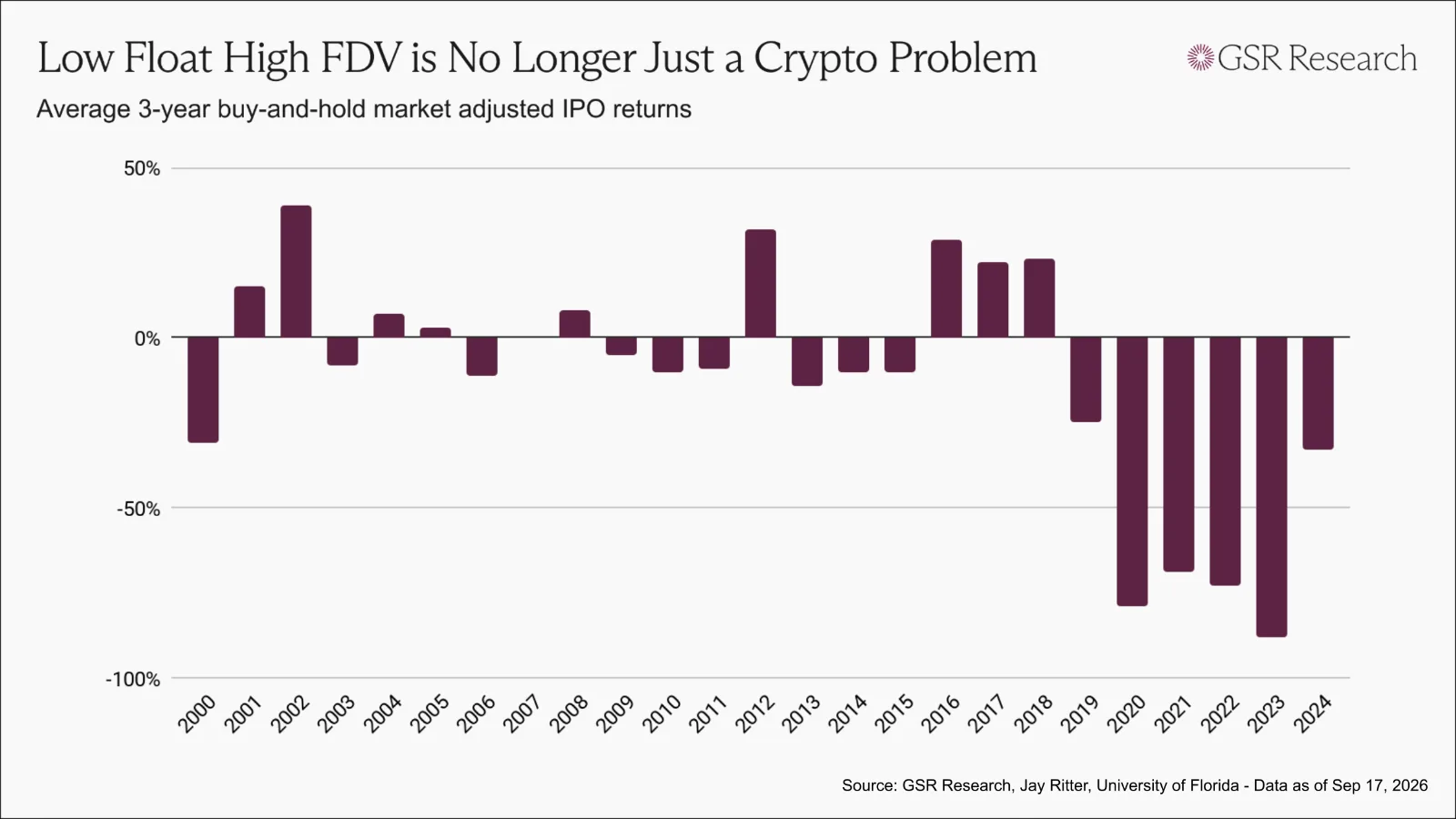
Take SpaceX as an example, a company that has remained private for over a decade, where insiders and late-stage funds continuously accumulate shares at escalating valuations. By the time of an IPO, the public market receives only a tiny fraction of shares. On a 3-year buy-and-hold basis, IPO cohorts have underperformed the broader market in every vintage year since 2019, with recent cohorts suffering some of the worst drawdowns in history.
In essence, crypto’s token issuance dynamic is simply the modern-day new-issue dilemma, differing only in shorter vesting periods and lower information transparency.
Solutions to the problem
While offering no silver bullet and remaining skeptical of one-size-fits-all promises, GSR highlights three key levers:
- Set reasonable valuations for both holders and traders: Sustainable communities form around assets where public users have the opportunity to participate early at reasonable prices. Conversely, offering public allocations at the peak valuations of private funding rounds puts holders at a disadvantage and drives traders away as upside is eliminated.
- Increase float to foster genuine price discovery: The initial circulating supply should reach at least 30%—akin to norms in traditional IPO markets—and must be carefully evaluated in relation to total valuation. The core requirement is ensuring float is deep enough so that day-one pricing accurately reflects true market value.
- Diversify participants and participation timing: Current trends are heading in the right direction through several innovations: smaller-ticket co-investment models on venture terms, allocations tied to real user contribution metrics, public sales, on-chain auctions, and fair launches with 100% of supply unlocked. Each approach involves distinct trade-offs.
Furthermore, the regulatory framework is showing positive signs. Europe’s MiCA regulation has established clear rails for issuing tokens directly to the public. If the CLARITY Act passes in the US alongside limits on direct sales to retail investors, the excuse that securities laws force projects into private accumulation models will no longer hold up. At that point, issuance structure becomes a strategic choice rather than a mandatory constraint.
In conclusion, the research report reinforces an objective reality: the low-float, high-FDV model fundamentally serves the interests of insiders rather than the community. To cultivate a durable base of holders, projects must offer valuations that are genuinely attractive to the public, maintain a float large enough to anchor real value, and allow insiders to succeed over the long run—winning alongside the community rather than extracting value ahead of it.