
The Federal Reserve Bank of Cleveland recently published a working paper with a cheeky title: “Do You Even Crypto, Bro?”. The content, however, is far more serious than its name suggests. It explains why crypto fluctuates in a manner completely different from stocks, bonds, or gold.
In repeated surveys of up to 25,000 U.S. households per wave, authors Michael Weber, Bernardo Candia, Olivier Coibion, and Yuriy Gorodnichenko found that the factor best explaining who owns crypto is not age, income, or gender, but rather expectations of future returns. Crypto owners expect an average return of +22% per year, while non-owners expect only +7%.
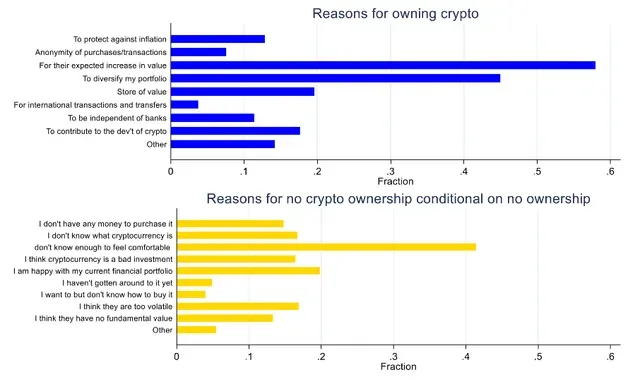
For every additional percentage point in return expectations, the probability that an individual owns crypto rises by about 0.8 percentage points. This is the complete opposite of traditional assets, where demographic and financial characteristics typically explain ownership far better than return expectations.
The most notable part lies in a randomized experiment. In 2025, the research team showed selected households Bitcoin’s trailing 12-month returns. The result: their desired allocation to crypto increased by about 2 percentage points, representing an increase of roughly 47% relative to the control group’s 4.3% average. Actual subsequent purchases also rose by about 2.5 percentage points.
This effect was concentrated among individuals who reported they had not bought due to a lack of information. Meanwhile, those who already viewed crypto as a bad investment barely responded to the information provided.
The study also highlights a subtle detail: when Bitcoin’s price doubles, holders tend to purchase more durable goods, as if they had received a windfall bonus rather than seeing their wealth appreciate. In other words, crypto returns are perceived closer to “gambling money” or lottery winnings than to long-term wealth accumulation.
The study’s conclusion may make industry insiders uncomfortable: lacking “common information and shared beliefs” about crypto, price volatility will continue to be a defining feature of the asset class for the foreseeable future. The next rally, by this logic, depends not just on Bitcoin’s price itself, but on what investors are told about where that price has been.