On September 29, OpenAI officially launched GPT-6.1 Sol just one week after rolling out GPT-6 Sol. The new model conveys a clear core message: delivering performance nearly on par with GPT-6 Astra across professional workloads, computer-use tasks, and agent development, while cutting costs down to just 1/5. The decisive driver behind this cost optimization is a steep reduction in stored-context retrieval pricing, slashing cached input token rates by 95% compared to standard input.
GPT-6.1 Sol is designed as an outright replacement for the earlier GPT-6 Sol rather than a secondary tier. The release follows OpenAI’s decision to scrap the flagship GPT-6.1 Astra model following compliance and risk management concerns.
API Pricing
The specific API pricing for GPT-6.1 Sol is:
-
Input: 2 USD/M tokens
-
Cached input: 0.10 USD/M tokens (a 50% discount compared to GPT-6 Sol and 95% compared to GPT-6 Astra)
-
Output: 10 USD/M tokens
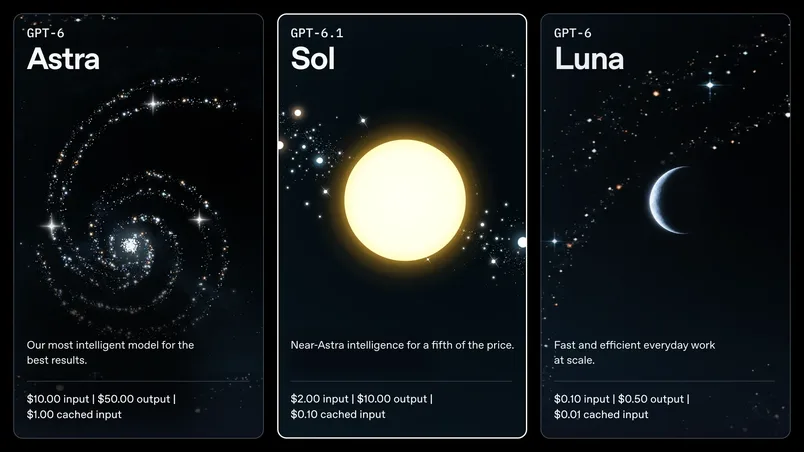
This price reduction delivers significant economic advantages for agents that repeatedly reuse the same context block across multi-turn interactions. Conversely, for single-turn chatbot queries, the discount barely impacts final billing since cached tokens are not repeatedly retrieved.
Benchmarks: Scores Nearly Equal to GPT-6 Astra
Across five reported benchmark tests, OpenAI reports that GPT-6.1 Sol achieves parity or near-parity with GPT-6 Astra on the first three evaluations:
-
DeepSWE v1.1 (Long-horizon software development): Evaluates capabilities on real-world codebases. GPT-6.1 Sol surpassed the 75% mark at an operating cost of under 1 USD per task. Compared to approximately 74% and 4.40 USD for GPT-6 Astra, this is a major highlight, demonstrating roughly 5 times the cost efficiency while matching or exceeding performance.
-
GDP.pdf (Deep document analysis): Evaluates responses to complex inquiries across PDF documents. The model outperformed Claude Opus 5.5 (with fallback) while cutting operational costs by half.
-
AutomationBench (Multi-step workflows): Tests agentic execution capabilities. Under moderate reasoning effort, the model edged out Opus 5.5 by 2.2 percentage points at roughly one-third the cost.
However, results diverged noticeably on the remaining two evaluations:
-
OSWorld 2.0 (Desktop environment actions): At maximum reasoning effort, the model gained 7 percentage points over GPT-6 Sol but still trailed Astra by 2.1 percentage points, despite costing nearly 7 times less.
-
Terminal-Bench Science 0.1 (Advanced scientific inquiry): While doubling GPT-6 Sol’s score, the model still lagged behind Astra (which held the lead at 68.1%). OpenAI itself advises retaining Astra for the most demanding research problems.
From a methodological standpoint, OpenAI’s internal evaluation figures contrast with competitor scores drawn from public reports. On AutomationBench, the company pointed out that actual costs for Claude Fable 5.1 could be higher because roughly 40% of tasks require fallback allowances not factored into baseline rates.
Independent analysis from Artificial Analysis corroborated OpenAI’s published figures while highlighting several additional nuances.
On the Intelligence Index scale, GPT-6.1 Sol picked up a 4-point gain over GPT-6 Sol and scored 5 points above GPT-5.6 Sol, narrowing the margin behind GPT-6 Astra to just 1 point. On economics, per-task cost under maximum reasoning was only 0.72 USD, which is 31% cheaper than GPT-6 Sol and less than a quarter of Astra’s 3.26 USD.
In the Coding Agent Index benchmark, the model trailed Astra by 2 points at high reasoning settings, but actually surpassed Astra by 1 point at ultra-high (xhigh) reasoning while costing under 15%. Increased output token production across all reasoning settings continues to push cost-performance boundaries compared to earlier generations.
In addition, Artificial Analysis highlighted two key takeaways omitted from OpenAI’s announcement:
-
Blended cost optimization: Thanks to the subsequent cached input rate cut (following the 50% discount introduced with GPT-6 Sol), the overall blended cost declined modestly against its predecessor.
-
Higher output token usage: The model uses roughly 10 to 30% more output tokens than GPT-6 Sol. At low-to-medium reasoning settings, intelligence score gains readily offset the extra token volume; at maximum reasoning, however, that trade-off no longer sustains per-token efficiency.
Safety and Availability
Regarding safety, OpenAI stated that the new model exhibits greater transparency regarding its limitations and adheres more reliably to user-defined constraints, approaching Astra’s reliability.
When tested on warning users during search tool failures, GPT-6.1 Sol failed to respond in only 2.1% of cases—substantially lower than the 4.9% rate for GPT-6 Sol and 28.7% for GPT-6 Luna, trailing only Astra (1.5%). Furthermore, evaluations showed the model did not intentionally attempt to bypass automated safety monitors, matching Astra and Sol. Because these evaluations are deliberately designed to trigger failure states, however, the results do not wholly mirror everyday operational conditions.
Regarding availability, the model rolled out on September 29 to all Plus, Pro, Business, Enterprise, and Edu subscribers across ChatGPT Work and Codex, and is offered via the API under the name gpt-6.1-sol. Standard free-tier ChatGPT does not yet support this model. Over the coming days, OpenAI plans to introduce an Ultrafast speed tier on Codex, offering throughput up to 8 times faster than standard baseline speeds.
Looking broadly, this update represents more than just a typical version increment. Only one week earlier, the launch of GPT-6 Sol delivered a 50% price reduction relative to GPT-5.6 Sol. Slashing prices again in such rapid succession indicates that cached retrieval costs have become the critical competitive battleground, superseding benchmark score wars. The underlying question is whether deprecating a model after only seven days truly optimizes operational costs or simply complicates model selection decisions.