OpenAI announced GPT-6 Sol and GPT-6 Luna, two new models expanding the GPT-6 series following GPT-6 Astra. Sol is priced at 2 USD input, 10 USD output per million tokens, half the price of GPT-5.6 Sol. Luna is priced at 0.10 USD input, 0.50 USD output, as cheap as DeepSeek V4.1 Flash and cheaper than any other Chinese model on the market. Together with Astra, OpenAI now offers a model trio covering the entire price spectrum.
GPT 6 Luna: As Cheap as Chinese Models
The most notable aspect is Luna’s price. According to OpenRouter, GPT-6 Luna is priced at 0.10 USD per million input tokens and 0.50 USD output, matching DeepSeek V4.1 Flash and much cheaper than Xiaomi’s MiMo-V2.6-Pro (0.435/0.87 USD). This marks the first time a model from a US frontier lab is priced on par with China’s cheapest model.
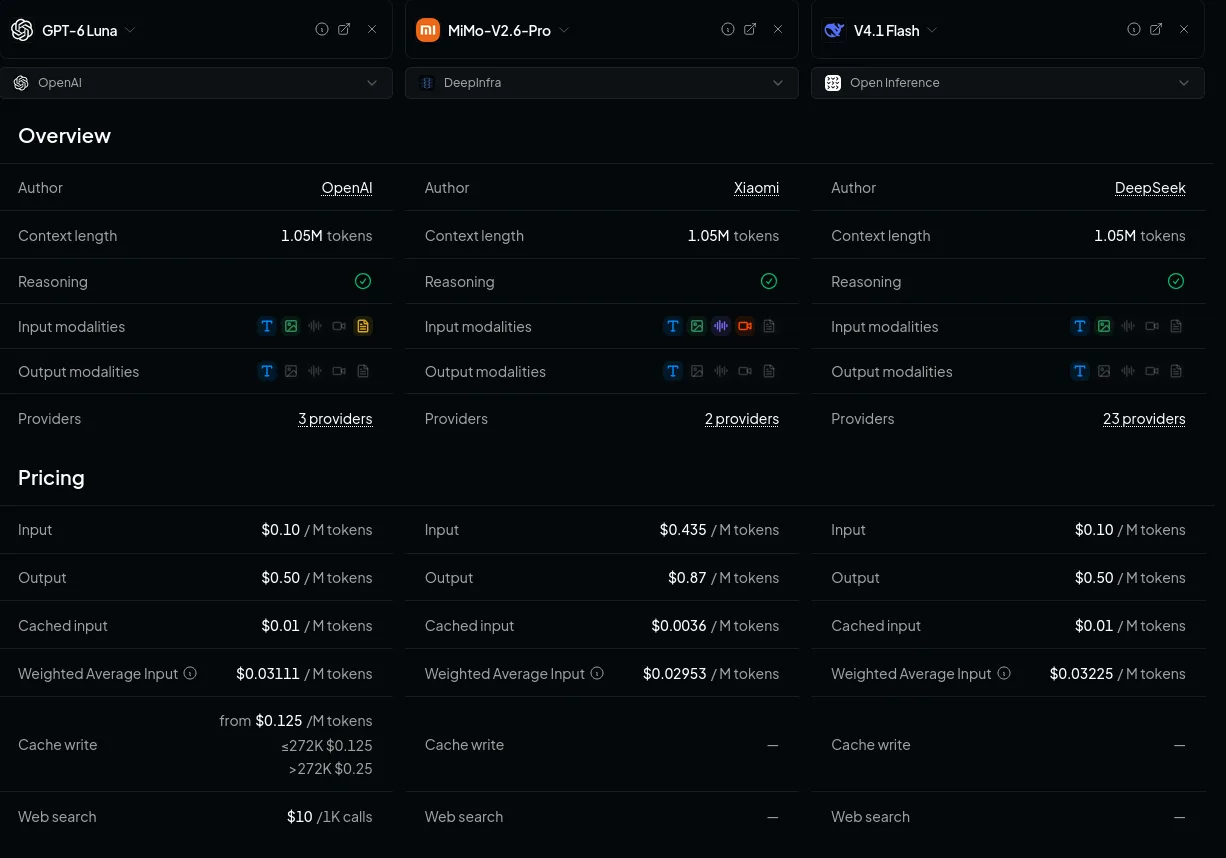
Luna is designed for “high-volume work with clear objectives, such as document summarization, information extraction, or quick Q&A”. The model is available for free to ChatGPT Free and Go users on the desktop app. On DeepSWE v1.1 (coding agent), Luna achieves 66.6%, not far behind Sol (68.8%).
GPT 6 Sol: Half the Price of Opus 5.5, Competitive Capabilities
Sol is priced at 2/10 USD, cheaper than Anthropic’s Opus 5.5 (4/20 USD) released just 90 minutes earlier.
- On AutomationBench, Sol achieves 33.2% at a cost of 0.27 USD per task, compared to Opus 5 achieving 26.9% at around 3 USD per task—an 11-fold cost difference for higher performance.
- On DeepSWE v1.1, GPT 6 Sol reaches 68.8%. OpenAI also claims that the deception rate in coding dropped to 1.3% compared to 10.4% for GPT 5.6 Sol, and the tool-disclosure error rate fell from 77.5% down to 4.9%.
These are behavioral safety improvements similar to the kind Anthropic has branded around, but OpenAI packages them into a much cheaper model.
However, GPT 6 Sol actually regresses on OSWorld 2.0 (computer use): 60.5% compared to GPT 5.6 Sol’s 65.7%. The model is half the price but performs worse on the most generalized capability benchmark. OpenAI is optimizing cost per task rather than the performance ceiling.
The GPT-6 Trio: Astra, Sol, Luna
OpenAI now has three distinct model tiers:
- Astra (10/50 USD) for frontier reasoning.
- Sol (2/10 USD) for coding and complex tasks.
- Luna (0.10/0.50 USD) for high-volume work.
An OpenAI spokesperson confirmed the pricing is permanent, not a promotional discount.
Sol is available in ChatGPT Work, Codex, and API. Luna is available in the desktop app for Free and Go users. OpenAI expects to roll it out gradually across ChatGPT (app and web) throughout the day.
A developer choosing among these models no longer needs to leave the OpenAI ecosystem regardless of budget. The barrier to entry for OpenAI infrastructure has dropped near zero at the lowest tier.
The 48-Hour Price War
Four models from four different labs launched within 48 hours: Grok 4.7 (SpaceXAI) on September 21 at 2/6 USD, Opus 5.5 (Anthropic) on September 22 at 4/20 USD, and Sol/Luna (OpenAI) on the same day at 2/10 USD and 0.10/0.50 USD. The coordinated pricing structure that labs maintained through the “pacing the frontier” phase collapsed in less than two days.
When competitive pressure arrives, the “pause” vanishes. The antitrust lawsuit filed on September 18 alleged the slowdown was an output-limiting cartel. The price war that followed makes that argument harder to dismiss, not because labs coordinated to raise prices, but because the moment coordination collapsed, prices fell by half.