Microsoft announced on October 12, 2026, its direction to make Azure Maia the core AI inference platform for internal services. The company plans to expand this chip line to a gigawatt scale starting in 2027. Regarding progress, the Maia 200 chip is already in actual operation with production workloads, while the next-generation chip, Maia 300, will officially enter the production process in 2027.
Currently, Maia 200 operates Microsoft Copilot and supports the MAI team in building new generation models. Microsoft plans to continue applying this chip line to Microsoft Foundry and GitHub Copilot before the end of 2026. It should be noted that the launch of the new Maia 300 chip is a separate development milestone and does not mean that all applications will immediately switch to the new infrastructure.
System Designed Around Model Serving
The design of Maia 300 prioritizes optimizing inference capabilities, meaning the ability to execute models to respond to requests, rather than focusing on the training phase. Three core tasks Microsoft aims for include: processing large-capacity contexts, responding to conversational requests requiring ultra-low latency, and orchestrating AI agents operating continuously through multi-step processes.
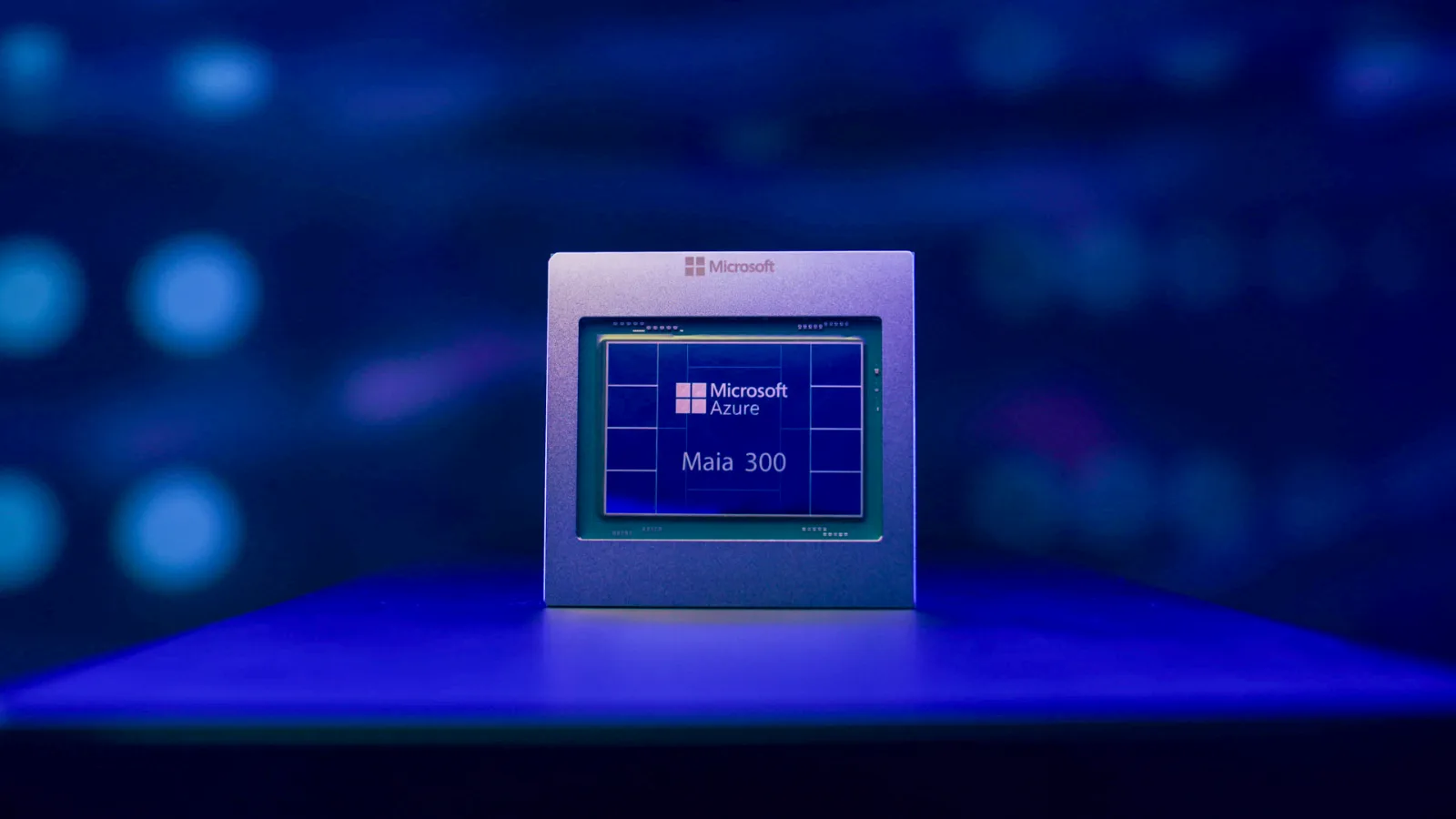
For these types of workloads, pure computational power is not enough to determine performance. The data transfer speed between memory, processor, and network infrastructure must be fast enough to eliminate system waiting times. Thanks to its optimized architecture, Maia 300 allows software to proactively arrange data close to the computation location, helping to limit data travel distance and correspondingly reduce energy consumption.
Technical disclosures from Microsoft indicate that each accelerator features 288 GB of HBM4 memory with a peak bandwidth of 18 TB/s. The chip uses the TSMC N2P process for the compute block, while separating memory control and connectivity components into independent chiplets. It should be noted that these specifications reflect the theoretical design from the manufacturer and have not undergone independent verification of actual operating speeds across all models.
Analyzing the Nature of Comparison Figures
According to Microsoft’s announcement, the Maia 300 system is expected to produce 40% more tokens per megawatt when compared to leading GPU systems. The word “expected” should be emphasized, as this is not actual data independently verified by a third party, and the official documentation does not specifically list the benchmarked GPU systems.
Furthermore, the rack-level token throughput of Maia 300 is said to reach 7 times that of the Maia 200 generation when fully equipped with 96 accelerators. However, since the number of accelerators per Maia 300 rack has doubled compared to its predecessor, this 7x growth figure applies to the entire rack configuration and does not imply that the performance of each individual processor has increased by 7 times.
Regarding detailed specifications, each rack contains 96 accelerators operating at a maximum power consumption of 167 kW, possessing a total HBM memory capacity of 27.6 TB and an aggregate memory bandwidth of 1.7 PB/s. Additionally, the theoretical network architecture supports linking up to 12,288 accelerators within the same communication domain; however, this on-paper design capability still differs from a fully operational, real-world server cluster.
2027 Deployment Roadmap and Operational Reality
According to information from Microsoft, the Maia 200 chip is currently being applied in three markets: the US, Europe, and Australia. In certain selected AI tasks, the company reports processing efficiency of up to 1.7 times more tokens per watt compared to leading GPU infrastructure. However, this measurement applies only to Maia 200 on specific workloads, and therefore cannot be considered a complete benchmark for the Maia 300 chip line.
Furthermore, the plan to expand to a multi-gigawatt scale from 2027 does not mean that all of that capacity will be operational immediately in 2026. Microsoft’s two published documents also do not specify the total target capacity or detailed completion timeline for the entire program.
Since all currently available data comes directly from Microsoft’s announcements and has not undergone independent verification, the aspect that needs continued monitoring is whether Maia 300, once in actual production, can maintain its advantages in power consumption and throughput across various model types, context lengths, and different numbers of concurrent users.