On October 6, Mistral officially announced the public preview of Mistral Large 4 (playfully nicknamed Le Chonk). The company’s largest model to date features a mixture-of-experts architecture with a total of 1,000 billion parameters and 52 billion active parameters per token. The model supports multimodal inputs and was trained entirely from scratch on a cluster of 3,800 NVIDIA Grace Blackwell GPUs across Mistral’s data centers in Europe.
Currently, users can only access the model via the API or the Le Chat interface. The model weights have not yet been publicly released because Mistral is conducting real-world security red-teaming alongside government agencies and security partners; the weights are scheduled for release at the end of this month.
Service Costs and Competitive Advantages
Official Pricing
In terms of costs, Mistral has set pricing at $1.36 per million input tokens and $4.18 per million output tokens. While higher than smaller-scale models, this pricing remains highly competitive and significantly more economical than frontier model families from OpenAI or Anthropic.
An evaluation by MindStudio shows that operational cost efficiency is achieved through an optimized architecture: capping active parameters at 52 billion per token substantially reduces inference costs compared to dense models of equivalent size. As a result, Mistral delivers an impressive parameter scale while maintaining remarkably reasonable operating expenses.
Safety and Security
Alongside its pricing edge, cybersecurity is positioned as a core pillar. According to the Cyber Leaderboard from Artificial Analysis, Mistral Large 4 ranks among the global top 5 tools for software bug detection and remediation, while leading the pack among open-weight models developed outside China. In real-world tests reproducing and patching open-source vulnerabilities, the model achieved an 82% success rate—the highest reported—along with passing 93% of evaluations on Cybench.
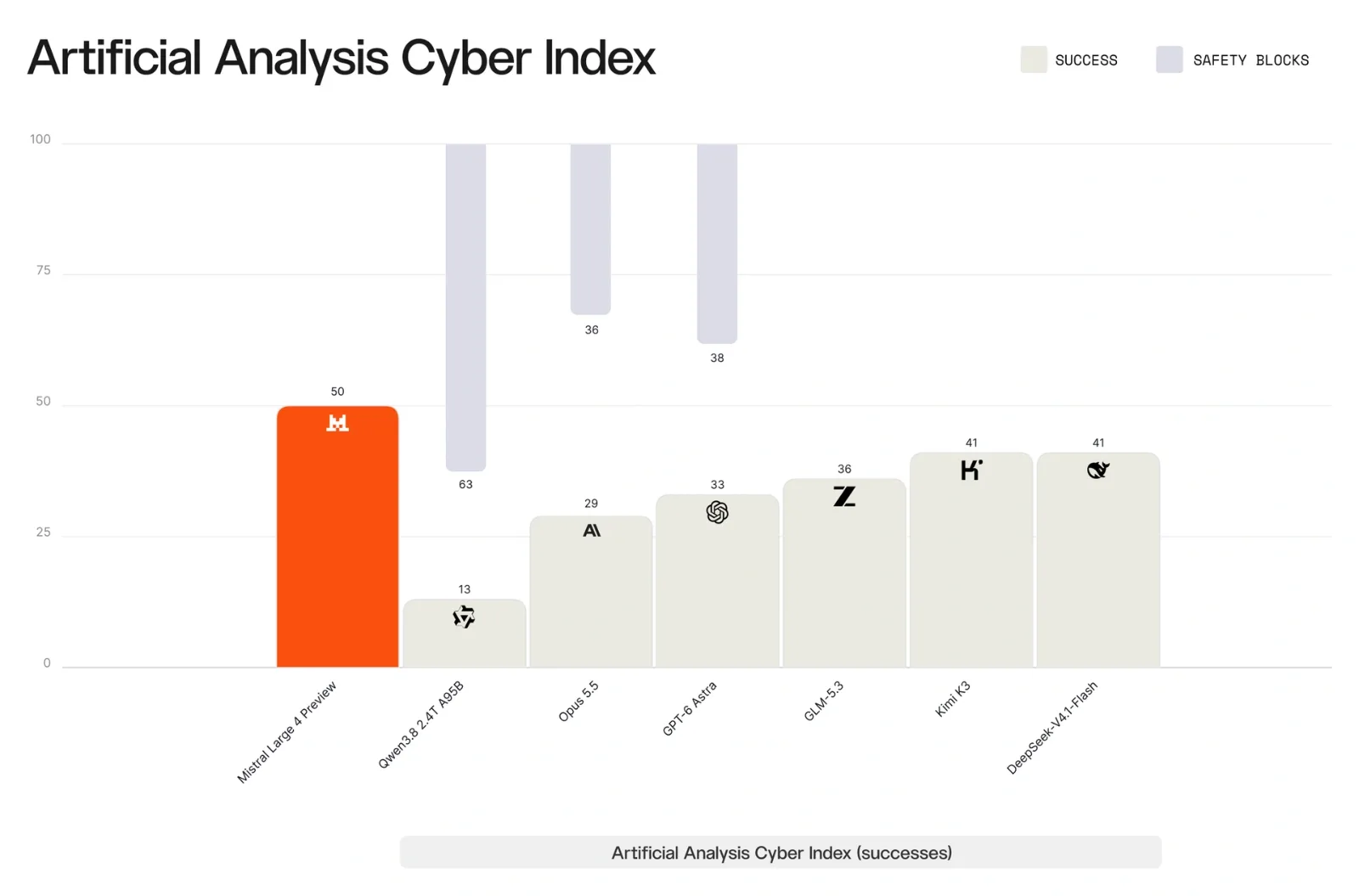
A noteworthy aspect of Mistral’s argument is their claim that several leading models (notably Claude Opus 5.5 and GPT-6 Astra) scored near 0% on the same benchmark because they flatly refused to execute the requests. While this comparison should be viewed objectively as it stems from Mistral’s internal perspectives and metrics, it highlights a practical limitation: rigid safety censorship mechanisms in closed models can sometimes inadvertently hinder defense work, which fundamentally requires simulating and demonstrating the existence of security vulnerabilities.
Coding Performance and Agent Task Execution
On the programming front, figures released by Mistral indicate that the model scored 61.7% on DeepSWE v1.1, 59.4% on SWE-Atlas-QnA, and 28.3% on Terminal-Bench 4. Overall, on the Coding Agent Index, Mistral Large 4 reached 49.8%, ranking above competitors Qwen3.8 Max and DeepSeek V4 Pro 0813.
In blind testing conducted by Surge AI, where human evaluators scored outputs without knowing the identity of the generating model, Mistral Large 4 took second place out of five participating models with a score of 3.74. This score surpassed Kimi K3 and two versions of GLM, trailing only Claude Opus 5 (4.22 points).
In parallel, independent testing results from MindStudio also observed several signals consistent with the published benchmarks:
-
IDOR vulnerability detection: The model successfully identified an experimental IDOR vulnerability in a Flask application and pinpointed the root cause: the delete endpoint enforced authorization, but the read endpoint left it open.
-
Source code security: It further detected plaintext passwords and a hardcoded session key directly embedded in the source code.
Current Limitations and Factors to Watch
Alongside its strengths, MindStudio also highlighted several existing shortcomings of the model:
-
Command-line tasks & enterprise workflows: China’s GLM 5.3 maintains a lead in command-line processing tasks and cross-application workflows.
-
Translation performance: Mistral Large 4 performs well with high-resource languages (Chinese, Arabic, Japanese, Thai), but quality drops noticeably on low-resource languages such as Gujarati.
-
Image rendering: In simulation tests, fine visual details such as flames in a scene did not achieve the vividness of the original.
For an accurate assessment, information should be separated into three perspectives:
-
Verified facts: Mistral released a preview on October 6, utilized European infrastructure for training, published service pricing, and committed to releasing open weights within the month.
-
Analytical perspective: An open-weight model delivering high cybersecurity scores provides a major advantage for organizations seeking to deploy systems on-premises.
-
Unverified factors: Most benchmark metrics originate from Mistral itself or third-party scoreboards that have not yet undergone comprehensive independent verification.
Capital from its Series D round worth 3 billion euros, a record-setting size for a European tech enterprise, is being heavily deployed by Mistral to upgrade its compute infrastructure. Even so, the biggest question lies ahead: will the tech community be able to replicate these impressive security results once the weights are officially released at the end of the month, or will the final production release yield results different from the preview?